
Biology · chapter PYQs
Biomolecules, on the exam screen.
11 questions from NEET 2026, Re-NEET 2026, NEET 2020, 11 minutes, marked +4 / −1. See them with solutions.
Biomolecules · PYQs
Candidate: You
Time Left
Q1/11
Alpha-helix is found in which level of protein structure?
Answer and explanation
Answer: (1)
The alpha-helix is a right-handed coiling of the polypeptide backbone stabilised by hydrogen bonds and is the hallmark of the secondary structure of proteins. Primary structure is the linear amino-acid sequence, tertiary structure is the folded three-dimensional shape, and quaternary structure results from the assembly of more than one polypeptide chain.
Identify the correct statements about biomolecules.
Statement I: Lipids are generally water soluble.
Statement II: Proteins are polypeptides.
Statement III: Polysaccharides are long chains of sugars.
Statement IV: Adenine and guanine are substituted pyrimidines.
Statement V: Almost all enzymes are proteins.
Choose the correct answer from the options given below:Answer and explanation
Answer: (2)
Proteins are polypeptides (Statement II), polysaccharides are long chains of monosaccharides (Statement III), and almost all enzymes are proteins (Statement V), so these are correct. Statement I is wrong because lipids are generally hydrophobic and water-insoluble; Statement IV is wrong because adenine and guanine are substituted purines, not pyrimidines.
Which of the following statements are correct regarding amino acids?
Statement I: They are substituted methanes.
Statement II: Serine is an aromatic amino acid.
Statement III: Valine is a neutral amino acid.
Statement IV: Lysine is an acidic amino acid.
Choose the correct answer from the options given below:Answer and explanation
Answer: (3)
Amino acids are substituted methanes because the alpha carbon carries , , and an R group (I correct), and valine is a neutral (non-polar) amino acid (III correct). Statement II is wrong since serine has a hydroxyl side chain, making it an alcoholic (not aromatic) amino acid; Statement IV is wrong because lysine has an extra amino group, making it a basic (not acidic) amino acid. Hence I and III.
Match List I with List II :
List I
List II
P) Trypsin
I) Intercellular ground substance
Q) Morphine
II) Lectin
R) Concanavalin A
III) Enzyme
S) Collagen
IV) Alkaloid
Choose the correct answer from the options given below:
Answer and explanation
Answer: (1)
Trypsin is a proteolytic enzyme (P-III), morphine is an alkaloid secondary metabolite (Q-IV), concanavalin A is a lectin (R-II), and collagen acts as an intercellular ground substance (S-I). This gives P-III, Q-IV, R-II, S-I.
The following reaction depicts the activity of a particular class of enzymes:
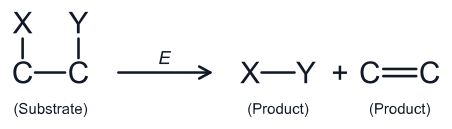
Identify the enzyme class 'E' from the following options:
Answer and explanation
Answer: (3)
Lyases catalyse the removal of groups from substrates by mechanisms other than hydrolysis, leaving behind double bonds. The reaction shown removes the X and Y groups (as X-Y) and generates a C=C double bond, which is characteristic of lyase activity. Transferases move a group between substrates, isomerases interconvert isomers, and ligases join two molecules together, none of which fit this reaction.
Why the other options are wrong:
- (1) Transferases transfer a functional group between a pair of substrates, not create a double bond.
- (2) Isomerases interconvert optical, geometric or positional isomers.
- (4) Ligases link two compounds together, the opposite of this elimination.Match List-I with List-II.
List I
List II
P) Starch
I) Fights infection
Q) Antibody
II) Energy storage
R) Concanavalin A
III) Glucose transport
S) Glut-4
IV) Lectin
Choose the correct answer from the options given below :
Answer and explanation
Answer: (2)
Starch is the storage polysaccharide of plants, a reserve of energy (P-II). Antibodies are immunoglobulins that recognise and neutralise pathogens (Q-I). Concanavalin A is the standard textbook example of a lectin, a carbohydrate-binding protein (R-IV). GLUT-4 is the insulin-responsive transporter that carries glucose across the plasma membrane into muscle and fat cells (S-III). NCERT Class 11, Biomolecules (protein functions).
Arrange the following elements in descending order of their contribution to percentage weight of the human body.
Statement I: Oxygen
Statement II: Carbon
Statement III: Hydrogen
Statement IV: Nitrogen
Choose the correct answer from the options given below :Answer and explanation
Answer: (1)
By WEIGHT the human body is roughly 65 per cent oxygen, 18 per cent carbon, 10 per cent hydrogen and 3 per cent nitrogen, so the order is oxygen, carbon, hydrogen, nitrogen. Oxygen dominates because most of the body is water and hydrogen contributes little mass despite being very abundant by number of atoms - a useful reminder that ranking by weight and ranking by atom count give different answers. NCERT Class 11, Biomolecules (elemental analysis).
Identify the substances having glycosidic bond and peptide bond, respectively in their structure
Answer and explanation
Answer: (3)
Inulin contains a glycosidic bond, linking its fructose units. Insulin contains peptide bonds, linking its amino acid residues. Chapter: Biomolecules.
Which one of the following is the most abundant protein in the animals?
Answer and explanation
Answer: (1)
Collagen is the most abundant protein in animals, forming the structural framework of bones, skin, and connective tissues. Chapter: Biomolecules.
Identify the basic amino acid from the following.
Answer and explanation
Answer: (2)
Lysine is a basic amino acid due to its positively charged amino group on the side chain. Chapter: Biomolecules.
Match the following and select the correct option.
List I
List II
P) Inhibitor of catalytic activity
I) Ricin
Q) Possess peptide bonds
II) Malonate
R) Cell-wall material in fungi
III) Chitin
S) Secondary metabolite
IV) Collagen
Answer and explanation
Answer: (4)
Malonate inhibits catalytic activity competitively; collagen contains peptide bonds; fungal walls contain chitin; and ricin is a secondary metabolite. Thus P-II, Q-IV, R-III, S-I. Chapter: Biomolecules.
Your result
0 / 44
Keep practising with NEET PYQs, review explanations and track your chapter accuracy in the app. Free until the 2027 exam.