
Biology · chapter PYQs
Principles of Inheritance and Variation, on the exam screen.
14 questions from NEET 2026, Re-NEET 2026, NEET 2020, 14 minutes, marked +4 / −1. See them with solutions.
Principles of Inheritance and Variation · PYQs
Candidate: You
Time Left
Q1/14
Match List-I with List-II
List I
List II
P) Incomplete dominance
I) Human skin colour
Q) Co-dominance
II) Inheritance of flower colour in Antirrhinum sp.
R) Pleiotropy
III) Phenylketonuria disease in humans
S) Polygenic inheritance
IV) ABO blood groups
Choose the correct answer from the options given below:
Answer and explanation
Answer: (1)
Incomplete dominance is shown by flower colour in Antirrhinum, where the heterozygote is intermediate; co-dominance is illustrated by ABO blood groups, where alleles and are both expressed; pleiotropy is exemplified by phenylketonuria, where one gene affects several traits; and polygenic inheritance controls human skin colour. This gives P-II, Q-IV, R-III, S-I.
Which of the following statements are true with reference to the sex-determination in honeybees?
Statement I: An offspring formed from the union of a sperm and an egg, develops as a female (queen or worker).
Statement II: An unfertilized egg develops as a male by parthenogenesis.
Statement III: A male has half the number of chromosomes than that of a female.
Statement IV: Males produce sperms by meiosis.
Statement V: Honeybees have a haplodiploid sex-determination system.
Choose the correct answer from the options given below:Answer and explanation
Answer: (1)
Honeybees use a haplodiploid system (Statement V). A fertilised egg (diploid) becomes a female, queen or worker (Statement I); an unfertilised egg develops parthenogenetically into a haploid male (Statement II); the haploid male therefore has half the chromosome number of the diploid female (Statement III). Statement IV is false because haploid males cannot undergo normal reductional meiosis and instead form sperm by a modified mitosis, so the correct set is I, II, III and V.
Which one of the following disorders is caused by the substitution of Glutamic acid (Glu) by Valine (Val) at the sixth position of the beta globin chain of the haemoglobin molecule?
Answer and explanation
Answer: (2)
Sickle-cell anaemia is an autosomal recessive disorder caused by a point mutation (GAG to GUG) that substitutes glutamic acid with valine at the sixth position of the beta-globin chain. Thalassemia results from reduced or absent globin-chain synthesis, phenylketonuria from a defect in phenylalanine metabolism, and haemophilia is an X-linked clotting disorder.
What is the probability of having children with 'O' blood group, where both mother and father are heterozygous for 'A' and 'B' blood group, respectively?
Answer and explanation
Answer: (1)
A heterozygous type-A parent is and a heterozygous type-B parent is . Their cross gives offspring (AB), (A), (B) and (O) in a 1:1:1:1 ratio. Only the genotype is blood group O, giving a probability of 1 in 4, i.e. 25%.
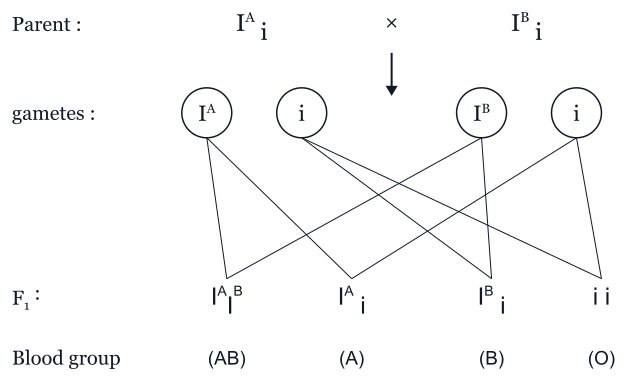
Why the other options are wrong:
- (2) Since both parents carry the recessive i allele, an O child is possible.
- (3) 75% would be the chance of a non-O child, not an O child.
- (4) 50% does not match the 1:1:1:1 offspring ratio for this cross.The sixth mutant codon of beta globin gene causing polymerization of Haemoglobin and change in RBC shape is ______.
Answer and explanation
Answer: (1)
In sickle cell anaemia the sixth codon of the -globin gene changes from GAG to GUG, so glutamic acid is replaced by valine. This substitution makes haemoglobin polymerize at low oxygen tension and distorts the red blood cell (RBC) into a sickle shape, so the mutant codon is GUG.
In a population of a grasshopper species, the chromosome number of some members is 23 and some other members possess 24 chromosomes. The 23 and 24 chromosome-bearing members in this species are ______.
Answer and explanation
Answer: (3)
Grasshoppers follow the XO type of sex determination: males are XO (a single X and no partner sex chromosome) while females are XX. Therefore the individual with 23 chromosomes lacks the second sex chromosome and is male, while the one with 24 chromosomes is female. Hence males and females respectively.
In which animal do haploid cells divide mitotically to produce gametes?
Answer and explanation
Answer: (1)
In honeybees the males (drones) are haploid, developing from unfertilised eggs by parthenogenesis, so their gametes must be formed by mitosis rather than meiosis. Male earthworms, frogs and grasshoppers are diploid and produce gametes through meiosis. Hence male honeybees.
Given below are two statements :
Statement I: Down's syndrome is caused by the absence of one of the X-chromosomes.
Statement II: Turner's syndrome is caused by the presence of an additional copy of the chromosomes.
In the light of the above statements, choose the correct answer from the options given below :Answer and explanation
Answer: (2)
Both statements have been swapped. Down's syndrome is an AUTOSOMAL trisomy - an extra copy of chromosome 21, giving 47 chromosomes - and has nothing to do with the X chromosome. Turner's syndrome is the opposite kind of error: a MISSING X, giving the 45,X karyotype in a phenotypic female with rudimentary ovaries. So the descriptions belong to each other's conditions, and neither statement as written is correct. NCERT Class 12, Principles of Inheritance and Variation.
For a person with blood group 'O', which of the following is not a possible combination of parents' blood group genotypes?
Answer and explanation
Answer: (4)
Blood group O is the homozygous recessive genotype , so EACH parent must be able to contribute an allele. A father of genotype carries no allele at all and can only pass on or , so option (4) cannot produce an O child. Every other option pairs two heterozygous carriers, each of whom can donate . NCERT Class 12, Principles of Inheritance and Variation (multiple allelism).
Given below are two statements : one is labelled as Assertion A and the other is labelled as Reason R.
Assertion (A): In an experiment, Mendel observed that the progeny plants are all tall and none are dwarf.
Reason (R): Stem height is a contrasting trait, with tall being dominant and dwarf being recessive.
In the light of the above statements, choose the most appropriate answer from the options given below :Answer and explanation
Answer: (1)
Crossing true-breeding tall and dwarf pea plants gave an generation that was uniformly tall, with no intermediates and no dwarfs - one of Mendel's central observations. The reason states exactly why: the plants are heterozygous , and because the tall allele is dominant it masks the recessive dwarf allele in the phenotype. The dwarf allele reappears in the generation, confirming it was never lost. NCERT Class 12, Principles of Inheritance and Variation.
Experimental verification of the chromosomal theory of inheritance was done by
Answer and explanation
Answer: (3)
Thomas Hunt Morgan provided experimental verification of the chromosomal theory of inheritance through his work with Drosophila melanogaster. Chapter: Principles of Inheritance and Variation.
How many true breeding pea plant varieties did Mendel select as pairs, which were similar except in one character with contrasting traits?
Answer and explanation
Answer: (2)
Mendel selected 14 true breeding pea plant varieties as pairs, each differing in one character with contrasting traits. Chapter: Principles of Inheritance and Variation.
Select the correct match
Answer and explanation
Answer: (2)
- Haemophilia is X-linked recessive. - Phenylketonuria is autosomal recessive. - Sickle cell anaemia is an autosomal recessive trait linked to chromosome 11. - Thalassemia is autosomal recessive, not X-linked. Chapter: Principles of Inheritance and Variation.
Identify the wrong statement with reference to the gene 'I' that controls ABO blood groups.
Answer and explanation
Answer: (2)
The gene 'I' has three alleles: , , and i. A person will have only two of these alleles. When and are present together, they express different types of sugars, not the same type. The allele i does not produce any sugar. Chapter: Principles of Inheritance and Variation.
Your result
0 / 56
Keep practising with NEET PYQs, review explanations and track your chapter accuracy in the app. Free until the 2027 exam.