
Chemistry · chapter PYQs
Aldehydes, Ketones and Carboxylic Acids, on the exam screen.
6 questions from NEET 2026, Re-NEET 2026, NEET 2020, 6 minutes, marked +4 / −1. See them with solutions.
Aldehydes, Ketones and Carboxylic Acids · PYQs
Candidate: You
Time Left
Q1/6
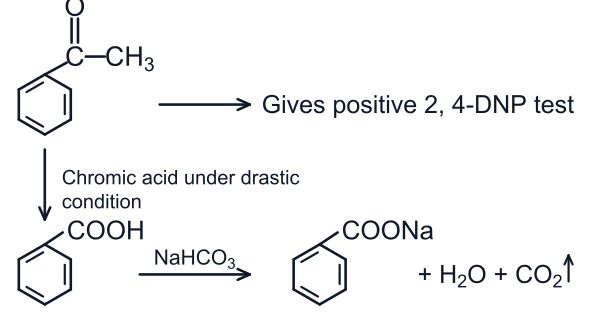
Compound P () gives a red-orange precipitate with 2,4-DNP reagent but does not reduce Fehling's reagent or give a positive Tollens' test. On drastic oxidation with chromic acid, P gives an aromatic product Q that produces effervescence with aqueous . Compounds P and Q, respectively, are:
Answer and explanation
Answer: (4)
P is acetophenone, . Its aryl-ketone carbonyl gives the red-orange 2,4-DNP precipitate, while as a ketone it is negative to BOTH Fehling's and Tollens'; a positive Tollens' test would mean an aldehyde, so an aromatic aldehyde such as p-tolualdehyde is excluded. Drastic oxidation with chromic acid cleaves the methyl ketone to benzoic acid: . Q is benzoic acid, whose −COOH liberates with aqueous : . Option (1) gives the wrong oxidation product for acetophenone; options (2) and (3) take P to be p-tolualdehyde, which the Tollens' clue rules out.
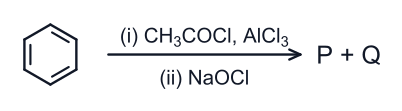
For the following reaction sequence, choose the correct option.
Answer and explanation
Answer: (3)
Friedel-Crafts acylation converts benzene to acetophenone, and sodium hypochlorite then carries out the haloform reaction on the methyl ketone, giving sodium benzoate (P) and chloroform (Q). Acidifying sodium benzoate liberates benzoic acid, and chloroform slowly oxidises in air and light to phosgene, , which is highly poisonous - the reason chloroform is stored in dark bottles with a little ethanol. NCERT Class 12, Aldehydes, Ketones and Carboxylic Acids (haloform reaction); chloroform's oxidation is in Haloalkanes and Haloarenes.
Why the other options are wrong:
- (1) identifies P correctly but calls chloroform a primary alcohol, confusing the haloform product with a reduction product
- (2) chloroform contains no ring and is not aromatic, so both products cannot be aromatic
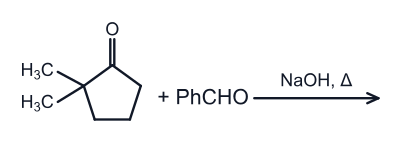
- (4) neither the carboxylate salt nor chloroform retains a C=O available as a carbonyl compound in the sense intendedThe compound that CANNOT be obtained from the aldol condensation reaction shown below, is
Answer and explanation
Answer: (1)
The ketone has -hydrogens only at C-5, because C-2 already carries two methyl groups and no hydrogen. Cross-aldol with benzaldehyde followed by dehydration therefore gives the benzylidene product at C-5, available as both geometrical isomers (options (2) and (4)). Self-condensation between two ketone molecules places the new double bond BETWEEN the -carbon of one ring and the former carbonyl carbon of the other, which is the exocyclic alkene of option (3). Option (1) shows the rings joined by a single bond with the alkene sitting inside the second ring - no addition-elimination sequence produces that connectivity. NCERT Class 12, Aldehydes, Ketones and Carboxylic Acids.
Why the other options are wrong:
- (2) is obtainable - the standard cross-aldol condensation product with the non-enolisable aldehyde
- (3) is obtainable - the self-aldol condensation product, since the ketone does possess one enolisable position
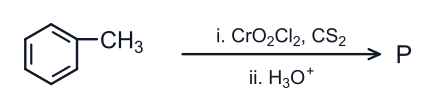
- (4) is obtainable - simply the other geometrical isomer of the same benzylidene productConsider the following reaction, and choose the correct option.
Answer and explanation
Answer: (4)
Chromyl chloride in carbon disulphide oxidises the methyl group of toluene only as far as the aldehyde, and hydrolysis of the chromium complex releases benzaldehyde - the Etard reaction. Benzaldehyde is exactly the product of Rosenmund reduction, in which benzoyl chloride is hydrogenated over palladium poisoned with barium sulphate, so option (4) is a genuine alternative preparation. NCERT Class 12, Aldehydes, Ketones and Carboxylic Acids (preparation of aldehydes).
Why the other options are wrong:
- (1) effervescence with bicarbonate is a test for carboxylic ACIDS; an aldehyde is not acidic enough to release
- (2) acylation of benzene with acetyl chloride gives acetophenone, a ketone, not benzaldehyde
- (3) a white precipitate with bromine water is characteristic of activated rings such as phenol or aniline, not of benzaldehydeReaction between acetone and methylmagnesium chloride followed by hydrolysis will give :
Answer and explanation
Answer: (2)
The reaction of acetone with methylmagnesium chloride forms a tertiary alkoxide, which upon hydrolysis yields tert-butyl alcohol. This follows the Grignard reagent mechanism where the nucleophilic attack occurs at the carbonyl carbon, leading to the formation of a tertiary alcohol. Chapter: Aldehydes, Ketones and Carboxylic Acids.
Reaction between benzaldehyde and acetophenone in presence of dilute NaOH is known as
Answer and explanation
Answer: (3)
The reaction between benzaldehyde and acetophenone in the presence of dilute NaOH is a cross aldol condensation. This reaction involves the condensation of an aldehyde with a ketone to form a -hydroxy ketone. Chapter: Aldehydes, Ketones and Carboxylic Acids.
Your result
0 / 24
Keep practising with NEET PYQs, review explanations and track your chapter accuracy in the app. Free until the 2027 exam.