
Chemistry · chapter PYQs
Chemical Kinetics, on the exam screen.
7 questions from NEET 2026, Re-NEET 2026, NEET 2020, 7 minutes, marked +4 / −1. See them with solutions.
Chemical Kinetics · PYQs
Candidate: You
Time Left
Q1/7
Match List I (Order of reaction) with List II (Unit of rate constant):
List I
List II
P) Zero order
I)
Q) First order
II)
R) Second order
III)
S) Third order
IV)
Answer and explanation
Answer: (2)
The unit of the rate constant of an nth-order reaction is . For n=0 this is (IV); n=1 gives (III); n=2 gives (I); n=3 gives (II). Hence P-IV, Q-III, R-I, S-II.
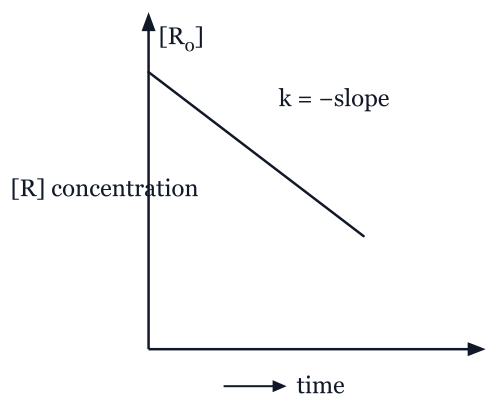
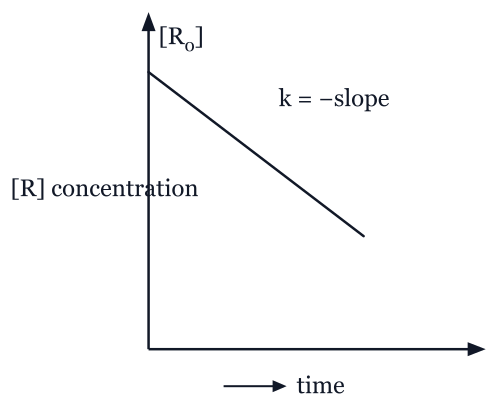
For a certain reaction R → Product, the plot of concentration [R] vs time has a negative slope as shown. The order of reaction is:
Answer and explanation
Answer: (1)
A straight-line plot of concentration [R] against time corresponds to a zero-order reaction, for which ; the constant (linear) rate of decrease means the rate is independent of concentration and equal to the rate constant k (= -slope). First- and higher-order reactions give curved concentration-time plots, not straight lines.
Given below is an expression for the rate constant of a first-order reaction occurring at a certain temperature, T (K): . The energy of activation in kcal mol for the reaction is: (Given: k in s, R = 1.987 cal mol K)
Answer and explanation
Answer: (1)
Comparing with the Arrhenius form , the slope term gives . Thus cal mol kcal mol (1).
For the zero-order reaction 2A → B, the rate constant is . If the initial concentration of A is 2 M, then the time taken to complete 75% of the reaction will be
Answer and explanation
Answer: (2)
The rate of REACTION is defined as because of the stoichiometric coefficient 2, so A itself disappears at per minute. Integrating, . Completing 75% means 1.5 M of A has been consumed, so and . NCERT Class 12, Chemical Kinetics (integrated rate equation for zero order).
For an elementary chemical reaction, the Arrhenius plot is given below.
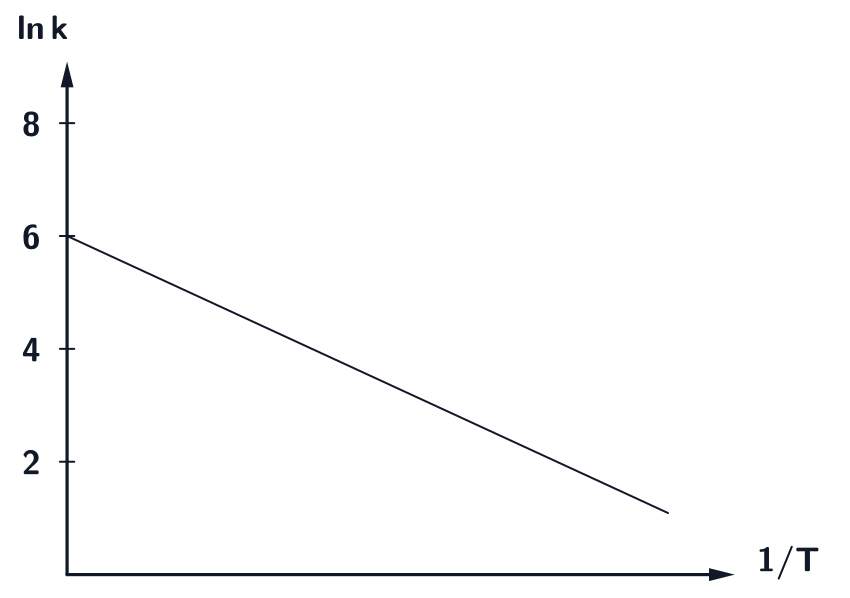
If the energy of activation is 6.64 kJ and , the temperature at which the rate constant becomes , is
Answer and explanation
Answer: (3)
In logarithmic form the Arrhenius equation is , a straight line of slope whose intercept on the axis is . The graph shows that intercept at 6, so . Setting gives , hence and . NCERT Class 12, Chemical Kinetics (temperature dependence of rate).
Why the other options are wrong:
- Option (1): at 125 K, , so , not 2
- Option (2): at 150 K, , so , not 2
- Option (4): at 250 K, , so , not 2The rate constant for a first order reaction is 4.606 × 10⁻³ s–1. The time required to reduce 2.0 g of the reactant to 0.2 g is :
Answer and explanation
Answer: (2)
For a first-order reaction, . Substituting, . Chapter: Chemical Kinetics.
An increase in the concentration of the reactants of a reaction leads to change in
Answer and explanation
Answer: (3)
An increase in the concentration of reactants leads to a higher collision frequency, as more particles are available to collide. This does not affect activation energy, heat of reaction, or threshold energy. Chapter: Chemical Kinetics.
Your result
0 / 28
Keep practising with NEET PYQs, review explanations and track your chapter accuracy in the app. Free until the 2027 exam.