
Chemistry · chapter PYQs
Hydrocarbons, on the exam screen.
7 questions from NEET 2026, Re-NEET 2026, NEET 2020, 7 minutes, marked +4 / −1. See them with solutions.
Hydrocarbons · PYQs
Candidate: You
Time Left
Q1/7
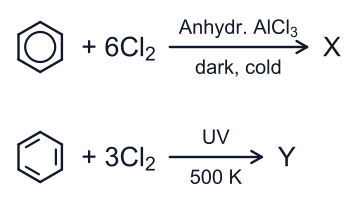
The number of chlorine atoms present in the organic products X and Y of the following reactions, respectively, are:
Answer and explanation
Answer: (3)
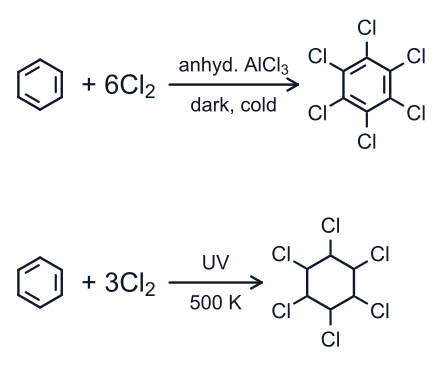
With anhydrous in the dark and cold, benzene undergoes electrophilic substitution to hexachlorobenzene (X), which contains 6 chlorine atoms. Under ultraviolet (UV) light at 500 K, benzene adds three molecules to give benzene hexachloride (Y), also containing 6 chlorine atoms. So both products carry 6 chlorine atoms, matching option (3).
Given below are two statements.
Statement I : trans-But-2-ene upon treatment with in gives the following product.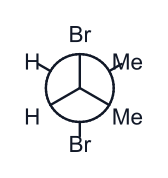
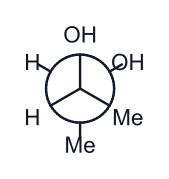
Statement II : cis-But-2-ene upon treatment with alkaline gives the following product.
In the light of the above statements, choose the most appropriate answer from the options given below.
Answer and explanation
Answer: (4)
Bromine in adds ANTI through a cyclic bromonium ion, so trans-but-2-ene gives meso-2,3-dibromobutane. The Newman projection drawn has the two Br atoms anti but the two methyl groups gauche. In the meso isomer, Br anti to Br puts Me anti to Me as well, so the drawing is the chiral (2R,3R) isomer. Statement I is wrong. Alkaline adds SYN through a cyclic manganate ester, and syn dihydroxylation of cis-but-2-ene does give meso-butane-2,3-diol, so Statement II is right. The rule worth remembering: for a symmetrically substituted alkene, anti addition to trans and syn addition to cis both give the meso product. NCERT Class 11, Hydrocarbons (addition reactions of alkenes).
Why the other options are wrong:
- (1) accepts Statement I by assuming bromination of trans-but-2-ene gives the chiral (2R,3R) product drawn, confusing anti addition to trans with anti addition to cis
- (2) rejects Statement II as well, missing that syn dihydroxylation of the cis alkene genuinely gives the meso diol
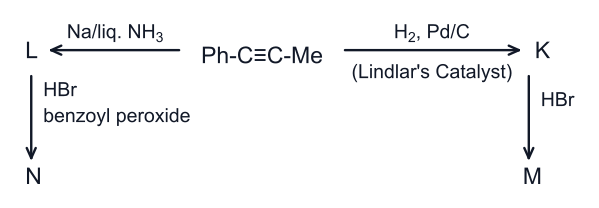
- (3) reverses both verdicts, applying syn stereochemistry to bromination and anti to permanganateConsider the following reaction sequences and choose the correct option.
Answer and explanation
Answer: (1)
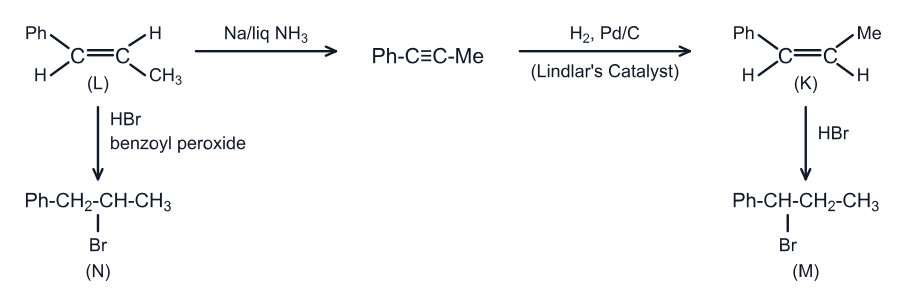
Dissolving-metal reduction with /liq. proceeds through a trans vinyl radical anion and delivers the E (trans) alkene , whereas Lindlar hydrogenation adds both hydrogens to the same face and gives the Z (cis) alkene . Same formula, same connectivity, different arrangement about the double bond - geometrical isomers. The bromides are a different matter: forms by Markovnikov addition at the benzylic carbon while forms by peroxide-mediated anti-Markovnikov addition at the other carbon, so they are POSITIONAL isomers, not stereoisomers. NCERT Class 11, Hydrocarbons (alkynes and alkenes).
Why the other options are wrong:
- (2) enantiomers are non-superimposable mirror images; these alkenes are achiral diastereomers about a double bond
- (3) the two bromides differ in WHERE the bromine sits, which is constitutional isomerism, not geometrical
- (4) same error as (3) - different connectivity rules out any kind of stereoisomerismAmong the following, the compound having conjugated double bonds is
Answer and explanation
Answer: (1)
Double bonds are conjugated when they alternate with exactly one single bond, letting the p orbitals overlap continuously. In hepta-1,3-diene the unsaturations are at C1-C2 and C3-C4, separated by the single C2-C3 bond, so the system is conjugated. The others place two or more single bonds between the double bonds, making them isolated. NCERT Class 11, Hydrocarbons.
An alkene on ozonolysis gives methanal as one of the product. Its structure is
Answer and explanation
Answer: (2)
Methanal is formed only when ozonolysis cleaves a terminal =CH group. Allylcyclohexane contains -CH-CH=CH, so its terminal carbon gives HCHO. Chapter: Hydrocarbons.
Why the other options are wrong:
- (1) 3-Propylcyclohexene: its only double bond is inside the ring, so ozonolysis opens the ring into one dialdehyde and gives no methanal.
- (3) 4-Propylcyclohexene: ozonolysis cleaves the ring double bond and gives a single dialdehyde, with no terminal =CH to give methanal.
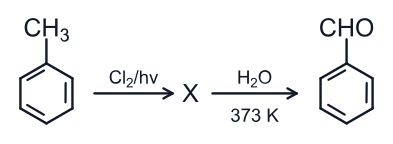
- (4) 1-Cyclohexylpropene: ozonolysis splits it into cyclohexanecarbaldehyde and ethanal (), not methanal.Identify compound X in the following sequence of reactions
Answer and explanation
Answer: (2)
Successive side-chain chlorination of toluene under light gives benzal chloride, CHCHCl. Hydrolysis at 373 K converts its gem-dichloride group to -CHO, forming benzaldehyde. Chapter: Hydrocarbons.
Why the other options are wrong:
- (1) Benzyl chloride, : hydrolysis swaps its single Cl for OH and gives benzyl alcohol, not benzaldehyde.
- (3) Benzotrichloride, : hydrolysis turns the group into -COOH and gives benzoic acid, not benzaldehyde.
- (4) Chlorobenzene: it has no side-chain carbon to become -CHO, and in light chlorinates the side chain, not the ring.Which of the following alkane cannot be made in good yield by Wurtz reaction?
Answer and explanation
Answer: (2)
A Wurtz reaction with one alkyl halide gives a symmetrical alkane with an even total carbon count. Making n-heptane requires two different halides, producing a mixture, so it cannot be obtained in good yield. Chapter: Hydrocarbons.
Your result
0 / 28
Keep practising with NEET PYQs, review explanations and track your chapter accuracy in the app. Free until the 2027 exam.