
Chemistry · chapter PYQs
Organic Chemistry: Some Basic Principles and Techniques, on the exam screen.
7 questions from NEET 2026, Re-NEET 2026, NEET 2020, 7 minutes, marked +4 / −1. See them with solutions.
Organic Chemistry: Some Basic Principles and Techniques · PYQs
Candidate: You
Time Left
Q1/7
The pair of molecules that are metamers among the following is:
Answer and explanation
Answer: (4)
Metamers have the same molecular formula and same functional group but differ in the alkyl groups attached on either side of that group. Methyl n-propyl ether and diethyl ether are both ethers differing only in the distribution of carbons about the oxygen, so they are metamers.
Why the other options are wrong:
- (1) 1-propanol and 2-propanol are position isomers, not metamers.
- (2) n-Pentane and isopentane are chain isomers.
- (3) Propanone and propanal are functional-group isomers.The correct IUPAC name of the following compound is:
Answer and explanation
Answer: (1)
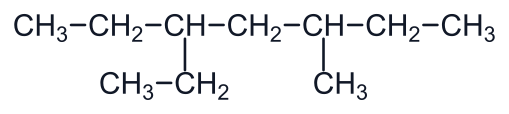
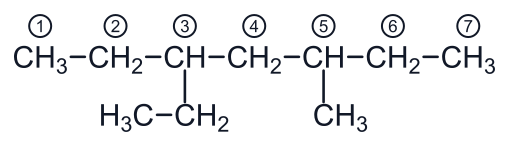
The longest continuous carbon chain has seven carbons, so the parent is heptane. Numbering to give the lowest set of locants places an ethyl group at C-3 and a methyl group at C-5. Listing substituents alphabetically (ethyl before methyl) gives 3-ethyl-5-methylheptane.
Why the other options are wrong:
- (2) Chooses a 6-carbon parent, missing the longest chain.
- (3) Right parent but substituents not in alphabetical order and wrong locants.
- (4) Wrong parent chain length and substituent identification.Two products X and Y are formed in the following reaction sequence.

The suitable method that can be used for the separation of products X and Y is:
Answer and explanation
Answer: (1)
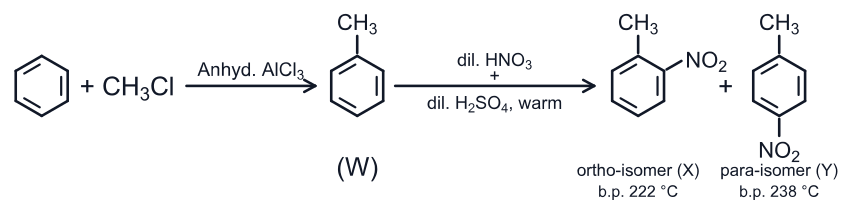
Friedel-Crafts methylation of benzene gives toluene (W), and nitration then gives o-nitrotoluene (X) and p-nitrotoluene (Y). These isomeric liquids have close but different boiling points (o 222 °C, p 238 °C) and are separated by fractional distillation (under reduced pressure). Sublimation suits solids that vaporise directly, while extraction methods separate a solute between immiscible solvents, which does not apply here.
During Lassaigne's test, the elements present in an organic compound are converted from:
Answer and explanation
Answer: (2)
In Lassaigne's (sodium fusion) test the organic compound is fused with sodium metal, which converts the covalently bonded N, S and halogens into water-soluble ionic sodium salts (NaCN, NaS, NaX). These ions are then detected in aqueous extract, so covalent forms are transformed into ionic forms.
The following carbocation is stabilized by the interaction of the empty p orbital with
Answer and explanation
Answer: (1)
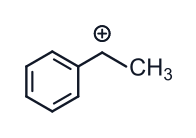
Stabilising an electron-deficient centre means DONATING electron density into its empty p orbital, so the interacting orbitals must be filled. Two filled sets are available here: the filled orbitals of the benzene ring, which deliver resonance stabilisation to this benzylic cation, and the filled C-H orbitals of the adjacent methyl group, which supply hyperconjugation. Empty orbitals such as or have nothing to give. NCERT Class 11, Organic Chemistry: Some Basic Principles and Techniques (resonance and hyperconjugation).
Why the other options are wrong:
- (2) pairs the empty p orbital with other EMPTY orbitals, which cannot transfer any electron density
- (3) gets the contribution right but calls the hyperconjugating orbital ; it is the filled C-H orbital that donates
- (4) selects two antibonding, empty orbitals - the exact opposite of what a cation needsArrange the following compounds in the increasing order of polarity.
Statement I:
Statement II:
Statement III:
Statement IV:
Choose the correct answer from the options given below.Answer and explanation
Answer: (4)
Polarity here is judged by how strongly the functional group interacts through dipoles and hydrogen bonding, which is the ordering used in chromatography. Diethyl ether has no O-H and only weak dipolar interaction, so it is least polar. Acetone's carbonyl is strongly polar but it can only ACCEPT hydrogen bonds, never donate one, so it ranks below ethanol, which has an O-H donor. Acetic acid combines a carbonyl, an O-H donor and acidic ionisation, making it the most polar. Hence I < III < II < IV. NCERT Class 11, Organic Chemistry: Some Basic Principles and Techniques (chromatographic separation).
A tertiary butyl carbocation is more stable than a secondary butyl carbocation because of which of the following ?
Answer and explanation
Answer: (3)
A tertiary butyl carbocation is more stable than a secondary butyl carbocation due to hyperconjugation, which involves the delocalization of -bond electrons into the empty p-orbital of the carbocation. This effect increases the stability of the carbocation. Chapter: Organic Chemistry: Some Basic Principles and Techniques.
Your result
0 / 28
Keep practising with NEET PYQs, review explanations and track your chapter accuracy in the app. Free until the 2027 exam.