
Chemistry · chapter PYQs
Structure of Atom, on the exam screen.
4 questions from NEET 2026, Re-NEET 2026, NEET 2020, 4 minutes, marked +4 / −1. See them with solutions.
Structure of Atom · PYQs
Candidate: You
Time Left
Q1/4
Match List I (Quantum Numbers, given as n and l) with List II (Orbital):
List I
List II
P) n = 2, l = 1
I) 3d
Q) n = 4, l = 0
II) 2p
R) n = 5, l = 3
III) 4s
S) n = 3, l = 2
IV) 5f
Answer and explanation
Answer: (3)
The orbital is named by n and the subshell letter for l (l = 0,1,2,3 -> s,p,d,f). So n=2,l=1 is 2p (II); n=4,l=0 is 4s (III); n=5,l=3 is 5f (IV); n=3,l=2 is 3d (I). This gives P-II, Q-III, R-IV, S-I.
A bulb is rated at 150 watt, converting 8% energy into light. If energy of one photon is , how many photons are emitted by the bulb per second?
Answer and explanation
Answer: (1)
In one second the bulb consumes 150 J; only 8% becomes light, so light energy per second = J. The number of photons n = (light energy)/(energy per photon) = . The other options come from omitting the 8% factor or arithmetic errors.
Consider the following schematic plots of orbital wavefunction () against distance (r) from the nucleus.
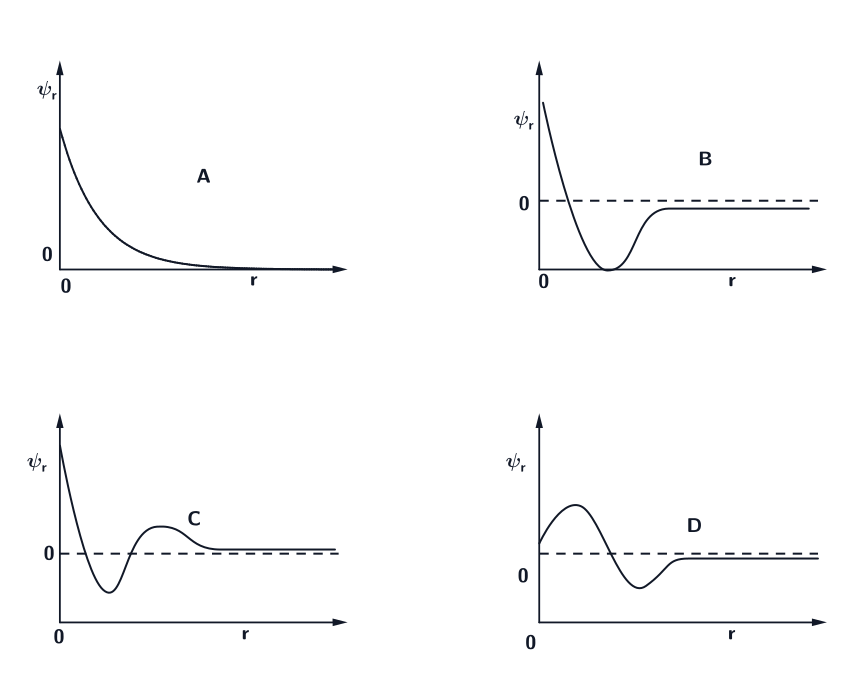
The figure representing two radial nodes in the orbital is
Answer and explanation
Answer: (3)
A radial node is a distance at which the wavefunction actually CHANGES SIGN, so on a versus r plot you simply count how many times the curve crosses the horizontal axis. Merely approaching zero asymptotically at large r does not count. The plot labelled C crosses the axis twice - once into negative values and once back up - so it has two radial nodes, matching an orbital with such as 3s. NCERT Class 11, Structure of Atom (quantum mechanical model, nodes).
Why the other options are wrong:
- (1) shows a curve that decays without ever changing sign - zero radial nodes, as in 1s
- (2) crosses the axis only once, so it has a single radial node
- (4) crosses more often than twice, so its node count is higher than asked forThe number of protons, neutrons and electrons in Lu, respectively, are
Answer and explanation
Answer: (4)
The atomic number (71) gives the number of protons and electrons, and the mass number (175) minus the atomic number gives the number of neutrons: 175 - 71 = 104. Chapter: Structure of Atom.
Your result
0 / 16
Keep practising with NEET PYQs, review explanations and track your chapter accuracy in the app. Free until the 2027 exam.