
Physics · chapter PYQs
Electrostatic Potential and Capacitance, on the exam screen.
9 questions from NEET 2026, Re-NEET 2026, NEET 2020, 9 minutes, marked +4 / −1. See them with solutions.
Electrostatic Potential and Capacitance · PYQs
Candidate: You
Time Left
Q1/9
Five capacitors of capacitances and are connected as shown, along with a battery of 50 V.
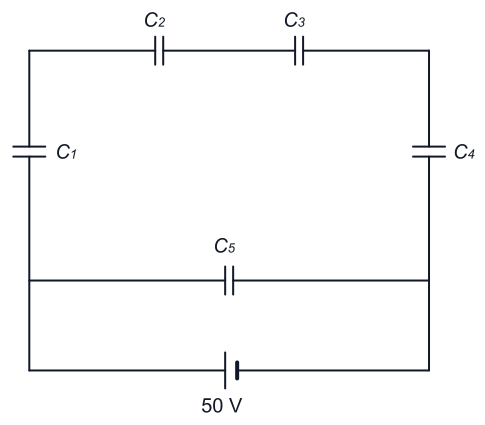
The equivalent capacitance and the charges on each capacitor respectively are:
Answer and explanation
Answer: (2)
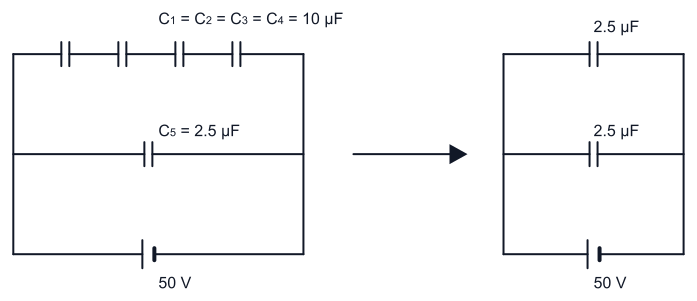
The four 10 capacitors are in series, giving , and this branch is in parallel with , so . Each branch has 50 V across it, so the series branch carries (the same charge flows through to ) and also holds . Every capacitor therefore stores 125 , option (2).
Consider two uncharged capacitors of equal capacitance 200 pF. One of them is charged by a 100 V supply and disconnected. Now this capacitor is connected to the uncharged capacitor. The amount of electrostatic energy lost in the process is:
Answer and explanation
Answer: (1)
When a charged capacitor shares its charge with an identical uncharged one, the energy dissipated is . With and , this equals (option (1)). The loss is real and independent of the connecting-wire resistance; answers in whole joules mishandle the pico-farad factor.
Which of the following statements are correct? Choose the correct answer from the options given below.
Statement I: Inside a conductor, the electrostatic field is zero.
Statement II: Electric field at the surface of a charged conductor does not depend on its surface charge density.
Statement III: The interior of a charged conductor can have no excess charge in the static situation.
Statement IV: At the surface of a charged conductor, the electrostatic field must be normal to the surface at every point.
Statement V: The electrostatic potential is zero everywhere inside a charged conductor.Answer and explanation
Answer: (3)
In electrostatic equilibrium, the electric field inside a conductor is zero, and any excess charge lies on its surface. The field just outside is normal to the surface and depends on the local surface charge density, . The potential is constant inside but need not be zero. Therefore internal statements I, III and IV hold; II and V do not.
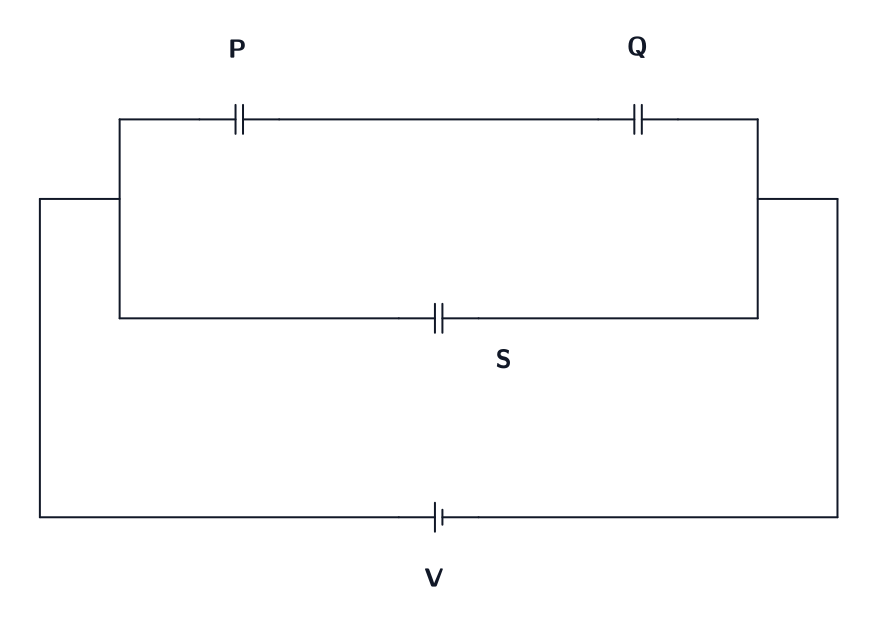
Three identical capacitors, , and , each of the capacitance , are connected to a battery of voltage , as shown in the figure. If the energy stored in the capacitor and total energy stored in the system are and , respectively, then the ratio is:
Answer and explanation
Answer: (4)
and form a series branch of equivalent capacitance , and that branch sits in parallel with across the battery, so and . Identical capacitors in series split the voltage equally, so holds and . The ratio is . NCERT Class 12, Electrostatic Potential and Capacitance.
Why the other options are wrong:
- (1) treats all three capacitors as being in parallel, so each stores an equal third and plus gives 2/3
- (2) assumes the three capacitors share the energy equally, ignoring that sees only half the battery voltage
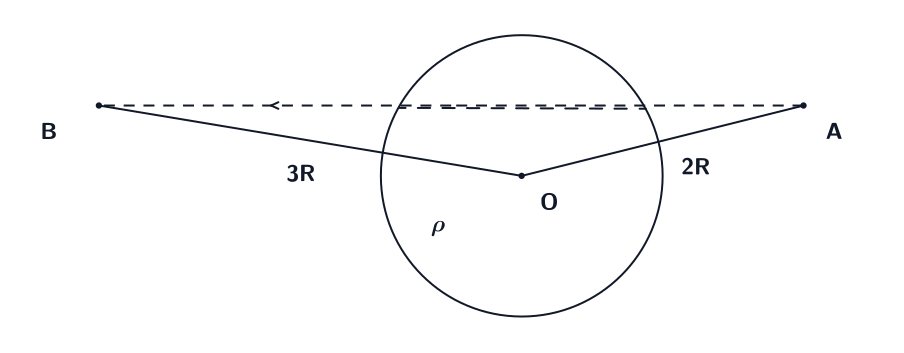
- (3) computes the ratio of to the energy of the series branch alone, forgetting to include in the totalA unit positive point charge is taken slowly through an infinitesimally thin tube that is inside a charged dielectric sphere of radius , having uniform positive charge density , as shown in the figure. The initial and final positions of the charge are marked by and at distance and respectively, from the centre of the sphere. In this process, the magnitude of the total work done on the point charge is . The value of is : ( is the permittivity of vacuum)
Answer and explanation
Answer: (4)
Work done in moving a charge slowly is path-independent and depends only on the endpoint potentials, so the detour through the tube is a red herring. Both and lie OUTSIDE the sphere, where with . Then , giving . NCERT Class 12, Electrostatic Potential and Capacitance.
Why the other options are wrong:
- (1) uses only the from position and drops the volume factor
- (2) computes but forgets the carried by the sphere's total charge
- (3) integrates the internal field along the tube as if the endpoints were inside the sphereConsider a fixed uniformly charged insulating sphere with radius and total charge . A point charge () with mass is released from rest at a distance of from the centre of the charged sphere. When the point charge reaches the surface of the sphere, its speed is: ( is the permittivity of vacuum, neglect gravitational forces).
Answer and explanation
Answer: (3)
Outside the sphere the potential energy of the attracting pair is . Energy conservation from (at rest) to gives . Solving, . NCERT Class 12, Electrostatic Potential and Capacitance.
In a certain region of space with volume 0.2 m3, the electric potential is found to be 5 V throughout. The magnitude of electric field in this region is :
Answer and explanation
Answer: (4)
Electric field is the negative spatial gradient of potential. A constant 5 V everywhere in the region has zero gradient, so the field is zero. Chapter: Electrostatic Potential and Capacitance.
A short electric dipole has a dipole moment of 16 × 10⁻⁹ C m. The electric potential due to the dipole at a point at a distance of 0.6 m from the centre of the dipole, situated on a line making an angle of 60° with the dipole axis is (1/(4πε₀) = 9 × 10⁹ N m² C⁻²)
Answer and explanation
Answer: (1)
The electric potential due to a dipole is given by . Substituting the values, . Chapter: Electrostatic Potential and Capacitance.
The capacitance of a parallel plate capacitor with air as medium is 6 μF. With the introduction of a dielectric medium, the capacitance becomes 30 μF. The permittivity of the medium is (ε₀ = 8.85 × 10⁻¹² C² N⁻¹ m⁻²)
Answer and explanation
Answer: (2)
The dielectric constant is 30/6 = 5. Therefore ε = 5ε = = C N m, matching option (2). Chapter: Electrostatic Potential and Capacitance.
Your result
0 / 36
Keep practising with NEET PYQs, review explanations and track your chapter accuracy in the app. Free until the 2027 exam.