
Physics · chapter PYQs
Laws of Motion, on the exam screen.
4 questions from NEET 2026, Re-NEET 2026, NEET 2020, 4 minutes, marked +4 / −1. See them with solutions.
Laws of Motion · PYQs
Candidate: You
Time Left
Q1/4
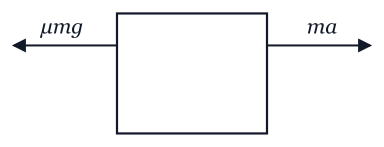
A box of mass 15 kg is kept on the floor of a stationary trolley. The coefficient of static friction between the box and the trolley is 0.12. Keeping the box in stationary state over the trolley, the maximum acceleration with which the trolley can be moved horizontally in m s is: ( m/s)
Answer and explanation
Answer: (4)
The box stays with the trolley only while static friction can supply the force needed to accelerate it. The maximum friction is , so the greatest common acceleration is m/s, option (4). The mass cancels out, and beyond this acceleration the box slips relative to the trolley.
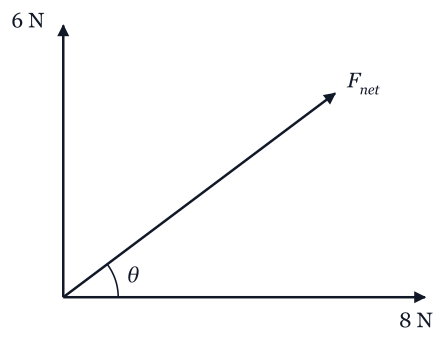
The magnitude and direction of the acceleration produced in a body of mass 5 kg when two mutually perpendicular forces 8 N and 6 N act on it, are respectively:
Answer and explanation
Answer: (4)
The two perpendicular forces give a resultant , so . The resultant makes an angle with the 8 N force where , i.e. measured from the 8 N force (option (4)). Option (1) forgets to divide by the mass, and the others attach the angle to the wrong force or invert the ratio.
A car travels on a circular racetrack of radius 50 m, which is banked at an angle . If the car travels at a speed 10 , then the wear and tear on its tyres is minimum. Taking the acceleration due to gravity to be 10 , the value of is:
Answer and explanation
Answer: (1)
Minimum wear and tear is the exam's way of saying no sideways friction is needed, i.e. the car is at the optimum (design) speed of the banked track. Then the horizontal component of the normal reaction alone supplies the centripetal force, giving , so . NCERT Class 11, Laws of Motion (motion on a banked road).
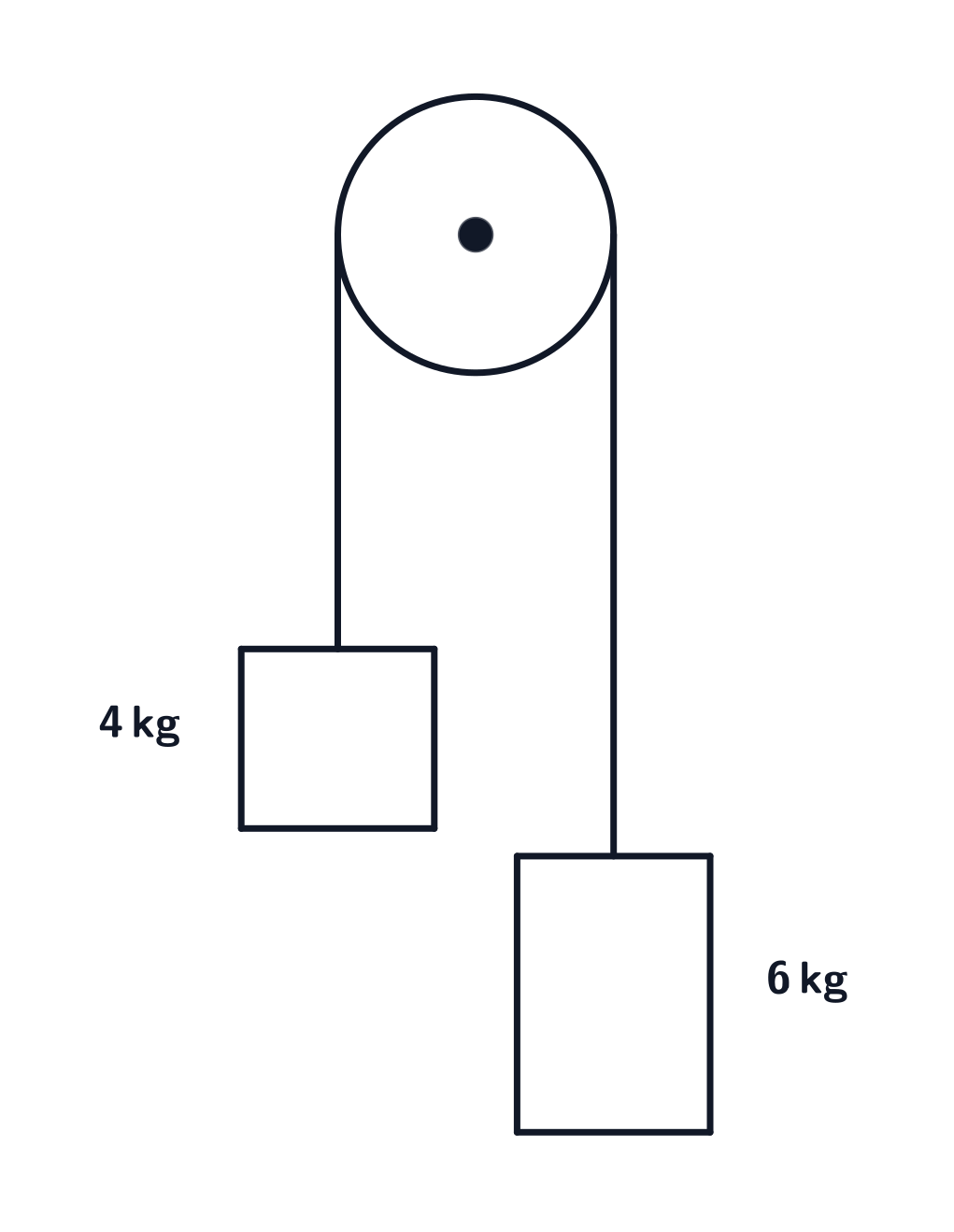
Two bodies of mass 4 kg and 6 kg are tied to the ends of a massless string. The string passes over a pulley which is frictionless (see figure). The acceleration of the system in terms of acceleration due to gravity (g) is
Answer and explanation
Answer: (2)
For a system of two masses and connected by a massless string over a frictionless pulley, the acceleration a is given by . Substituting and , . Chapter: Laws of Motion.
Why the other options are wrong:
- (1) : this divides the net pull by the 4 kg block alone, but both blocks accelerate together, so the full 10 kg must be used.
- (3) : this takes the net pull as , but the unbalanced weight is , which gives twice that.
- (4) : this is free fall. The 4 kg block's weight pulls back against the 6 kg block and the net pull moves all 10 kg, so must be less than .
Your result
0 / 16
Keep practising with NEET PYQs, review explanations and track your chapter accuracy in the app. Free until the 2027 exam.