
Physics · chapter PYQs
Mechanical Properties of Fluids, on the exam screen.
4 questions from NEET 2026, Re-NEET 2026, NEET 2020, 4 minutes, marked +4 / −1. See them with solutions.
Mechanical Properties of Fluids · PYQs
Candidate: You
Time Left
Q1/4
A submarine is designed to withstand an absolute pressure of . How deep can it go below the water surface? (Consider the density of water , and gravitational acceleration )
Answer and explanation
Answer: (1)
Absolute pressure at depth is . So , giving , hence .
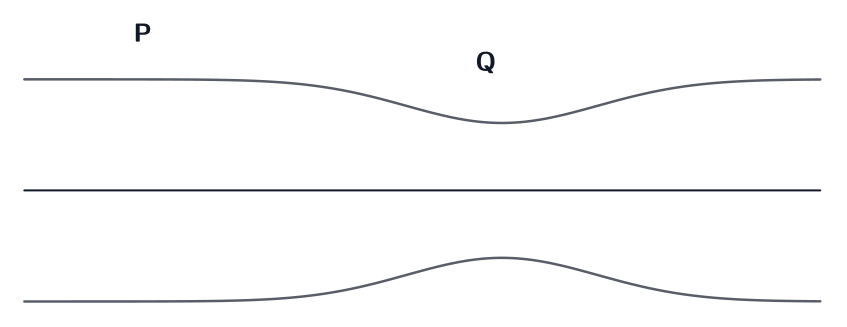
Water flows in a streamline motion through a horizontal pipe of circular cross-section as shown in the figure. The pressure difference of water between and is 15 . The area of cross-section at and are 40 and 20 , respectively. The rate of flow of water through the pipe, in , is: [Take density of water = 1000 ]
Answer and explanation
Answer: (4)
Continuity gives , so halving the area doubles the speed: . For a horizontal pipe Bernoulli's equation reduces to . Substituting gives , and the volume flow rate is . NCERT Class 11, Mechanical Properties of Fluids.
Why the other options are wrong:
- (1) uses the narrow area with the wide-section speed , mismatching the pair
- (2) drops the factor 3 from , effectively using alone
- (3) mixes SI and centimetre-gram-second (CGS) units partway through, most often by leaving in alongside areas inIn the measurement of viscosity of liquids using terminal velocity experiment, spherical balls of same radius but having different densities are used. The variation of the terminal velocity () with the ratio of density of spherical ball () to density of the liquid (), is best represented by:
Answer and explanation
Answer: (1)
Stokes' law gives , which can be rewritten as . With fixed this is a STRAIGHT LINE in whose intercept on the horizontal axis is exactly at . Below that value the ball is lighter than the liquid and does not sink at all, so the downward terminal velocity stays zero. NCERT Class 11, Mechanical Properties of Fluids (Stokes' law).
Why the other options are wrong:
- (2) takes and lets the line pass through the origin, ignoring the buoyant term
- (3) places the zero-velocity crossing at some arbitrary density ratio rather than at the neutral-buoyancy point
- (4) treats terminal velocity as a fixed property of the ball once it sinks, missing its linear dependence on excess densityA capillary tube of radius r is immersed in water and water rises in it to a height h. The mass of the water in the capillary is 5 g. Another capillary tube of radius 2r is immersed in water. The mass of water that will rise in this tube is :
Answer and explanation
Answer: (2)
Capillary rise h is inversely proportional to r. The risen mass is ρrh, so it is proportional to r. Doubling the radius therefore doubles 5 g to 10 g. Chapter: Mechanical Properties of Fluids.
Your result
0 / 16
Keep practising with NEET PYQs, review explanations and track your chapter accuracy in the app. Free until the 2027 exam.