
Physics · chapter PYQs
Thermodynamics, on the exam screen.
4 questions from NEET 2026, Re-NEET 2026, NEET 2020, 4 minutes, marked +4 / −1. See them with solutions.
Thermodynamics · PYQs
Candidate: You
Time Left
Q1/4
An electric heater supplies heat to a system at a rate of 100 W. If the system performs work at a rate of 75 J/s, then the rate at which internal energy increases will be:
Answer and explanation
Answer: (4)
By the first law of thermodynamics . Differentiating with respect to time, , so W. The distractors correspond to the given work rate (1), heat rate (2), or the incorrect sum (3).
In an adiabatic expansion, the temperature of one mole of an ideal monatomic gas () decreases from 60 K to 50 K. The work done by the gas in the process is: (Take the universal gas constant as )
Answer and explanation
Answer: (3)
In an adiabatic process , so the work done by the gas comes entirely out of its internal energy: . For a monatomic gas , giving . The same follows from with . NCERT Class 11, Thermodynamics.
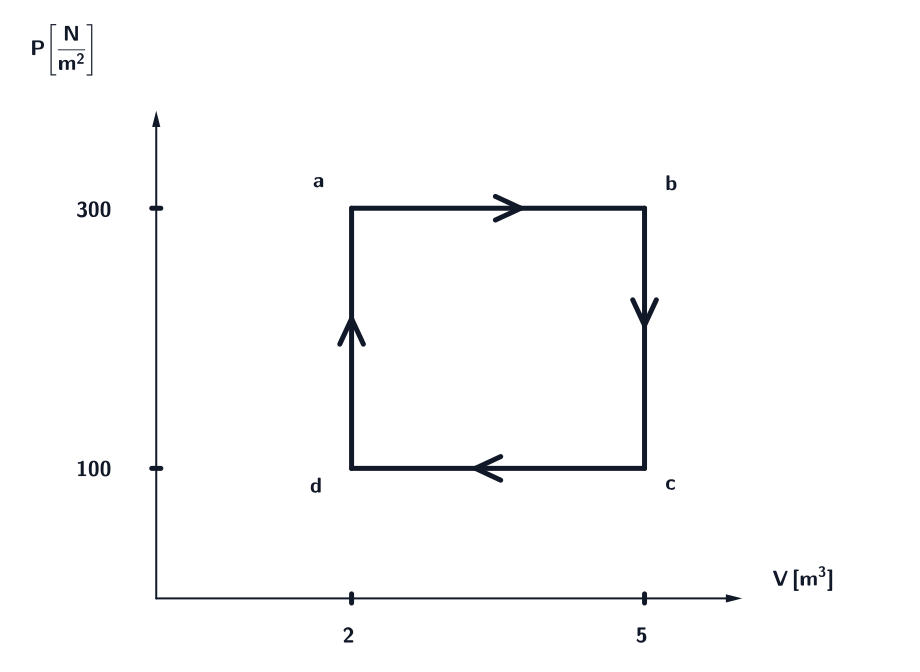
One mole of an ideal monatomic gas undergoes a cyclic process as shown in the figure. The total heat supplied to the gas is:
Answer and explanation
Answer: (3)
Over a complete cycle the gas returns to its initial state, so and the first law reduces to . The cycle is a rectangle on the diagram between and and and , traversed clockwise, so the work done by the gas is the enclosed area . Hence 600 J of heat is supplied. NCERT Class 11, Thermodynamics (cyclic process).
Why the other options are wrong:
- (1) miscounts one side of the rectangle, typically taking
- (2) computes only the net heat of the two isobaric legs and omits the isochoric contributions to the balance
- (4) adds the areas under the two isobaric legs instead of taking their difference, double-counting the return pathTwo cylinders A and B of equal capacity are connected to each other via a stop cock. A contains an ideal gas at standard temperature and pressure. B is completely evacuated. The entire system is thermally insulated. The stop cock is suddenly opened. The process is :
Answer and explanation
Answer: (1)
The system is thermally insulated, so q = 0; the gas expands freely against vacuum, so w = 0. This is an irreversible adiabatic free expansion (with T = 0 for an ideal gas). Chapter: Thermodynamics.
Your result
0 / 16
Keep practising with NEET PYQs, review explanations and track your chapter accuracy in the app. Free until the 2027 exam.