
Full paper
Re-NEET 2026, on the exam screen.
All 180 questions, one at a time, marked +4 / −1. Your answers are saved on this device as you go. Read the paper with solutions.
Re-NEET 2026 · Full paper
Candidate: You
Time Left
Q1/180
Before you start
- 180 questions: Physics 1 to 45, Chemistry 46 to 90, Biology 91 to 180.
- 180 minutes, one per question. The clock starts when you press START TEST and submits for you at zero.
- +4 for a correct answer, −1 for a wrong one, 0 for a question left blank. Where NTA accepted more than one option, any of them earns the marks.
- Tap an option to answer; tap it again to clear. Mark for Review & Next keeps a question to come back to.
- Your answers are saved on this device. Closing the tab does not stop the clock.
- After you submit, every question shows its answer and a worked solution.
A particle of mass moves along a horizontal axis from to . The coefficient of kinetic friction varies as a function of as , where , are constants of appropriate dimensions, so that . The total work done by the frictional force during the motion is , where is the acceleration due to gravity. The value of is:
Answer and explanation
Answer: (4) · Work, Energy and Power
The condition fixes , so falls linearly from to zero. Because the force varies with position, the work must be integrated: . Comparing with gives , which is simply the average of the initial and final friction coefficients since the variation is linear. NCERT Class 11, Work, Energy and Power (work done by a variable force).
The mean free path of molecules in an ideal gas is half that of another ideal gas . The diameter of the spherical molecules of gas is twice the diameter of the molecules of . If number densities of the gases and are and , respectively, the correct option is:
Answer and explanation
Answer: (4) · Kinetic Theory
Mean free path is , so . Taking the ratio, . Substituting and gives , hence . NCERT Class 11, Kinetic Theory (mean free path).
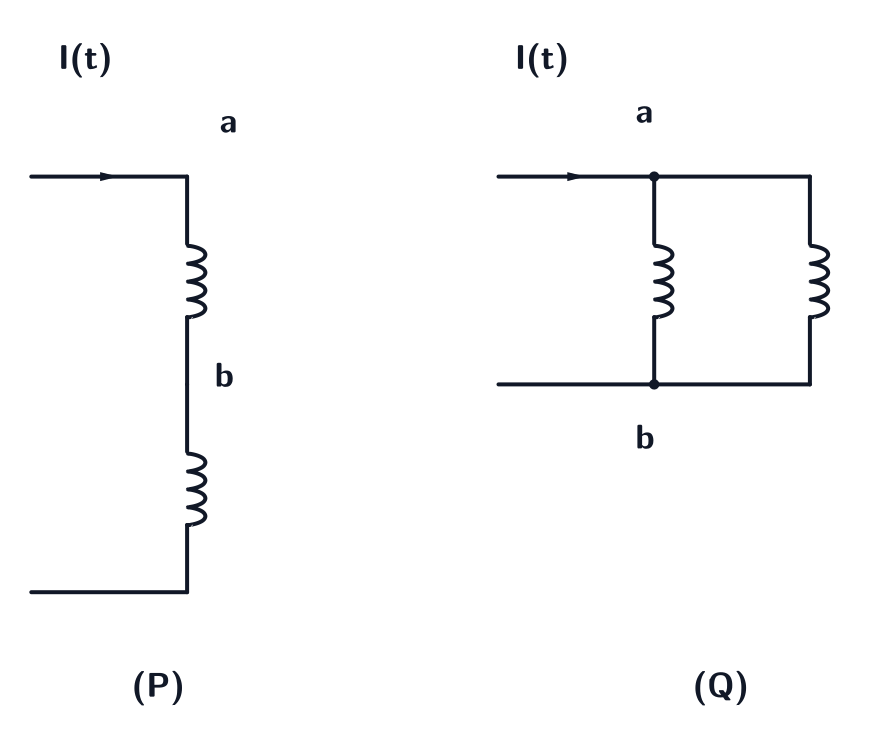
Two identical inductors are connected in two different configurations and , where a time varying current is flowing, as shown in the figure. The induced emf between points and for configuration is and that for configuration is . The ratio is: [Neglect the effect of mutual inductance.]
Answer and explanation
Answer: (4) · Electromagnetic Induction
In configuration the two inductors are in series and the segment between and spans just ONE of them, carrying the full current, so . In configuration the points and straddle the parallel pair, whose equivalent inductance is , so . The ratio is therefore 2. NCERT Class 12, Electromagnetic Induction (self-inductance).
Why the other options are wrong:
- (1) takes across the series pair as and inverts the ratio
- (2) inverts the correct answer by swapping which configuration sits in the numerator
- (3) assumes identical inductors must produce identical electromotive forces (emfs) regardless of how and are placedFor sound waves, if the number of nodes for the 5th harmonic of an open-ended pipe is and that for the 9th harmonic of the same pipe with one of its ends closed is , the ratio is
Answer and explanation
Answer: (3) · Waves
An open-open pipe has antinodes at both ends, and its -th harmonic contains exactly nodes, so the 5th harmonic gives . A closed pipe supports only odd harmonics, with a node at the closed end and an antinode at the open end; its -th harmonic ( odd) contains nodes, so the 9th harmonic gives . The ratio is therefore 1. NCERT Class 11, Waves (standing waves in air columns).
Consider a long solenoid of length and radius . If is the number of turns per unit length and is the permeability of free space, the inductance of the solenoid is :
Answer and explanation
Answer: (1) · Electromagnetic Induction
For a long solenoid , where is turns per unit length and the cross-sectional area. Substituting gives . NCERT Class 12, Electromagnetic Induction (self-inductance).
Consider a particle moving along a straight line, whose position as a function of time is given by , where , and . The average speed of the particle, in from to s is:
Answer and explanation
Answer: (3) · Motion in a Straight Line
Average speed uses total PATH LENGTH, not displacement, so the turning point must be located first. Here , which vanishes at s. Positions are , , , giving 9 m travelled in each leg and 18 m in total. Hence average speed . NCERT Class 11, Motion in a Straight Line.
Consider the following nuclear reaction . Take masses of , and as 238.050 u, 234.043 u and 4.003 u, respectively. The Q value for the reaction, in keV, is: [Given: 1 u = 931.5 MeV ]
Answer and explanation
Answer: (1) · Nuclei
The Q value is the mass defect converted to energy: . Multiplying by the conversion factor, . The positive value confirms the decay is spontaneous. NCERT Class 12, Nuclei (mass-energy and nuclear reactions).
A beam of light falls on a metal surface such that photo-electrons are generated. If power of the light source starts to decrease linearly with time , then variation of the photocurrent and magnitude of the stopping potential with time is best represented by:
Answer and explanation
Answer: (1) · Dual Nature of Radiation and Matter
Photocurrent is set by the NUMBER of photons striking the surface per second, so it is proportional to the source power and falls linearly with . Stopping potential, by contrast, depends only on the maximum kinetic energy of the emitted electrons, , which is fixed by the FREQUENCY and the work function - neither of which changes here. So stays flat while decays. NCERT Class 12, Dual Nature of Radiation and Matter.
Why the other options are wrong:
- (2) treats stopping potential as intensity-dependent, the single most common photoelectric misconception
- (3) swaps the roles entirely, tying current to frequency and stopping potential to intensity
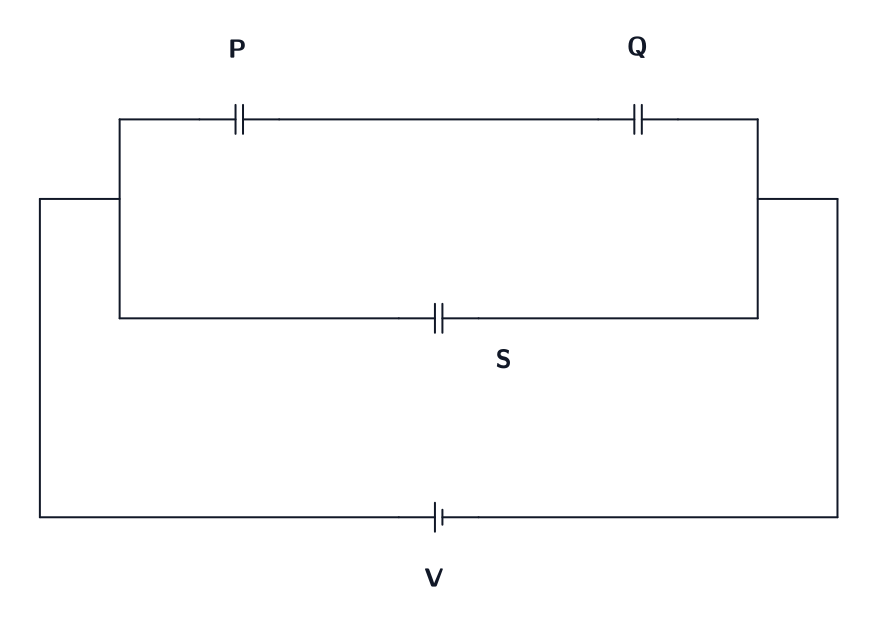
- (4) assumes neither quantity responds to the source, ignoring that current tracks photon fluxThree identical capacitors, , and , each of the capacitance , are connected to a battery of voltage , as shown in the figure. If the energy stored in the capacitor and total energy stored in the system are and , respectively, then the ratio is:
Answer and explanation
Answer: (4) · Electrostatic Potential and Capacitance
and form a series branch of equivalent capacitance , and that branch sits in parallel with across the battery, so and . Identical capacitors in series split the voltage equally, so holds and . The ratio is . NCERT Class 12, Electrostatic Potential and Capacitance.
Why the other options are wrong:
- (1) treats all three capacitors as being in parallel, so each stores an equal third and plus gives 2/3
- (2) assumes the three capacitors share the energy equally, ignoring that sees only half the battery voltage
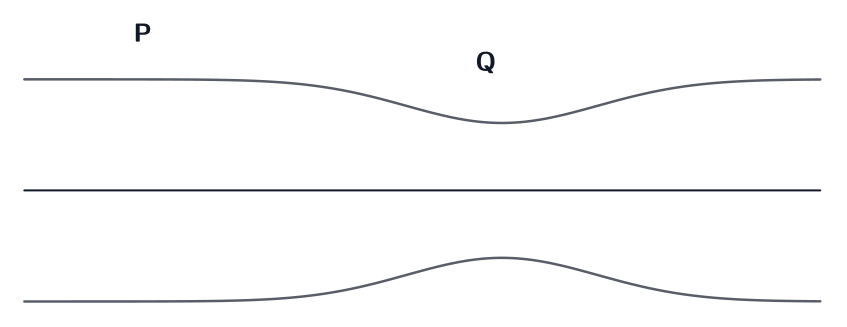
- (3) computes the ratio of to the energy of the series branch alone, forgetting to include in the totalWater flows in a streamline motion through a horizontal pipe of circular cross-section as shown in the figure. The pressure difference of water between and is 15 . The area of cross-section at and are 40 and 20 , respectively. The rate of flow of water through the pipe, in , is: [Take density of water = 1000 ]
Answer and explanation
Answer: (4) · Mechanical Properties of Fluids
Continuity gives , so halving the area doubles the speed: . For a horizontal pipe Bernoulli's equation reduces to . Substituting gives , and the volume flow rate is . NCERT Class 11, Mechanical Properties of Fluids.
Why the other options are wrong:
- (1) uses the narrow area with the wide-section speed , mismatching the pair
- (2) drops the factor 3 from , effectively using alone
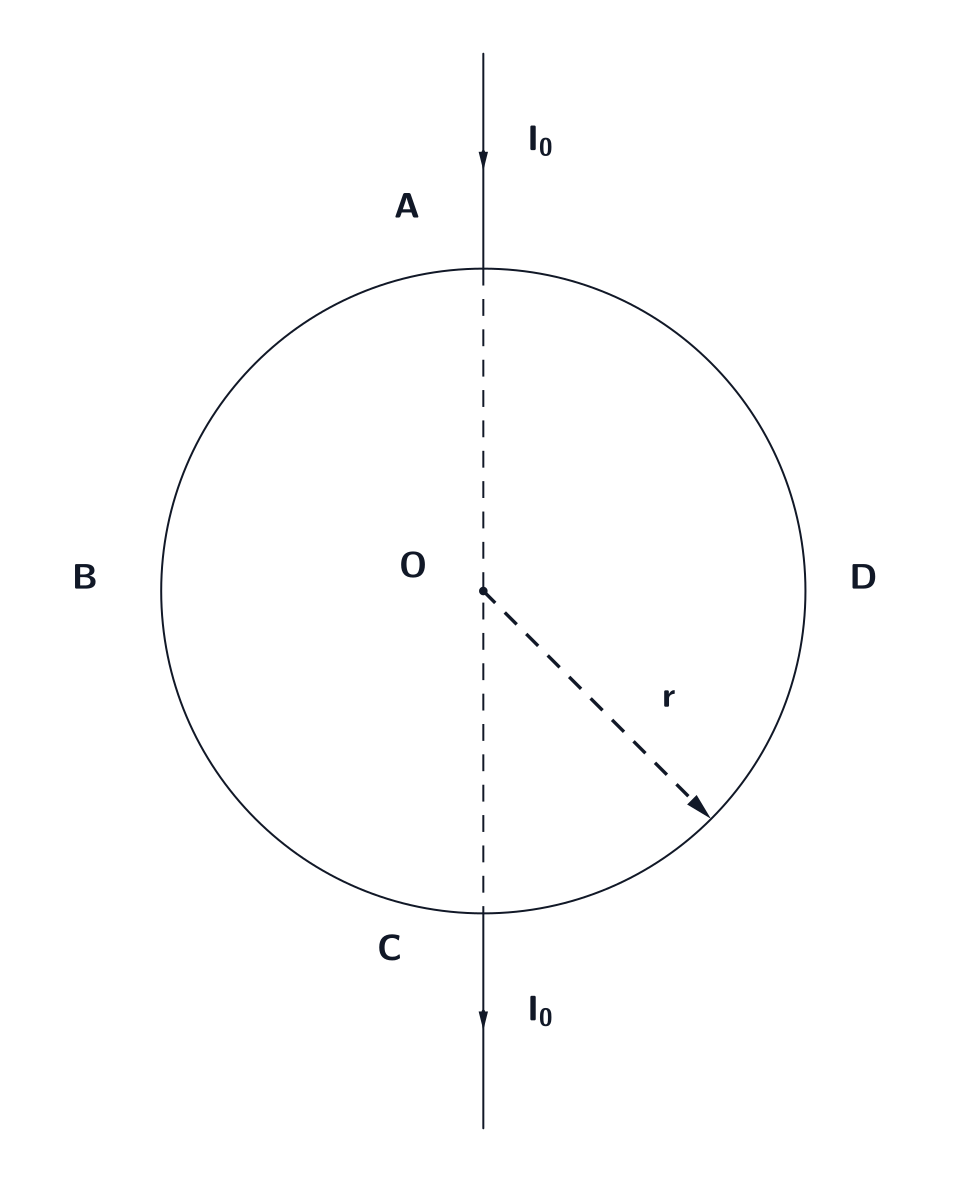
- (3) mixes SI and centimetre-gram-second (CGS) units partway through, most often by leaving in alongside areas inA current flows through a metallic circular loop of radius as shown in the figure. Resistance of the segment is half that of . Magnitude of magnetic field at the centre of the loop is :
Answer and explanation
Answer: (1) · Moving Charges and Magnetism
The current entering at divides between the two arcs in INVERSE proportion to their resistances, so with the currents are and . Each arc is a semicircle ( at the top, at the bottom), contributing but in OPPOSITE directions at . The net field is . NCERT Class 12, Moving Charges and Magnetism (Biot-Savart law).
Why the other options are wrong:
- (2) sends the whole current round one semicircle and ignores the opposing contribution from the other arc
- (3) uses the full-loop result without splitting the current or accounting for cancellation
- (4) applies the formula for a long straight wire, , instead of an arcIn the measurement of viscosity of liquids using terminal velocity experiment, spherical balls of same radius but having different densities are used. The variation of the terminal velocity () with the ratio of density of spherical ball () to density of the liquid (), is best represented by:
Answer and explanation
Answer: (1) · Mechanical Properties of Fluids
Stokes' law gives , which can be rewritten as . With fixed this is a STRAIGHT LINE in whose intercept on the horizontal axis is exactly at . Below that value the ball is lighter than the liquid and does not sink at all, so the downward terminal velocity stays zero. NCERT Class 11, Mechanical Properties of Fluids (Stokes' law).
Why the other options are wrong:
- (2) takes and lets the line pass through the origin, ignoring the buoyant term
- (3) places the zero-velocity crossing at some arbitrary density ratio rather than at the neutral-buoyancy point
- (4) treats terminal velocity as a fixed property of the ball once it sinks, missing its linear dependence on excess densityTwo planets and with equal mass have radii and , respectively, where . The escape speeds of and are and , respectively. Then is:
Answer and explanation
Answer: (3) · Gravitation
Escape speed is . With the masses equal, , so . The denser, smaller planet is harder to escape from, which is the physical sense check. NCERT Class 11, Gravitation (escape speed).
In a solar system, the time-period of revolution of a planet tracing a circular orbit of radius is proportional to:
Answer and explanation
Answer: (2) · Gravitation
Kepler's third law states for orbits about a common central mass, so . It also follows directly from equating gravitational and centripetal force: with . NCERT Class 11, Gravitation (Kepler's laws).
Two infinitely long parallel conducting wires and carry currents and , respectively, in the same direction. The wire has uniform mass per unit length and lies on an insulated floor. The wire is kept fixed at a height above the floor. The minimum magnitude of so that the wire does not rise from the floor is: [ is the acceleration due to gravity and is the permeability of free space.]
Answer and explanation
Answer: (2) · Moving Charges and Magnetism
Parallel currents in the SAME direction attract, so wire pulls wire upwards with force per unit length . Wire stays on the floor as long as this does not exceed its weight per unit length , so and . NCERT Class 12, Moving Charges and Magnetism (force between two parallel currents).
An ideal Zener diode with breakdown voltage of -3 V is reverse biased with a negative input voltage . The magnitude of voltage difference between point and is:
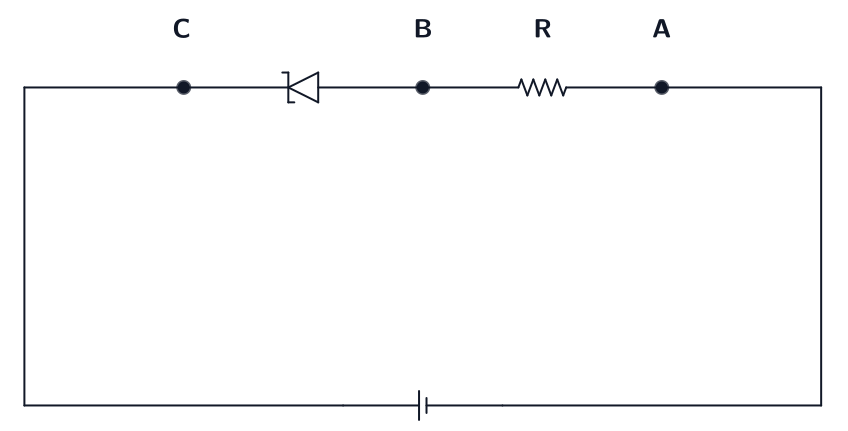
Answer and explanation
Answer: (2) · Semiconductor Electronics
Once an ideal Zener diode is driven past its breakdown voltage it CLAMPS the voltage across itself at 3 V and behaves like a constant-voltage source. The remaining of the supply must therefore appear across the series resistor, which is the element between and . NCERT Class 12, Semiconductor Electronics (Zener diode as a voltage regulator).
Why the other options are wrong:
- (1) reports the voltage across the ZENER rather than across the resistor between and
- (3) subtracts twice, or assumes the diode drops an extra 1 V forward-bias contribution
- (4) assumes the reverse-biased diode blocks all current, so no drop appears across the resistor - but breakdown means current does flowIn an adiabatic expansion, the temperature of one mole of an ideal monatomic gas () decreases from 60 K to 50 K. The work done by the gas in the process is: (Take the universal gas constant as )
Answer and explanation
Answer: (3) · Thermodynamics
In an adiabatic process , so the work done by the gas comes entirely out of its internal energy: . For a monatomic gas , giving . The same follows from with . NCERT Class 11, Thermodynamics.
A ray of light with wavelength is incident on three different photoelectric cells namely 1, 2 and 3. The threshold wavelength of these photoelectric cells are , , and , respectively and the magnitude of stopping potentials of these cells are , and , respectively. The relation between and threshold wavelengths are , and . The correct option is:
Answer and explanation
Answer: (1) · Dual Nature of Radiation and Matter
Emission occurs only when the incident wavelength is SHORTER than the threshold wavelength. Cell 1 has , so the photons are too weak and . For the other two, ; a LARGER threshold wavelength means a smaller work function and hence a larger stopping potential. Since , the term is nearly zero and . NCERT Class 12, Dual Nature of Radiation and Matter (Einstein's photoelectric equation).
A photon and an electron, each of 20 eV energy, move in free space. The ratio of linear momentum of electron to that of photon , is: [Take speed of light = , charge of electron = C and mass of electron = kg]
Answer and explanation
Answer: (3) · Dual Nature of Radiation and Matter
A photon's momentum is . A non-relativistic electron of the same kinetic energy has . The ratio is therefore about 225 - a massive particle carries far more momentum than a photon of the same energy, because for matter but for light. NCERT Class 12, Dual Nature of Radiation and Matter.
Which of the following measurements require 'index correction'?
Answer and explanation
Answer: (3) · Ray Optics and Optical Instruments
On an optical bench the positions read on the scale are those of the UPRIGHTS, not of the optical centres of the lens, mirror or object pin. The fixed offset between an upright's index mark and the actual optical element is removed by the index (or bench) correction, applied to every measured object and image distance before computing the focal length. NCERT Class 12 practical work, Ray Optics and Optical Instruments.
A unit positive point charge is taken slowly through an infinitesimally thin tube that is inside a charged dielectric sphere of radius , having uniform positive charge density , as shown in the figure. The initial and final positions of the charge are marked by and at distance and respectively, from the centre of the sphere. In this process, the magnitude of the total work done on the point charge is . The value of is : ( is the permittivity of vacuum)
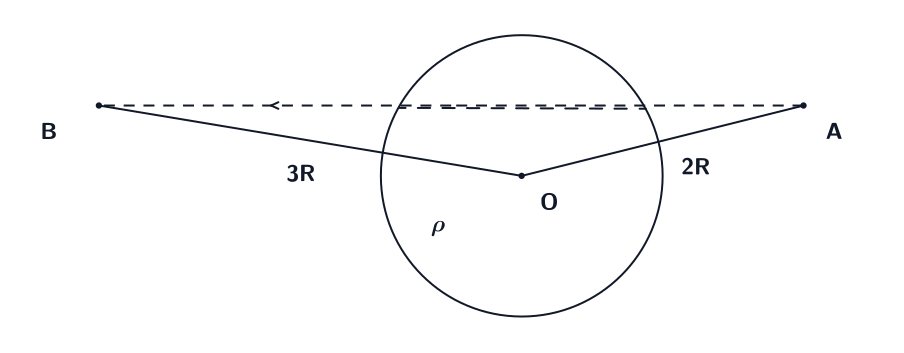
Answer and explanation
Answer: (4) · Electrostatic Potential and Capacitance
Work done in moving a charge slowly is path-independent and depends only on the endpoint potentials, so the detour through the tube is a red herring. Both and lie OUTSIDE the sphere, where with . Then , giving . NCERT Class 12, Electrostatic Potential and Capacitance.
Why the other options are wrong:
- (1) uses only the from position and drops the volume factor
- (2) computes but forgets the carried by the sphere's total charge
- (3) integrates the internal field along the tube as if the endpoints were inside the sphereConsider three media , and with refractive indices 1, 1.25, and 1.5 respectively. The medium having a thickness of 5 cm is placed between extended media and as shown in the figure. An object is placed at the centre of medium . If viewed from medium near the normal direction, the apparent depth of is . For similar observation from medium , the apparent depth is . The value of , in cm, is:
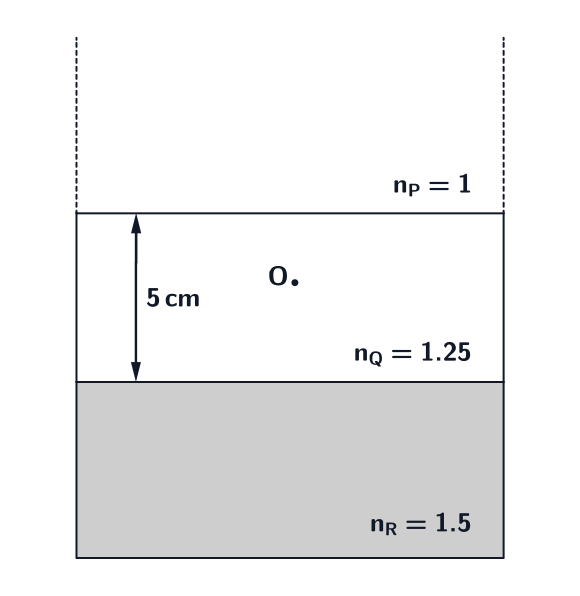
Answer and explanation
Answer: (2) · Ray Optics and Optical Instruments
For near-normal viewing across a plane boundary, apparent depth real depth , and the object sits 2.5 cm from each face. Viewed from : . Viewed from : . Hence . Looking in from the DENSER side makes the object appear farther away, which is the sense check here. NCERT Class 12, Ray Optics and Optical Instruments (refraction at plane surfaces).
Why the other options are wrong:
- (1) assumes the symmetric placement of the object makes the two apparent depths equal, ignoring the different observer media
- (3) uses the full 5 cm thickness instead of the 2.5 cm from the object to each face
- (4) computes alone and reports it as the differenceA frictionless circular wire of unit radius is fixed on the horizontal plane. Two-point particles of unit mass start moving simultaneously from point with identical uniform angular speeds in opposite directions, and meet again at point . During this time, which of the following figures schematically represent the magnitude of the total linear momentum of the system, as a function of ?
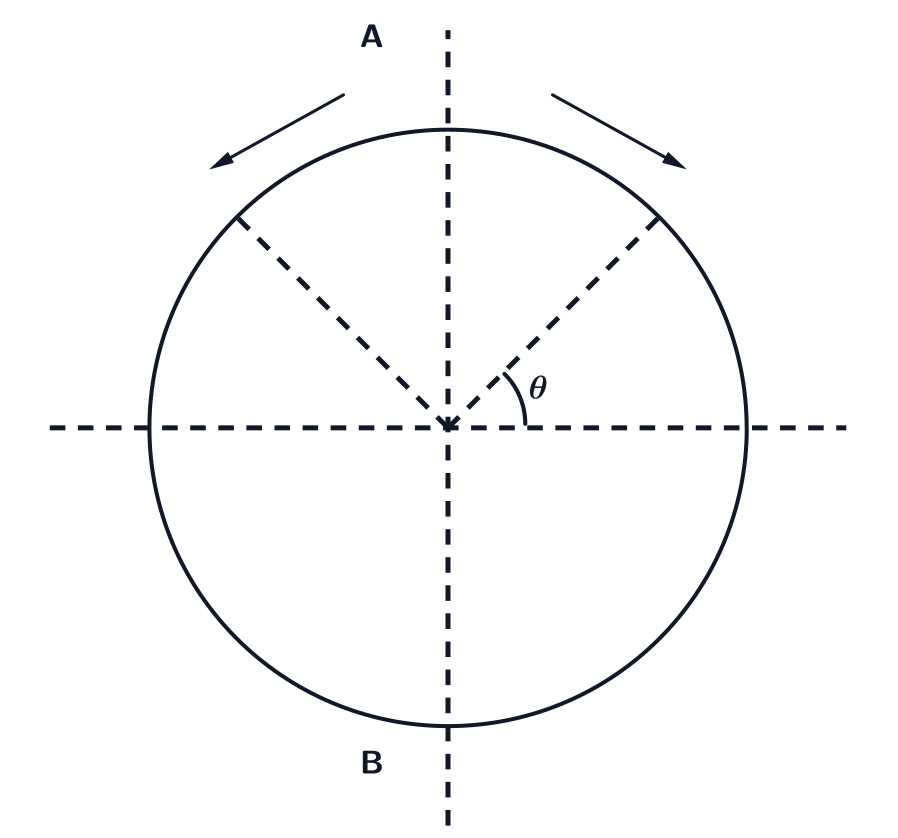
Answer and explanation
Answer: (3) · System of Particles and Rotational Motion
By symmetry the two particles sit at mirror-image angles about the vertical, so their tangential velocities have equal and opposite horizontal components while their vertical components add. Writing the particles at and , the resultant works out to , which is zero at the start (), peaks when the particles are diametrically opposite the meeting point (), and returns to zero as they collide at . That single smooth hump is option (3). NCERT Class 11, System of Particles and Rotational Motion (motion of the centre of mass).
Why the other options are wrong:
- (1) assumes momentum is conserved as a constant because the SPEEDS are constant, forgetting that momentum is a vector whose direction keeps changing
- (2) inverts the phase - takes , i.e. maximum where the particles start rather than where they are farthest apart
- (4) assumes falls off linearly with angle instead of following the cosine of the half-separationThe temperature of a metallic sphere of radius is increased by a small amount . If the linear coefficient of thermal expansion of the metal is , the approximate increase in the volume of the sphere is:
Answer and explanation
Answer: (3) · Thermal Properties of Matter
For small expansions the coefficient of volume expansion is . Hence . Equivalently, differentiating gives with . NCERT Class 11, Thermal Properties of Matter.
A cylindrical cork of uniform density floats in a liquid of density . If the cork is depressed slightly and released, it oscillates harmonically with time period . If the same cork floats in another liquid of density , then the similar oscillation has time period . The value of is:
Answer and explanation
Answer: (4) · Oscillations
Depressing the cork by creates an extra buoyant force directed back towards equilibrium, so the effective spring constant is and . With and unchanged, . Doubling the period therefore requires the density to fall by a factor of four: . NCERT Class 11, Oscillations (simple harmonic motion (SHM) examples).
One main scale division of a Vernier calliper is equal to 1 mm and the number of divisions on the Vernier scale is 10. When both the jaws touch each other, the Vernier scale shifts to the left of zero of the main scale in such a way that 4th Vernier division coincides with a division of the main scale. If this Vernier calliper measures the length of the wire to be 1 cm, the actual length of the wire is :
Answer and explanation
Answer: (4) · Units and Measurements
NTA dropped this question because no printed option matched the correct answer; option (4) is corrected here to 1.06 cm. Working: least count . The Vernier zero lies to the left of the main-scale zero, so the zero error is negative. With the 4th Vernier division coinciding, zero error . Therefore true length . NCERT Class 11, Units and Measurements (least count and instrumental error).
A solid sphere of radius and mass is attached at a point to a smaller solid sphere of radius and mass . Assume that the line joining their centres lies along the horizontal. The moment of inertia of the system calculated about a vertical axis passing through the centre of is and that calculated about a vertical axis passing through the centre of is . The difference is:
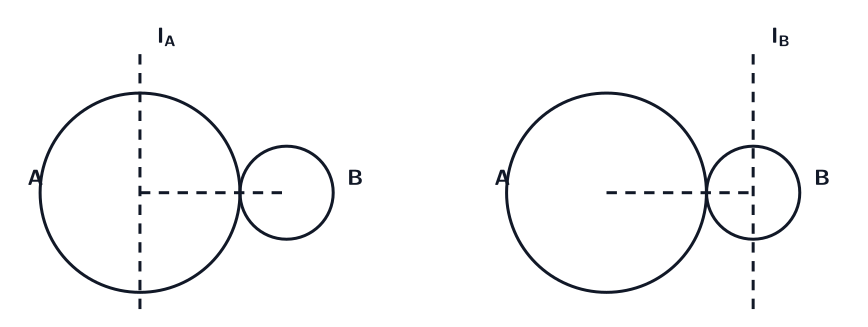
Answer and explanation
Answer: (2) · System of Particles and Rotational Motion
The spheres touch, so their centres are separated by . About the axis through : ; about the axis through : . The two spin terms are common to both and cancel, leaving , a negative quantity as expected since the heavier sphere sits off-axis in the second case. NCERT Class 11, System of Particles and Rotational Motion (parallel axis theorem).
Why the other options are wrong:
- (1) gets the separation right but flips the sign - attaches the parallel-axis term to the wrong body in each case
- (3) uses as the centre separation, as if the small sphere were embedded in the large one rather than attached externally
- (4) assumes the moment of inertia is independent of the choice of axis, ignoring the parallel axis theorem altogetherConsider a spring-mass simple harmonic oscillator in one dimension. The mass of the particle is kg and the spring constant is . At a given instant, the extension of the spring is -meter and the speed of the particle is . On the - plane, if the graph of as a function of is a circle, then the correct option is:
Answer and explanation
Answer: (2) · Oscillations
Conservation of energy gives , which rearranges to - an ellipse in the plane. An ellipse becomes a CIRCLE only when the two semi-axes are equal, i.e. , which requires numerically. NCERT Class 11, Oscillations (energy in simple harmonic motion).
The lens combination as shown in the figure, consists of two lenses, and , of the focal lengths +10 cm and -10 cm, respectively. The position of the image formed is:
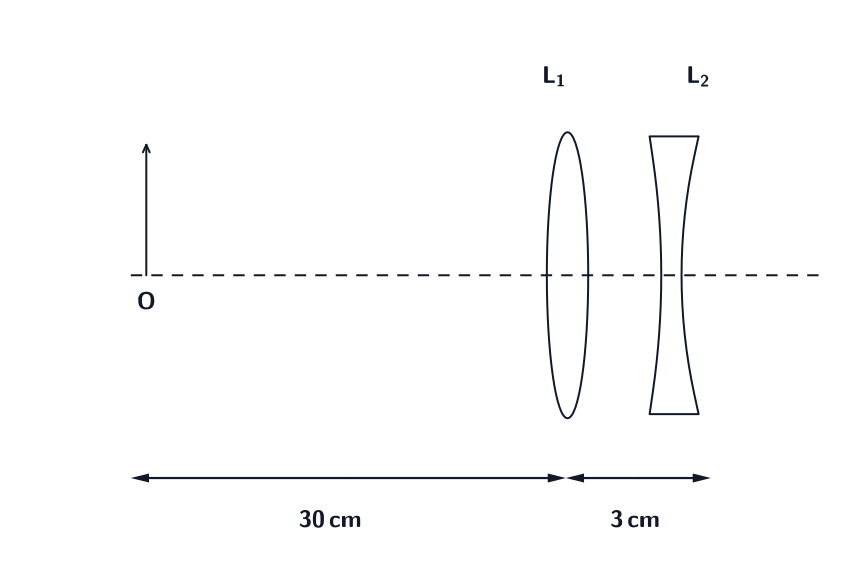
Answer and explanation
Answer: (2) · Ray Optics and Optical Instruments
For the convex lens, and give , so its image lies 15 cm to its right. The lenses are 3 cm apart, so that image sits 12 cm BEYOND the concave lens and acts as a VIRTUAL OBJECT with . Then , giving : 60 cm to the left of the concave lens. NCERT Class 12, Ray Optics and Optical Instruments (combination of thin lenses).
Why the other options are wrong:
- (1) uses the thin-lens-in-contact formula , which fails for a 3 cm separation
- (3) keeps the sign of positive, missing that a negative places a virtual image on the incoming side
- (4) gets the magnitude right but assigns the image to the wrong side of the concave lensAn ac voltage Volt is applied to a series LCR circuit. Then the current amplitude in this circuit is: (Given : , , )
Answer and explanation
Answer: (1) · Alternating Current
With , the reactances are and . Since the circuit is at RESONANCE, the reactances cancel and the impedance reduces to . The current amplitude is then . NCERT Class 12, Alternating Current (LCR series circuit and resonance).
A thin horizontal disc is rotating about a vertical axis passing through its fixed centre . Its angular momentum is and computed about points and , respectively, with . The value of is:
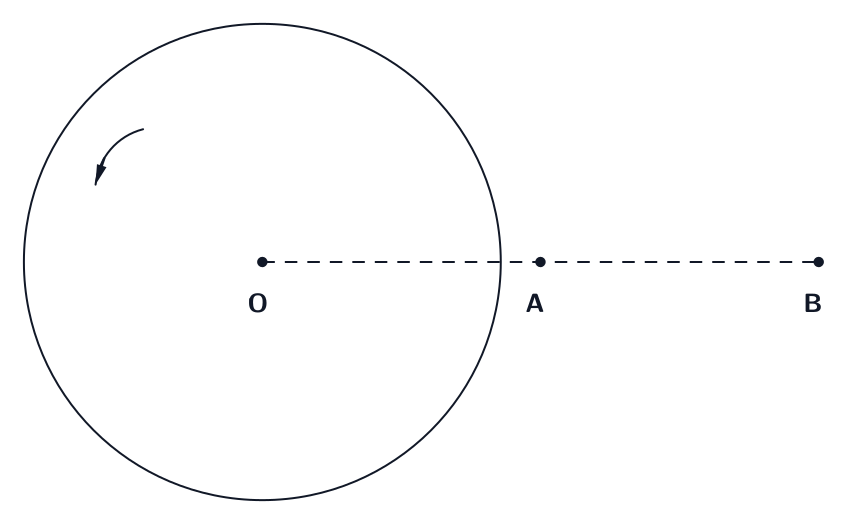
Answer and explanation
Answer: (3) · System of Particles and Rotational Motion
The angular momentum of a rigid body about any point splits as . Here the centre is FIXED, so and the orbital term vanishes for every reference point. Only the spin term survives, which is the same whether you compute about or , so the ratio is 1 regardless of the distances. NCERT Class 11, System of Particles and Rotational Motion (angular momentum of a rotating rigid body).
Why the other options are wrong:
- (1) assumes , importing an inverse-square intuition that does not apply
- (2) assumes scales inversely with the distance to the reference point
- (4) assumes grows in proportion to the distance, as it would for a single particle moving in a straight lineA conducting loop of finite resistance lies on the plane. There is a constant magnetic field in the direction. The area of the loop varies with time , as in appropriate units. The figure that correctly indicates the qualitative behaviour of the power dissipated in the loop as a function of time is:
Answer and explanation
Answer: (2) · Electromagnetic Induction
Faraday's law gives , so the dissipated power is . Because is MAXIMUM at and touches zero at , the correct graph starts at a peak and dips to zero, unlike a curve which would start at zero. is never negative because the electromotive force (emf) is squared. NCERT Class 12, Electromagnetic Induction (Faraday's law).
Why the other options are wrong:
- (1) differentiates to rather than , producing a curve that starts at zero
- (3) assumes the constant field means a constant emf, forgetting that it is the CHANGING area that drives induction
- (4) confuses the growing area with growing power, ignoring that the flux change is periodic and boundedA point charge is placed inside a cavity within a solid isolated conducting sphere. Consider points , and as shown in the figure, where the magnitudes of the electric fields are , , , respectively. The points and are at the same distance from the center of the solid sphere. The correct option is :
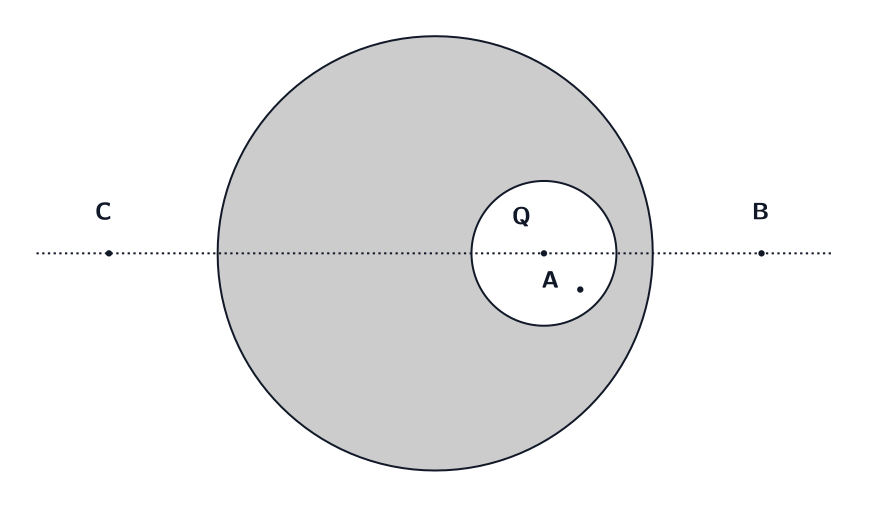
Answer and explanation
Answer: (2) · Electric Charges and Fields
Point lies in the empty cavity, not in the conducting material, so the field of is fully present there and . The induced on the cavity wall and on the outer surface arrange themselves so that the outer surface charge is UNIFORM regardless of where the cavity sits, so outside the sphere the field is exactly that of a point charge at the centre. Since and are equidistant from that centre, . NCERT Class 12, Electric Charges and Fields (electrostatics of conductors).
Why the other options are wrong:
- (1) confuses the cavity with the conducting material - the field vanishes inside the METAL, not inside the hollow
- (3) combines the cavity error with the idea that the off-centre cavity biases the external field towards
- (4) correctly sees but wrongly assumes the external field is skewed away from the cavity sideConsider a fixed uniformly charged insulating sphere with radius and total charge . A point charge () with mass is released from rest at a distance of from the centre of the charged sphere. When the point charge reaches the surface of the sphere, its speed is: ( is the permittivity of vacuum, neglect gravitational forces).
Answer and explanation
Answer: (3) · Electrostatic Potential and Capacitance
Outside the sphere the potential energy of the attracting pair is . Energy conservation from (at rest) to gives . Solving, . NCERT Class 12, Electrostatic Potential and Capacitance.
In Geiger-Marsden experiment, the number of scattered -particles is plotted as a function of scattering angle . Which of the following options represents the correct plot?
Answer and explanation
Answer: (3) · Atoms
Rutherford's scattering formula gives , so the count is enormous for small deflections and drops by several orders of magnitude as increases - which is exactly why the plots are drawn on a logarithmic vertical axis. The experimental finding was that the overwhelming majority of -particles pass almost undeviated, with only a tiny fraction turned through large angles by the nucleus. NCERT Class 12, Atoms (alpha-particle scattering).
Why the other options are wrong:
- (1) reverses the physics, implying most particles suffer large deflections and the atom is uniformly dense
- (2) captures the falling trend but far too weakly - it misses that the drop spans many orders of magnitude
- (4) invents a preferred scattering angle, as if the nucleus deflected particles by a characteristic amountConsider two circuits, (A) and (B), each having two resistors. One of them has a positive temperature coefficient of resistance, , while the other one has a negative temperature of coefficient, , as shown in the figure. The current through these circuits are denoted by and . At initial temperature, the resistance of the two resistors is . As the temperature is increased, the correct option that describes the variation of current in these circuits is:
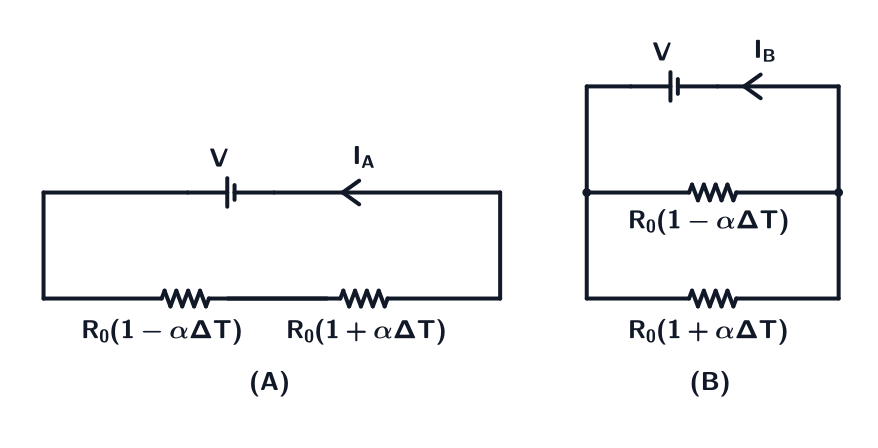
Answer and explanation
Answer: (1) · Current Electricity
In circuit (A) the resistors are in SERIES, so - the two temperature terms cancel exactly and is unchanged. In circuit (B) they are in PARALLEL, giving , which decreases as grows because of the term, so increases. NCERT Class 12, Current Electricity (temperature dependence of resistivity).
Why the other options are wrong:
- (2) assumes the series combination must heat up and resist more, missing the exact cancellation between and
- (3) swaps the two circuits, applying the parallel result to (A) and the series result to (B)
- (4) spots the cancellation in series and wrongly assumes the same cancellation holds for reciprocals in parallelConsider that , , represents Stefan-Boltzmann constant, Boltzmann constant and Wien's displacement law constant, respectively. The dimension of is
Answer and explanation
Answer: (1) · Units and Measurements
Take each constant from its defining equation. Stefan's law makes a power per unit area per , so . Boltzmann's constant is an energy per kelvin, , and Wien's constant is a wavelength times a temperature, . Multiplying, . NCERT Class 11, Units and Measurements; the constants themselves come from Thermal Properties of Matter.
An electromagnetic wave travelling in a lossless dielectric medium having a dielectric constant, , has the electric field, where is the amplitude and is the wave vector. Among the following options, the incorrect choice is
Answer and explanation
Answer: (2) or (3) (NTA accepted more than one option) · Electromagnetic Waves
NTA accepted both option (2) and option (3) as answers. The refractive index is , so , making option (1) correct. From , the frequency is , hence , not 300 m; therefore option (2) is incorrect. Option (3) is also incorrect as printed: the magnetic field should be , whereas the option uses . Option (4) is correct because represents propagation along . NCERT Class 12, Electromagnetic Waves.
One mole of an ideal monatomic gas undergoes a cyclic process as shown in the figure. The total heat supplied to the gas is:
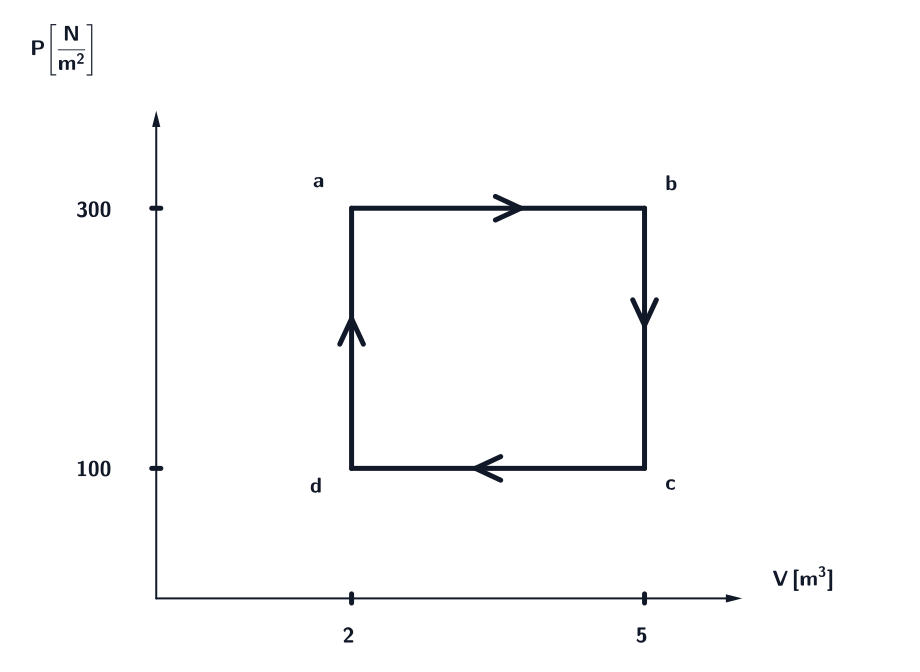
Answer and explanation
Answer: (3) · Thermodynamics
Over a complete cycle the gas returns to its initial state, so and the first law reduces to . The cycle is a rectangle on the diagram between and and and , traversed clockwise, so the work done by the gas is the enclosed area . Hence 600 J of heat is supplied. NCERT Class 11, Thermodynamics (cyclic process).
Why the other options are wrong:
- (1) miscounts one side of the rectangle, typically taking
- (2) computes only the net heat of the two isobaric legs and omits the isochoric contributions to the balance
- (4) adds the areas under the two isobaric legs instead of taking their difference, double-counting the return pathConsider that an electron is revolving in an excited state of Hydrogen atom with velocity . The radius of the orbit is m. The value of is: [Take the mass of electron to the kg, charge of electron = C and ]
Answer and explanation
Answer: (4) · Atoms
In a Bohr orbit the Coulomb attraction supplies the centripetal force: , which rearranges to . Substituting , the numerator is and the denominator is . Their ratio is , so . NCERT Class 12, Atoms (Bohr model).
A car travels on a circular racetrack of radius 50 m, which is banked at an angle . If the car travels at a speed 10 , then the wear and tear on its tyres is minimum. Taking the acceleration due to gravity to be 10 , the value of is:
Answer and explanation
Answer: (1) · Laws of Motion
Minimum wear and tear is the exam's way of saying no sideways friction is needed, i.e. the car is at the optimum (design) speed of the banked track. Then the horizontal component of the normal reaction alone supplies the centripetal force, giving , so . NCERT Class 11, Laws of Motion (motion on a banked road).
Three identical p-n junction diodes , , and are connected across a battery as shown in the figure. If the width of the depletion regions of , and are , and , respectively, then the correct option is:
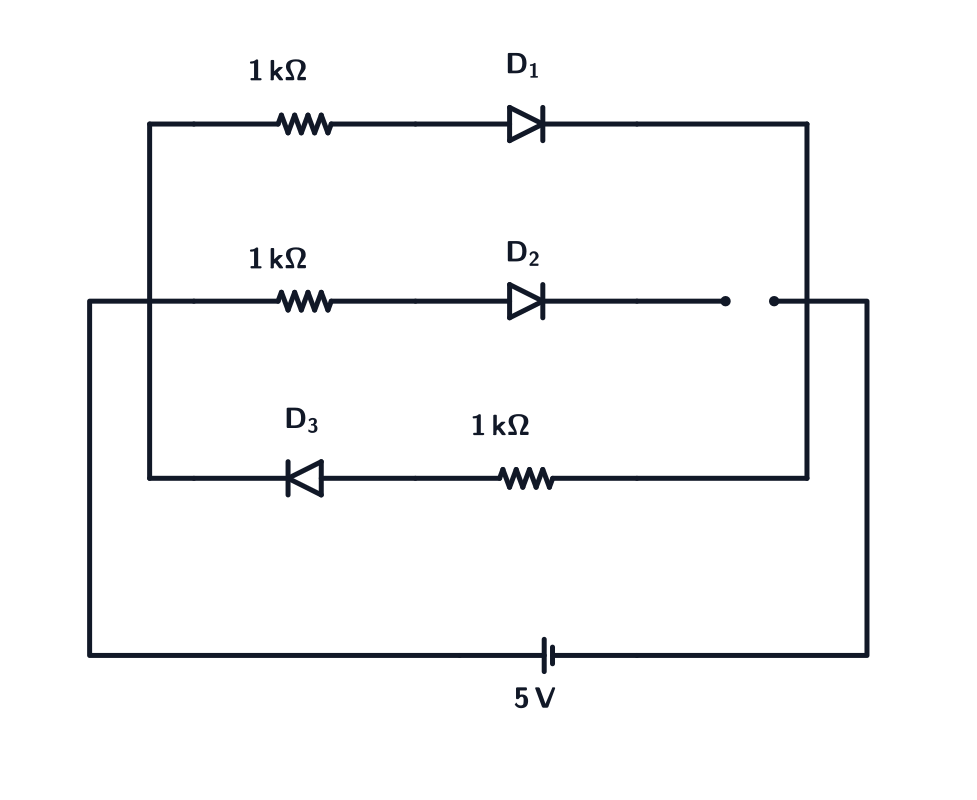
Answer and explanation
Answer: (3) · Semiconductor Electronics
Depletion width is set by the net potential barrier at the junction. Forward bias lowers the barrier and NARROWS the depletion layer; reverse bias raises it and WIDENS the layer; an unbiased junction sits at its equilibrium width in between. In this circuit is forward biased (narrowest), 's branch carries no bias so it keeps its equilibrium width, and is reverse biased (widest), giving . NCERT Class 12, Semiconductor Electronics (p-n junction).
Why the other options are wrong:
- (1) reverses the bias effect, assuming forward bias widens and reverse bias narrows the depletion region
- (2) assumes forward and reverse bias shift the width by equal and opposite amounts so that and coincide
- (4) treats the unbiased diode as the extreme case rather than the intermediate oneThe following table presents the part of the electromagnetic spectrum and their corresponding major applications. The correct option is:
List I
List II
P) Microwave
I) For purifying the water
Q) UV rays
II) For warming the food
R) Gamma rays
III) For AM and FM communication systems
S) Radio wave
IV) For treating the Cancer cells
Answer and explanation
Answer: (3) · Electromagnetic Waves
Microwaves are absorbed by water molecules in food and heat it, so P-II. Ultraviolet radiation is germicidal and is used in water sterilisation, so Q-I. Gamma rays carry enough energy to destroy malignant tissue and are used in radiotherapy, so R-IV. Radio waves are the carriers in amplitude modulated (AM) and frequency modulated (FM) broadcasting, so S-III. NCERT Class 12, Electromagnetic Waves (electromagnetic spectrum).
Bob of mass at rest is hanging vertically from the ceiling via a massless string of length 10 m, as shown in the figure. Point mass of mass travelling horizontally with speed 10 hits bob elastically. The bob rises meter after the collision. Taking the acceleration due to gravity and neglecting the size of the bob, the value of is:
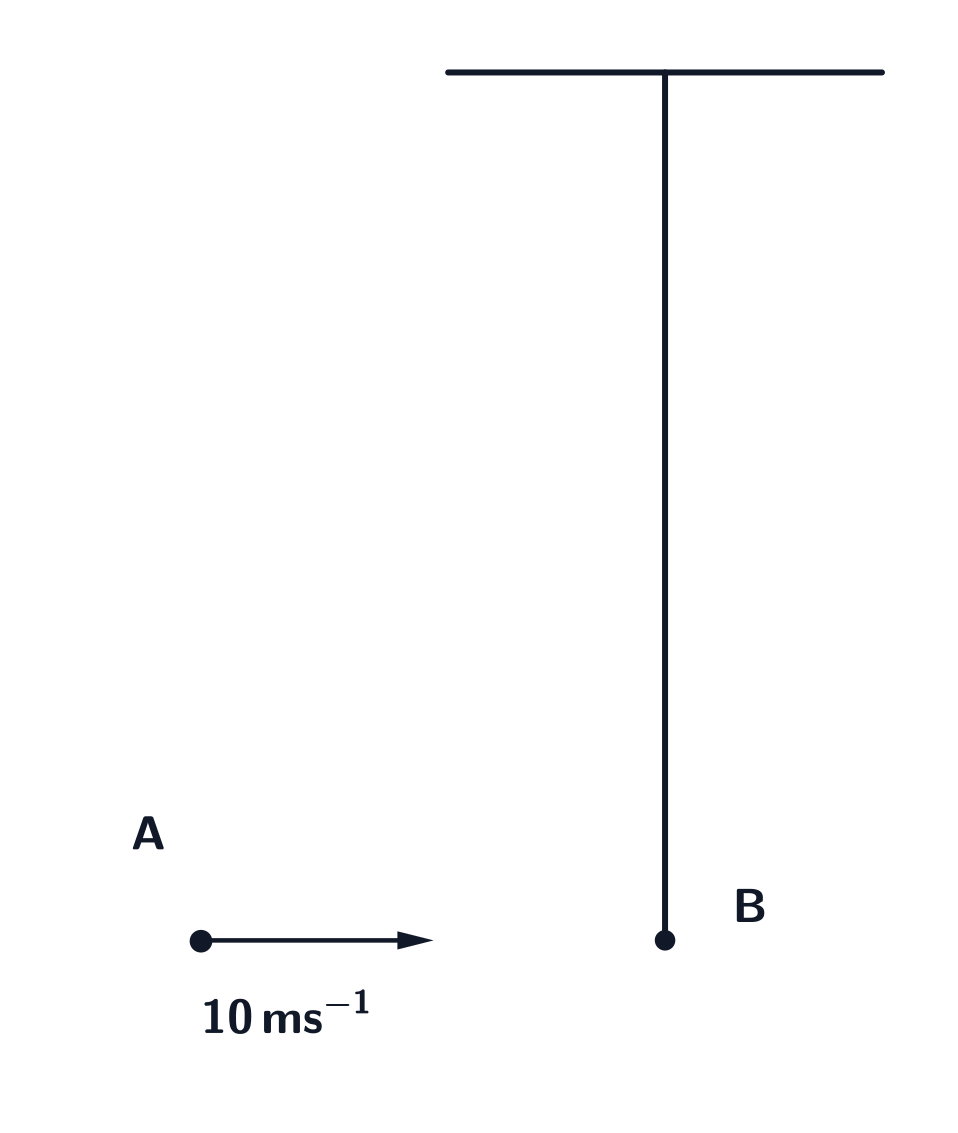
Answer and explanation
Answer: (3) · Work, Energy and Power
In a head-on ELASTIC collision between equal masses the velocities are simply exchanged, so stops dead and leaves the collision at the full 10 . Energy conservation on the swing then gives . The bob rises only 5 m, less than the 10 m string length, so it stays below the horizontal through the point of suspension and the string never goes slack. NCERT Class 11, Work, Energy and Power (collisions).
Why the other options are wrong:
- Option (1) (8 m) and option (2) (7 m) are higher than 5 m. Even if took all the kinetic energy of , it could rise only . A greater height needs energy the collision never supplied.
- Option (4) (2.5 m) gives only half the kinetic energy of , as if the energy were shared equally between the two masses. That halves the height. In an elastic collision of equal masses, all of it passes to .An ideal gas is made of polyatomic molecules. Each of the molecules has three translational, three rotational and number of vibrational modes. If the ratio of heat capacities of the gas is 8/7, then the value of is:
Answer and explanation
Answer: (1) · Kinetic Theory
Equipartition assigns to each translational and rotational mode but a full to each vibrational mode, so and . Setting gives , so . NCERT Class 11, Kinetic Theory (law of equipartition of energy).
For the following reaction sequence, choose the correct option.
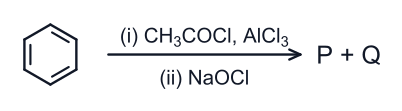
Answer and explanation
Answer: (3) · Aldehydes, Ketones and Carboxylic Acids
Friedel-Crafts acylation converts benzene to acetophenone, and sodium hypochlorite then carries out the haloform reaction on the methyl ketone, giving sodium benzoate (P) and chloroform (Q). Acidifying sodium benzoate liberates benzoic acid, and chloroform slowly oxidises in air and light to phosgene, , which is highly poisonous - the reason chloroform is stored in dark bottles with a little ethanol. NCERT Class 12, Aldehydes, Ketones and Carboxylic Acids (haloform reaction); chloroform's oxidation is in Haloalkanes and Haloarenes.
Why the other options are wrong:
- (1) identifies P correctly but calls chloroform a primary alcohol, confusing the haloform product with a reduction product
- (2) chloroform contains no ring and is not aromatic, so both products cannot be aromatic
- (4) neither the carboxylate salt nor chloroform retains a C=O available as a carbonyl compound in the sense intendedGiven below are two statements. (Given : )
Statement I: is chiral.
Statement II: trans- is chiral.
In light of the above statements, choose the most appropriate answer from the options given below:Answer and explanation
Answer: (3) · Coordination Compounds
A tris-chelate of type has no plane or centre of symmetry and exists as the non-superimposable delta and lambda propeller forms, so is indeed chiral. For the bis-chelate , only the CIS isomer is chiral; the TRANS isomer, with the two aqua ligands on opposite sides, possesses a plane of symmetry and is therefore achiral. Statement-II names the wrong isomer. NCERT Class 12, Coordination Compounds (isomerism).
The following carbocation is stabilized by the interaction of the empty p orbital with
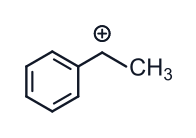
Answer and explanation
Answer: (1) · Organic Chemistry: Some Basic Principles and Techniques
Stabilising an electron-deficient centre means DONATING electron density into its empty p orbital, so the interacting orbitals must be filled. Two filled sets are available here: the filled orbitals of the benzene ring, which deliver resonance stabilisation to this benzylic cation, and the filled C-H orbitals of the adjacent methyl group, which supply hyperconjugation. Empty orbitals such as or have nothing to give. NCERT Class 11, Organic Chemistry: Some Basic Principles and Techniques (resonance and hyperconjugation).
Why the other options are wrong:
- (2) pairs the empty p orbital with other EMPTY orbitals, which cannot transfer any electron density
- (3) gets the contribution right but calls the hyperconjugating orbital ; it is the filled C-H orbital that donates
- (4) selects two antibonding, empty orbitals - the exact opposite of what a cation needsIn potash alum, the ratio of and ions is
Answer and explanation
Answer: (1) · p-Block Elements (Groups 13-14)
Potash alum is the double salt , most compactly written as . Each formula unit supplies one balanced against two sulphate ions (together with one ), so the ratio is 1 : 2. NCERT Class 11, The p-Block Elements (compounds of aluminium).
The correct statement about peptides and proteins is
Answer and explanation
Answer: (3) · Biomolecules
In a -pleated sheet the polypeptide chains lie stretched side by side, and the hydrogen bonds run BETWEEN neighbouring chains - intermolecular. This is the key structural contrast with the -helix, where the hydrogen bonds are intramolecular, formed within a single coiled chain. NCERT Class 12, Biomolecules (secondary structure of proteins).
The numbers 17.0145 and 21.0235 were rounded to three figures after the decimal point. The resulting numbers, respectively, are
Answer and explanation
Answer: (3) · Some Basic Concepts of Chemistry
Both numbers end in an exact 5 with nothing after it, which is the tie case, so the round-half-to-EVEN convention applies rather than always rounding up. In 17.0145 the digit to be retained is 4, already even, so it stays: 17.014. In 21.0235 the retained digit is 3, which is odd, so it is raised to the even value 4: 21.024. NCERT Class 11, Some Basic Concepts of Chemistry (significant figures).
The correct order of solubility of the given salts in water at 298 K is (Given at 298 K: = ; = ; = )
Answer and explanation
Answer: (4) · Equilibrium
values can only be compared directly when the salts share the same stoichiometry, so each must first be converted to molar solubility s. For the 1:1 salt , gives . For the 1:2 salts, : gives and gives . Ranking these, . NCERT Class 11, Equilibrium (solubility equilibria).
Among the following options, the correct trend in the electron gain enthalpy is
Answer and explanation
Answer: (3) · Classification of Elements and Periodicity in Properties
Chlorine, not fluorine, releases the most energy on gaining an electron. The 2p subshell of fluorine is so compact that the incoming electron meets strong inter-electronic repulsion, which offsets the favourable nuclear attraction; chlorine's larger 3p shell has no such penalty. Down the rest of the group the value falls with increasing size, giving Cl > F > Br > I. NCERT Class 11, Classification of Elements and Periodicity in Properties.
Assertion (A): For an ideal solution formed by mixing liquids and , and
Reason (R): No interactions occur between and
In the light of the above statements, choose the most appropriate answer from the options given below.Answer and explanation
Answer: (3) · Solutions
The assertion is a defining property of an ideal solution: because the molecules pack and interact just as they did before mixing, neither heat nor volume changes on mixing. The reason misstates why. Interactions certainly DO occur between P and Q - the requirement is that the P-Q interaction be equal in strength to the P-P and Q-Q interactions it replaces, so the energy terms cancel. A solution with no intermolecular forces at all would be a gas, not a liquid mixture. NCERT Class 12, Solutions (ideal and non-ideal solutions).
The amino acid that gives a red-blood colour on treating its sodium fusion extract with sodium nitroprusside is
Answer and explanation
Answer: (3) · Biomolecules
The sodium nitroprusside test detects SULPHUR: fusion with sodium converts organic sulphur to sulphide, which reacts with nitroprusside to give the intensely coloured complex . Of the four amino acids listed, only methionine contains sulphur - leucine is purely hydrocarbon in its side chain, while threonine and serine carry hydroxyl groups. NCERT Class 12, Biomolecules (amino acids); the detection method is from NCERT Class 11, Organic Chemistry: Some Basic Principles and Techniques.
The standard electrode potential (E°) for the half-cell reaction at 298 K is (Given : E°() = -0.04 V and E°() = -0.44 V at 298 K)
Answer and explanation
Answer: (2) · Electrochemistry
Electrode potentials are NOT additive when the electron counts differ; the additive quantity is . For , ; for , . Subtracting, , and since , . NCERT Class 12, Electrochemistry (electrode potential and Gibbs energy).
In an acidic medium, 10 mL of 0.25 M oxalic acid is titrated with solution. If the volume of solution required to reach end point is 10 mL, the strength of the solution is
Answer and explanation
Answer: (1) · Redox Reactions
Oxalate is oxidised by two electrons () so its n-factor is 2, while permanganate in ACIDIC medium is reduced by five electrons () so its n-factor is 5. Equating equivalents, , giving . NCERT Class 11, Redox Reactions (redox titrations).
According to crystal field theory, the correct order of ligands with respect to their decreasing order of field strength is
Answer and explanation
Answer: (1) · Coordination Compounds
The spectrochemical series orders ligands by the size of the crystal field splitting they produce. Carbon monoxide is the strongest field ligand in this set because it accepts electron density into its orbitals; ammonia follows as a stronger sigma donor than water; and chloride, being a weak-field pi donor, is the weakest. The accepted sequence is . NCERT Class 12, Coordination Compounds (crystal field theory).
Two moles of an ideal gas undergo free expansion from 10 L to 100 L at 300 K. The values of and are (R is universal gas constant)
Answer and explanation
Answer: (4) · Chemical Thermodynamics
Free expansion is into vacuum, so no work is done and no heat is exchanged: , . The surroundings are therefore completely untouched and . Entropy is a STATE function, so the system's change is computed along any reversible path with the same endpoints: . The net positive total confirms the irreversibility. NCERT Class 11, Thermodynamics (entropy and spontaneity).
For the zero-order reaction 2A → B, the rate constant is . If the initial concentration of A is 2 M, then the time taken to complete 75% of the reaction will be
Answer and explanation
Answer: (2) · Chemical Kinetics
The rate of REACTION is defined as because of the stoichiometric coefficient 2, so A itself disappears at per minute. Integrating, . Completing 75% means 1.5 M of A has been consumed, so and . NCERT Class 12, Chemical Kinetics (integrated rate equation for zero order).
Given below are two statements: One is labelled as Assertion A and the other is labelled as Reason R.
Assertion (A): Generally, 3d transition metals have high melting points.
Reason (R): Involvement of 3d-electrons in addition to 4s-electrons in the interatomic metallic bonding.
In light of the above statements, choose the most appropriate answer from the options given below:Answer and explanation
Answer: (1) · The d- and f-Block Elements
Melting point tracks the strength of the metallic bond, which depends on how many electrons each atom contributes to the delocalised sea. In s-block metals only the ns electrons participate, but in the 3d series the unpaired 3d electrons join the 4s electrons in bonding, producing much stronger interatomic attraction and correspondingly high melting points. The trend peaks near the middle of the series, where the number of unpaired d electrons is greatest. R is therefore the correct explanation of A. NCERT Class 12, The d- and f-Block Elements.
For a salt , which is a strong electrolyte, the plot of versus has a slope of -90.0 S at 298 K. At 0.01 M concentration of , the value of is 145.0 S . The limiting molar conductivity of ion (, in S ) at 298 K will be (Given : = 74.0 S )
Answer and explanation
Answer: (1) · Electrochemistry
For a strong electrolyte the Debye-Huckel-Onsager relation is , where the plot's slope is . At , , so . Kohlrausch's law then gives . NCERT Class 12, Electrochemistry (variation of conductivity with concentration).
The amount of carbon dioxide evolved upon complete combustion of 116 g of n-butane is (Given: atomic mass in amu H = 1, C = 12 and O = 16)
Answer and explanation
Answer: (1) · Some Basic Concepts of Chemistry
n-Butane is with molar mass 58 g/mol, so 116 g is exactly 2 mol. The balanced combustion yields 4 mol of per mole of butane, hence 8 mol here. Mass of . NCERT Class 11, Some Basic Concepts of Chemistry (stoichiometry).
For an elementary chemical reaction, the Arrhenius plot is given below.
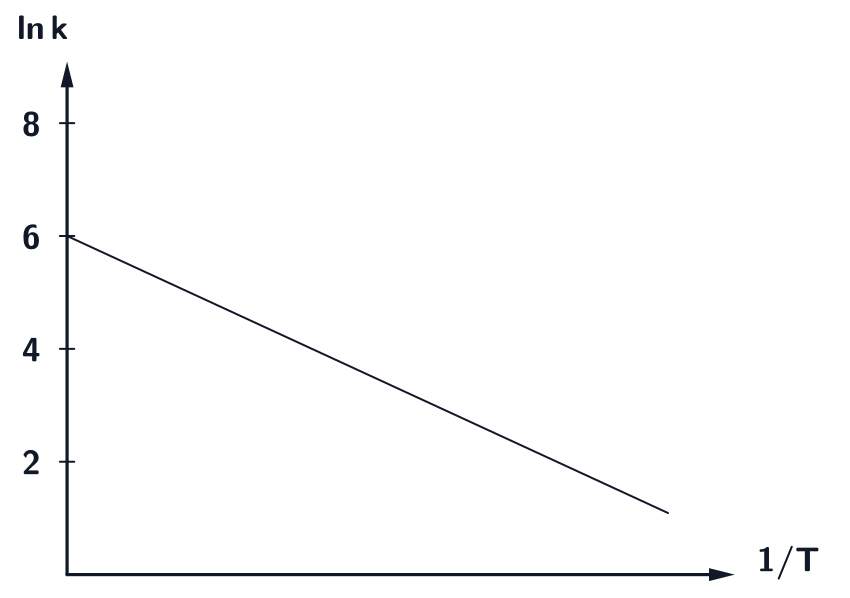
If the energy of activation is 6.64 kJ and , the temperature at which the rate constant becomes , is
Answer and explanation
Answer: (3) · Chemical Kinetics
In logarithmic form the Arrhenius equation is , a straight line of slope whose intercept on the axis is . The graph shows that intercept at 6, so . Setting gives , hence and . NCERT Class 12, Chemical Kinetics (temperature dependence of rate).
Why the other options are wrong:
- Option (1): at 125 K, , so , not 2
- Option (2): at 150 K, , so , not 2
- Option (4): at 250 K, , so , not 2Given below are two statements.
Statement I: Heating with concentrated and results in oxidation of Mn.
Statement II: Heating with concentrated and results in reduction of Mn.
In light of the above statements, choose the most appropriate answer from the options given below.Answer and explanation
Answer: (4) · p-Block Elements (Groups 15-18)
In both reactions acts as the OXIDISING agent on the halide, so manganese itself goes from +4 down to +2 - it is REDUCED, not oxidised. Statement-I therefore states the opposite of what happens and is wrong, while Statement-II describes the same reduction correctly for the iodide. This is the classic laboratory route to chlorine, . NCERT Class 12, The p-Block Elements (Group 17, preparation of chlorine).
Among the species given below, the spin-only magnetic moment is highest for (Given: Atomic number of Ti = 22, Mn = 25, Fe = 26 and Co = 27)
Answer and explanation
Answer: (1) · Coordination Compounds
All four are octahedral with strong-field or moderate-field ligands, so the electrons pair up in before entering . Counting d electrons: is , giving low-spin with TWO unpaired electrons; is , giving with one; is , giving with none; is with one. Since rises with n, the manganese complex has the highest moment at about 2.83 Bohr magneton (BM). NCERT Class 12, Coordination Compounds.
The lanthanide ion having four unpaired electrons is (Given : Atomic numbers of Ce = 58, Nd = 60, Tb = 65 and Ho = 67)
Answer and explanation
Answer: (4) · The d- and f-Block Elements
Lanthanoid tripositive ions have the configuration , where n is the atomic number minus 57. That gives , , and . Filling seven f orbitals by Hund's rule, places three pairs and leaves FOUR unpaired electrons, so is the answer. NCERT Class 12, The d- and f-Block Elements (lanthanoids).
The formula of tetraammineaquachloridocobalt(III) chloride is
Answer and explanation
Answer: (4) · Coordination Compounds
The name lists the coordination sphere first: four ammine, one aqua and one chlorido ligand around cobalt(III). Charge balance inside the brackets gives , so two chloride counter-ions are needed outside to neutralise the complex cation. The word 'chloride' at the end names those counter-ions, not a ligand. NCERT Class 12, Coordination Compounds (IUPAC nomenclature).
Consider the reversible processes for 1.0 mol of an ideal gas as shown in the figure.
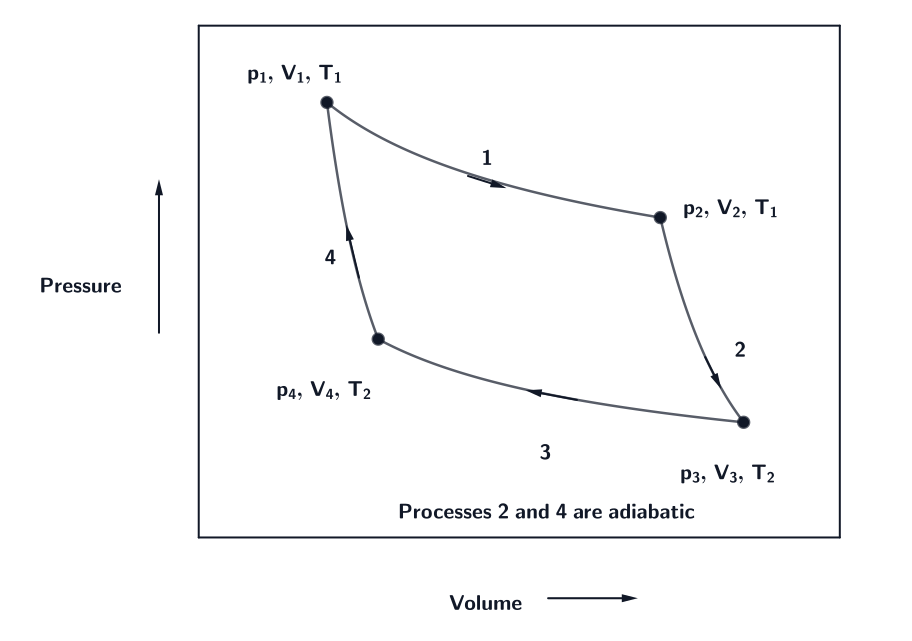
, , and represent work done (in calories) in the processes 1, 2, 3 and 4, respectively; and are changes in the internal energy for the processes 2 and 4, respectively. [use ] The correct option is
Answer and explanation
Answer: (1) · Chemical Thermodynamics
The cycle is a Carnot-type sequence: steps 1 and 3 are isothermal (at and ) and steps 2 and 4 are adiabatic. For a reversible isothermal change , so with and the two isothermal contributions add to exactly the expression in option (1). NCERT Class 11, Thermodynamics (work in reversible isothermal and adiabatic processes).
Why the other options are wrong:
- (2) for an adiabatic step so for EACH, giving ; the minus sign is the error
- (3) gets the sign of the isothermal work backwards and wrongly treats the adiabatic as zero
- (4) confuses over a cycle with ; the net work equals the enclosed area and is non-zeroGiven below are two statements: One is labelled as Assertion A and the other is labelled as Reason R.
Assertion (A): The first ionization enthalpy of O is lower than that of N and F.
Reason (R): The loss of an electron from O leads to stable half-filled p orbital
In light of the above statements, choose the most appropriate answer from the options given below:Answer and explanation
Answer: (1) · Classification of Elements and Periodicity in Properties
Oxygen is ; the fourth 2p electron must pair up in an already-occupied orbital and suffers extra repulsion, so it is comparatively easy to remove. Losing it gives with the half-filled configuration, which is extra stable through exchange energy. That is precisely why oxygen's first ionization enthalpy dips below nitrogen's despite nitrogen having a smaller nuclear charge, and stays below fluorine's. R therefore explains A. NCERT Class 11, Classification of Elements and Periodicity in Properties.
Consider the following statements about the solutions formed by mixing two liquids.
Statement I: An ideal solution thus formed obeys Raoult's law throughout the composition range.
Statement II: Mixture of chloroform and acetone shows negative deviation from Raoult's law.
Statement III: Mixture of aniline and phenol shows positive deviation from Raoult's law.Answer and explanation
Answer: (1) · Solutions
Statement I is the definition of ideality - Raoult's law must hold over the whole composition range, not merely at the dilute ends. Statement II is correct because chloroform's C-H is acidic enough to hydrogen-bond to acetone's carbonyl oxygen, an interaction stronger than either pure liquid had, so escaping tendency drops and the deviation is negative. Statement III is wrong for the same underlying reason: aniline and phenol also form strong hydrogen bonds with each other, which gives a NEGATIVE deviation, not a positive one. NCERT Class 12, Solutions.
One of the products formed in the following reaction is

Answer and explanation
Answer: (4) · Haloalkanes and Haloarenes
The reactants are cyclohexylmagnesium bromide and cyclohexylamine. A Grignard reagent is a very strong base and is destroyed by an acidic N-H proton: . The organic product derived from the Grignard reagent is therefore cyclohexane, option (4); no new C-C or C-N bond is formed. NCERT Class 12, Haloalkanes and Haloarenes (Grignard reagents).
Why the other options are wrong:
- (1) assumes the Grignard carbon substitutes at nitrogen; proton transfer occurs instead
- (2) assumes C-C coupling while retaining the amino group, but there is no electrophilic carbon or coupling catalyst
- (3) assumes direct coupling of the two cyclohexyl groups rather than acid-base proton transferThe correct statement is
Answer and explanation
Answer: (1) · p-Block Elements (Groups 13-14)
Boron sits in the second period, where only one 2s and three 2p orbitals are available for bonding - four orbitals in all - and there are no 2d orbitals to expand into. Its covalency therefore cannot exceed four, as in and . NCERT Class 11, The p-Block Elements (anomalous properties of boron).
A protein undergoes reversible thermal denaturation from its initial state to denatured state according to . At 60 °C, the concentrations of both and are equal at equilibrium, and the standard enthalpy change of denaturation is 666 kJ . The standard entropy change ( in kJ ) of the protein upon denaturation at 60 °C is closest to
Answer and explanation
Answer: (1) · Chemical Thermodynamics
Equal equilibrium concentrations mean , and since , the standard free energy change is zero. Setting gives , using . NCERT Class 11, Thermodynamics (Gibbs energy and equilibrium).
Match the species in List-I with their geometry in List-II.
List I
List II
P)
I) Tetrahedral
Q)
II) Square Planar
R)
III) Trigonal bipyramidal
S)
IV) Square pyramidal
Choose the correct answer from the options given below:
Answer and explanation
Answer: (2) · Chemical Bonding and Molecular Structure
has five bond pairs and no lone pair, so it is trigonal bipyramidal (P-III). has five bond pairs plus one lone pair; the lone pair occupies one octahedral position and pushes the shape to square pyramidal (Q-IV). is four bond pairs with no lone pair, hence tetrahedral (R-I). is a complex with the strong-field cyanide ligand, forcing hybridisation and a square planar geometry (S-II). NCERT Class 11, Chemical Bonding and Molecular Structure; NCERT Class 12, Coordination Compounds.
Given below are two statements.
Statement I : trans-But-2-ene upon treatment with in gives the following product.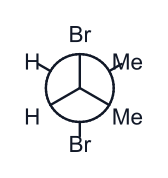
Statement II : cis-But-2-ene upon treatment with alkaline gives the following product.
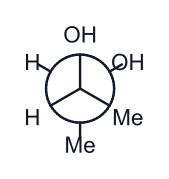
In the light of the above statements, choose the most appropriate answer from the options given below.
Answer and explanation
Answer: (4) · Hydrocarbons
Bromine in adds ANTI through a cyclic bromonium ion, so trans-but-2-ene gives meso-2,3-dibromobutane. The Newman projection drawn has the two Br atoms anti but the two methyl groups gauche. In the meso isomer, Br anti to Br puts Me anti to Me as well, so the drawing is the chiral (2R,3R) isomer. Statement I is wrong. Alkaline adds SYN through a cyclic manganate ester, and syn dihydroxylation of cis-but-2-ene does give meso-butane-2,3-diol, so Statement II is right. The rule worth remembering: for a symmetrically substituted alkene, anti addition to trans and syn addition to cis both give the meso product. NCERT Class 11, Hydrocarbons (addition reactions of alkenes).
Why the other options are wrong:
- (1) accepts Statement I by assuming bromination of trans-but-2-ene gives the chiral (2R,3R) product drawn, confusing anti addition to trans with anti addition to cis
- (2) rejects Statement II as well, missing that syn dihydroxylation of the cis alkene genuinely gives the meso diol
- (3) reverses both verdicts, applying syn stereochemistry to bromination and anti to permanganateConsider the following reaction sequences and choose the correct option.
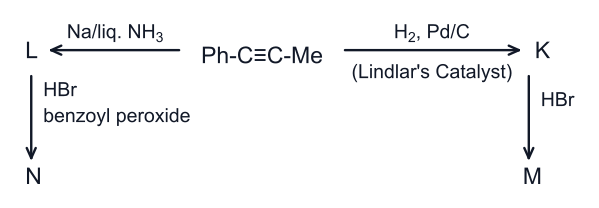
Answer and explanation
Answer: (1) · Hydrocarbons
Dissolving-metal reduction with /liq. proceeds through a trans vinyl radical anion and delivers the E (trans) alkene , whereas Lindlar hydrogenation adds both hydrogens to the same face and gives the Z (cis) alkene . Same formula, same connectivity, different arrangement about the double bond - geometrical isomers. The bromides are a different matter: forms by Markovnikov addition at the benzylic carbon while forms by peroxide-mediated anti-Markovnikov addition at the other carbon, so they are POSITIONAL isomers, not stereoisomers. NCERT Class 11, Hydrocarbons (alkynes and alkenes).
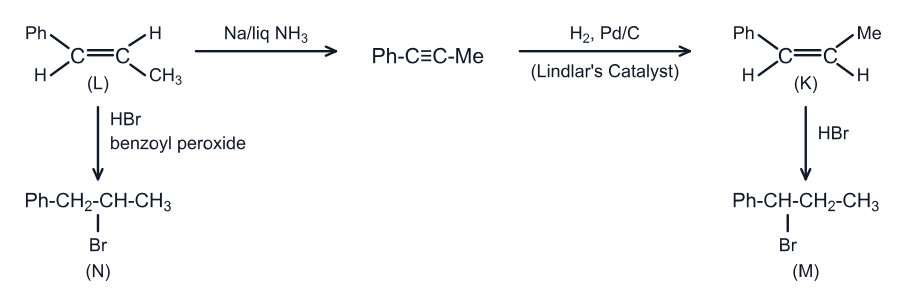
Why the other options are wrong:
- (2) enantiomers are non-superimposable mirror images; these alkenes are achiral diastereomers about a double bond
- (3) the two bromides differ in WHERE the bromine sits, which is constitutional isomerism, not geometrical
- (4) same error as (3) - different connectivity rules out any kind of stereoisomerismThe complex which has facial and meridional isomers is (Given : py = pyridine and en = )
Answer and explanation
Answer: (1) · Coordination Compounds
Facial and meridional isomerism is specific to octahedral complexes of the type . In the fac isomer the three identical ligands occupy one triangular face; in the mer isomer they lie in a plane through the metal. has exactly this 3:3 arrangement. NCERT Class 12, Coordination Compounds (geometrical isomerism).
Identify the reactions which give aniline as the major product.
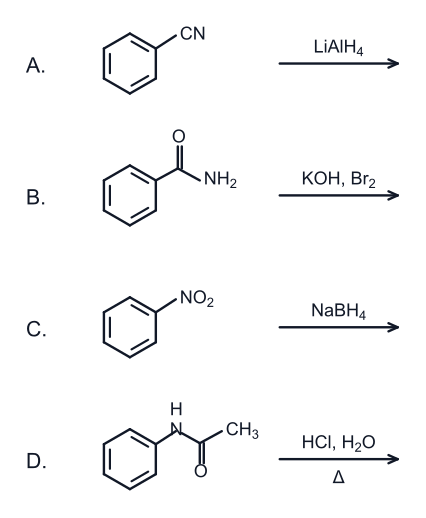
Choose the correct answer from the options given below.
Answer and explanation
Answer: (2) · Amines
Reaction B is the Hofmann bromamide degradation, which removes one carbon from an amide and delivers the amine with the nitrogen now bonded directly to the ring - aniline. Reaction D is simple acid hydrolysis of an anilide, cleaving the amide bond to regenerate aniline and acetic acid. Reaction A gives benzylamine, since reduces the nitrile carbon to and leaves an extra carbon in the chain, and reaction C fails because is too mild to reduce an aromatic nitro group. NCERT Class 12, Amines (methods of preparation).
Why the other options are wrong:
- (1) includes the nitrile reduction, forgetting that the nitrile carbon is retained and gives benzylamine
- (3) includes both the nitrile reduction and the attempt, neither of which yields aniline
- (4) includes the reduction, confusing it with or catalytic hydrogenationMatch the vitamins in List I with their sources in List II.
List I
List II
P) vitamin A
I) meat
Q) vitamin
II) sunflower oil
R) vitamin E
III) green leafy vegetables
S) vitamin K
IV) carrots
Choose the correct answer from the options given below.
Answer and explanation
Answer: (2) · Biomolecules
Carrots are rich in -carotene, the precursor of vitamin A (P-IV). Vitamin is essentially absent from plant foods and comes from animal sources such as meat (Q-I). Vitamin E is a fat-soluble antioxidant abundant in vegetable oils including sunflower oil (R-II). Vitamin K, needed for blood clotting, is supplied mainly by green leafy vegetables (S-III). NCERT Class 12, Biomolecules (vitamins).
The correct decreasing order of oxidation state of the underlined atom in each molecule is
Answer and explanation
Answer: (2) · Redox Reactions
Assigning oxidation numbers in option (2): nitrogen in is +5, aluminium in is +3, and sulphur in is -2 (hydrogen is +1 because sulphur is the more electronegative partner). The sequence +5 > +3 > -2 is genuinely decreasing, so (2) is correct. NCERT Class 11, Redox Reactions (oxidation number rules).
The compound that CANNOT be obtained from the aldol condensation reaction shown below, is
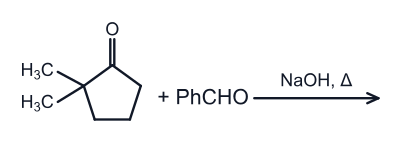
Answer and explanation
Answer: (1) · Aldehydes, Ketones and Carboxylic Acids
The ketone has -hydrogens only at C-5, because C-2 already carries two methyl groups and no hydrogen. Cross-aldol with benzaldehyde followed by dehydration therefore gives the benzylidene product at C-5, available as both geometrical isomers (options (2) and (4)). Self-condensation between two ketone molecules places the new double bond BETWEEN the -carbon of one ring and the former carbonyl carbon of the other, which is the exocyclic alkene of option (3). Option (1) shows the rings joined by a single bond with the alkene sitting inside the second ring - no addition-elimination sequence produces that connectivity. NCERT Class 12, Aldehydes, Ketones and Carboxylic Acids.
Why the other options are wrong:
- (2) is obtainable - the standard cross-aldol condensation product with the non-enolisable aldehyde
- (3) is obtainable - the self-aldol condensation product, since the ketone does possess one enolisable position
- (4) is obtainable - simply the other geometrical isomer of the same benzylidene productAmong the following, the compound having conjugated double bonds is
Answer and explanation
Answer: (1) · Hydrocarbons
Double bonds are conjugated when they alternate with exactly one single bond, letting the p orbitals overlap continuously. In hepta-1,3-diene the unsaturations are at C1-C2 and C3-C4, separated by the single C2-C3 bond, so the system is conjugated. The others place two or more single bonds between the double bonds, making them isolated. NCERT Class 11, Hydrocarbons.
Given below are two statements.
Statement I: Oxidation of p-nitrotoluene with acidic gives an acid that is stronger than benzoic acid.
Statement II: Reduction of p-nitrotoluene with followed by neutralization gives an amine that is more basic than aniline.
In light of the above statements, choose the most appropriate answer from the options given below.Answer and explanation
Answer: (1) · Amines
Each reagent attacks a different group on the same starting material. Acidic permanganate oxidises the methyl group to , leaving the nitro group intact; the resulting p-nitrobenzoic acid is stronger than benzoic acid because the electron-withdrawing nitro group stabilises the carboxylate anion. instead reduces the nitro group to , leaving the methyl in place; the resulting p-toluidine is more basic than aniline because the electron-releasing methyl group raises the electron density on nitrogen. Both statements are therefore correct. NCERT Class 12, Amines; Aldehydes, Ketones and Carboxylic Acids.
The green paramagnetic species formed by heating at 513 K is
Answer and explanation
Answer: (1) · The d- and f-Block Elements
Heating permanganate near 513 K decomposes it as 2KMnO → KMnO + MnO + O at 513 K. The manganate ion has manganese in the +6 state with a configuration, so it is both intensely green and paramagnetic - permanganate itself, with manganese(VII), is purple and diamagnetic. NCERT Class 12, The d- and f-Block Elements (potassium permanganate).
Consider the following reaction, and choose the correct option.
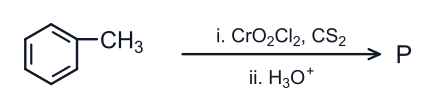
Answer and explanation
Answer: (4) · Aldehydes, Ketones and Carboxylic Acids
Chromyl chloride in carbon disulphide oxidises the methyl group of toluene only as far as the aldehyde, and hydrolysis of the chromium complex releases benzaldehyde - the Etard reaction. Benzaldehyde is exactly the product of Rosenmund reduction, in which benzoyl chloride is hydrogenated over palladium poisoned with barium sulphate, so option (4) is a genuine alternative preparation. NCERT Class 12, Aldehydes, Ketones and Carboxylic Acids (preparation of aldehydes).
Why the other options are wrong:
- (1) effervescence with bicarbonate is a test for carboxylic ACIDS; an aldehyde is not acidic enough to release
- (2) acylation of benzene with acetyl chloride gives acetophenone, a ketone, not benzaldehyde
- (3) a white precipitate with bromine water is characteristic of activated rings such as phenol or aniline, not of benzaldehydeA 1 : 3 electrolyte in an aqueous solution is
Answer and explanation
Answer: (3) · Coordination Compounds
Only the ions OUTSIDE the coordination sphere are released in solution; ligands bound to the metal stay put. has all six ammonia molecules coordinated and three chlorides as counter-ions, so it dissociates into one complex cation and three chloride ions - a 1 : 3 electrolyte. NCERT Class 12, Coordination Compounds (Werner's theory, primary and secondary valence).
Consider the following schematic plots of orbital wavefunction () against distance (r) from the nucleus.
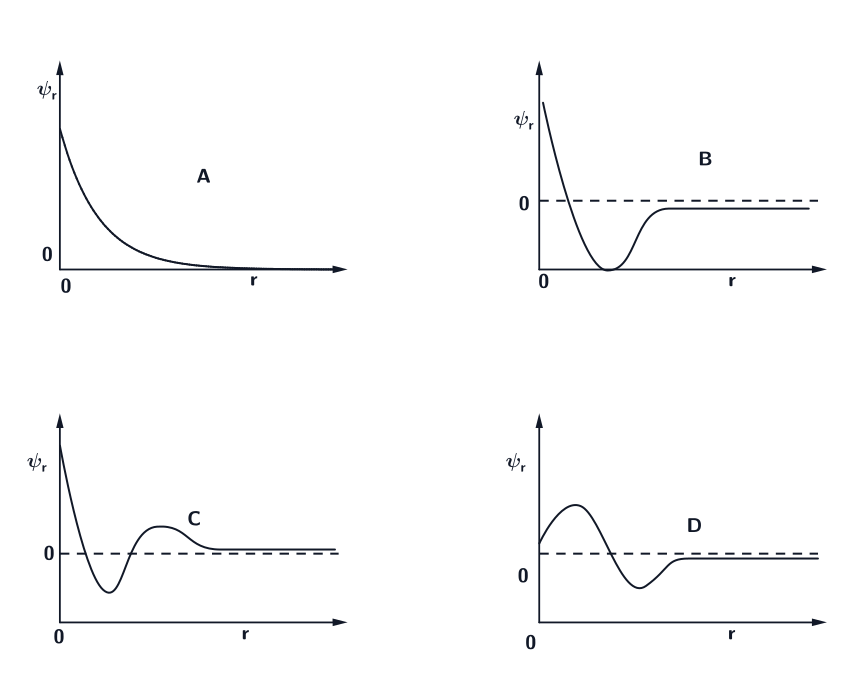
The figure representing two radial nodes in the orbital is
Answer and explanation
Answer: (3) · Structure of Atom
A radial node is a distance at which the wavefunction actually CHANGES SIGN, so on a versus r plot you simply count how many times the curve crosses the horizontal axis. Merely approaching zero asymptotically at large r does not count. The plot labelled C crosses the axis twice - once into negative values and once back up - so it has two radial nodes, matching an orbital with such as 3s. NCERT Class 11, Structure of Atom (quantum mechanical model, nodes).
Why the other options are wrong:
- (1) shows a curve that decays without ever changing sign - zero radial nodes, as in 1s
- (2) crosses the axis only once, so it has a single radial node
- (4) crosses more often than twice, so its node count is higher than asked forArrange the following compounds in the increasing order of polarity.
Statement I:
Statement II:
Statement III:
Statement IV:
Choose the correct answer from the options given below.Answer and explanation
Answer: (4) · Organic Chemistry: Some Basic Principles and Techniques
Polarity here is judged by how strongly the functional group interacts through dipoles and hydrogen bonding, which is the ordering used in chromatography. Diethyl ether has no O-H and only weak dipolar interaction, so it is least polar. Acetone's carbonyl is strongly polar but it can only ACCEPT hydrogen bonds, never donate one, so it ranks below ethanol, which has an O-H donor. Acetic acid combines a carbonyl, an O-H donor and acidic ionisation, making it the most polar. Hence I < III < II < IV. NCERT Class 11, Organic Chemistry: Some Basic Principles and Techniques (chromatographic separation).
The highest occupied molecular orbital for is
Answer and explanation
Answer: (4) · Chemical Bonding and Molecular Structure
has 20 electrons, enough to fill every molecular orbital derived from the 1s, 2s and 2p atomic orbitals. Filling in order, , the last two electrons enter , which is therefore the HOMO. With every bonding orbital matched by its antibonding partner the bond order is zero, which is why does not exist as a stable molecule. NCERT Class 11, Chemical Bonding and Molecular Structure.
The number of vertebrae in a human is ________.
Answer and explanation
Answer: (3) · Locomotion and Movement
The adult vertebral column contains 26 vertebrae. The count starts from 33 in the embryo but falls as the five sacral vertebrae fuse into a single sacrum and the four coccygeal vertebrae fuse into one coccyx: 7 cervical + 12 thoracic + 5 lumbar + 1 sacrum + 1 coccyx = 26. NCERT Class 11, Locomotion and Movement.
Symbiotic association between fungi and algae are called ________.
Answer and explanation
Answer: (1) · Biological Classification
In a lichen the algal partner (the phycobiont) photosynthesises and supplies food, while the fungal partner (the mycobiont) provides shelter, anchorage and absorbs mineral nutrients and water. Lichens are highly sensitive to pollution, which is why they are used as air-quality indicators. NCERT Class 11, Biological Classification.
Cell theory was formulated by ______________.
Answer and explanation
Answer: (1) · Cell: The Unit of Life
Matthias Schleiden concluded in 1838 that all plants are composed of cells, and Theodore Schwann reached the same conclusion for animals in 1839; together they formulated the cell theory. Rudolf Virchow later added the crucial third element, that all cells arise from pre-existing cells. NCERT Class 11, Cell: The Unit of Life.
Which of the following are characteristics of prokaryotic cells?
Statement I: Ribosomes are made of 50S and 30S subunits
Statement II: They can have plasmids
Statement III: They contain mesosome
Statement IV: They have peroxisomes
Choose the correct answer from the options given below :Answer and explanation
Answer: (4) · Cell: The Unit of Life
Prokaryotic ribosomes are 70S, built from 50S and 30S subunits, in contrast to the 80S ribosomes of eukaryotes (Statement I). Many bacteria carry plasmids, small extrachromosomal circles of DNA that confer traits such as antibiotic resistance (Statement II). The mesosome is a distinctive infolding of the prokaryotic plasma membrane involved in cell wall formation and respiration (Statement III). Peroxisomes, however, are MEMBRANE-BOUND ORGANELLES found only in eukaryotic cells, so (Statement IV) is false. NCERT Class 11, Cell: The Unit of Life.
Which of the following is not a part of human central neural system?
Answer and explanation
Answer: (4) · Neural Control and Coordination
The pericardium is the double-walled sac enclosing the HEART and belongs to the circulatory system. The other three are the meninges - the tough outer dura mater, the web-like middle arachnoid and the delicate inner pia mater - which wrap the brain and spinal cord. NCERT Class 11, Neural Control and Coordination.
Mitochondrial inner membrane encloses ___________ .
Answer and explanation
Answer: (1) · Cell: The Unit of Life
The mitochondrion has two membranes. The inner membrane throws out folds called cristae and encloses the MATRIX, a dense fluid containing the enzymes of the citric acid cycle, mitochondrial DNA and 70S ribosomes. The narrow space between the two membranes is the intermembrane space. NCERT Class 11, Cell: The Unit of Life.
Match List-I with List-II.
List I
List II
P) Cristae
I) Flat membrane sacs in stroma of chloroplast
Q) Cisternae
II) Infoldings in mitochondria
R) Thylakoids
III) Cell membrane
S) Phospholipid
IV) Disc shaped sacs in the Golgi apparatus
Choose the correct answer from the options given below:
Answer and explanation
Answer: (2) · Cell: The Unit of Life
Cristae are the infoldings of the inner mitochondrial membrane that increase surface area for the electron transport chain (P-II). Cisternae are the flattened disc-shaped sacs stacked to form the Golgi apparatus (Q-IV). Thylakoids are the flattened membranous sacs suspended in the chloroplast stroma where the light reactions occur (R-I). Phospholipids form the bilayer that is the structural basis of the cell membrane (S-III). NCERT Class 11, Cell: The Unit of Life.
The plastid that stores xanthophyll is known as __________.
Answer and explanation
Answer: (2) · Cell: The Unit of Life
Chromoplasts are the coloured plastids that hold carotenoid pigments - carotenes and xanthophylls - giving fruits, flowers and some roots their yellow, orange and red colours. Leucoplasts, being colourless, are the storage plastids and are further divided by what they store: amyloplasts for starch, elaioplasts for oils and aleuroplasts for proteins. NCERT Class 11, Cell: The Unit of Life.
Which of the following statements related to pituitary gland are correct?
Statement I: It is divided anatomically into adenohypophysis and neurohypophysis
Statement II: It secretes follicle stimulating hormone
Statement III: It secretes melanocyte stimulating hormone
Statement IV: It does not secrete prolactin
Choose the correct answer from the options given below :Answer and explanation
Answer: (2) · Chemical Coordination and Integration
The pituitary is anatomically divided into the adenohypophysis (anterior) and neurohypophysis (posterior), so (Statement I) is correct. The pars distalis of the adenohypophysis secretes FSH among other trophic hormones, making (Statement II) correct, and the pars intermedia secretes MSH, making (Statement III) correct. Statement IV is false: prolactin IS a pituitary hormone, secreted by the pars distalis to regulate mammary growth and milk production. NCERT Class 11, Chemical Coordination and Integration.
Photorespiration reaction catalyzed by RuBisCo is shown below: RuBP + O → 3-Phosphoglycerate + X. Identify "X" from the given options:
Answer and explanation
Answer: (2) · Photosynthesis in Higher Plants
Ribulose bisphosphate carboxylase-oxygenase (RuBisCO) has affinity for both and at the same active site. When oxygen wins, the five-carbon ribulose bisphosphate (RuBP) is split into one molecule of the three-carbon 3-phosphoglycerate and one molecule of the two-carbon 2-phosphoglycolate - note the carbon bookkeeping, 5 = 3 + 2. This wasteful route consumes adenosine triphosphate (ATP) without fixing carbon or producing sugar. NCERT Class 11, Photosynthesis in Higher Plants.
Mad cow disease is caused by _______.
Answer and explanation
Answer: (1) · Biological Classification
Prions are abnormally folded PROTEIN particles with no nucleic acid at all. They act as templates that force the normal cellular protein into the same misfolded shape, producing spongiform degeneration of the brain. Bovine spongiform encephalopathy in cattle and its human counterpart, Creutzfeldt-Jakob disease, are both prion diseases. NCERT Class 11, Biological Classification.
Which pigment has absorption peak at 700 nm in the photosynthetic reaction centre PS I (P700)?
Answer and explanation
Answer: (2) · Photosynthesis in Higher Plants
Only chlorophyll a occupies the reaction centre of a photosystem, and it is named for its absorption peak: P700 in photosystem I and P680 in photosystem II. All other pigments - chlorophyll b, xanthophylls and carotenoids - are ACCESSORY pigments in the light-harvesting complex that capture photons and funnel the energy to chlorophyll a. NCERT Class 11, Photosynthesis in Higher Plants.
In water, frogs respire using _____________.
Answer and explanation
Answer: (1) · Structural Organisation in Animals
Submerged frogs rely entirely on CUTANEOUS respiration: the moist, thin, richly vascularised skin allows dissolved oxygen and carbon dioxide to diffuse directly across it. On land the frog switches to buccal cavity respiration and pulmonary respiration through the lungs. The skin route is the only one available underwater. NCERT Class 11, Structural Organisation in Animals.
Which of the following represents the correct sequence of arrangement of bones in the lower limb of humans?
Answer and explanation
Answer: (3) · Locomotion and Movement
Working downward from the hip: the femur is the thigh bone, the patella is the kneecap covering the knee joint, the tibia and fibula form the leg below the knee, and the tarsals make up the ankle. The sequence femur-patella-tibia-tarsal follows that anatomical order. NCERT Class 11, Locomotion and Movement.
Phyllotaxy is the pattern of arrangement of ________.
Answer and explanation
Answer: (1) · Morphology of Flowering Plants
Phyllotaxy is the arrangement of LEAVES on the stem or branch, and it comes in three patterns: alternate (as in china rose), opposite (as in Calotropis) and whorled (as in Alstonia). The Greek root phyllon means leaf. The arrangement of flowers on the floral axis is called inflorescence, a separate term. NCERT Class 11, Morphology of Flowering Plants.
Match List-I with List-II.
List I
List II
P) Starch
I) Fights infection
Q) Antibody
II) Energy storage
R) Concanavalin A
III) Glucose transport
S) Glut-4
IV) Lectin
Choose the correct answer from the options given below :
Answer and explanation
Answer: (2) · Biomolecules
Starch is the storage polysaccharide of plants, a reserve of energy (P-II). Antibodies are immunoglobulins that recognise and neutralise pathogens (Q-I). Concanavalin A is the standard textbook example of a lectin, a carbohydrate-binding protein (R-IV). GLUT-4 is the insulin-responsive transporter that carries glucose across the plasma membrane into muscle and fat cells (S-III). NCERT Class 11, Biomolecules (protein functions).
Given below are two statements :
Statement I: When any plane passing through the central axis of the body divides the organism into two identical halves, it is called radial symmetry.
Statement II: In phylum Echinodermata, both adults and larvae are radially symmetrical.
In the light of the above statements, choose the most appropriate answer from the options given below :Answer and explanation
Answer: (3) · Animal Kingdom
Radial symmetry means that any plane through the central body axis divides an organism into similar halves. Adult echinoderms are radial, but their larvae are bilateral, consistent with a bilateral ancestry. Statement I is true and statement II is false.
Endomembrane system includes _______.
Answer and explanation
Answer: (1) · Cell: The Unit of Life
The endomembrane system is defined as those organelles whose functions are coordinated and whose membranes are continuous or exchanged through vesicles: the endoplasmic reticulum, Golgi complex, lysosomes and vacuoles. Mitochondria, chloroplasts and peroxisomes are deliberately excluded because their functions are not coordinated with this network. NCERT Class 11, Cell: The Unit of Life.
How many molecules of pyruvic acid are produced at the end of glycolysis from 206 molecules of glucose?
Answer and explanation
Answer: (4) · Respiration in Plants
Glycolysis splits each six-carbon glucose into TWO three-carbon pyruvate molecules, so the yield is simply doubled: . The carbon count checks out, since . NCERT Class 11, Respiration in Plants.
Which of the following plant growth regulators is used as herbicide?
Answer and explanation
Answer: (1) · Plant Growth and Development
2,4-dichlorophenoxyacetic acid is a synthetic auxin widely used to kill dicotyledonous weeds while leaving mature monocotyledonous crops such as wheat and rice largely unharmed. At herbicidal concentrations it forces uncontrolled, disorganised growth in susceptible plants. NCERT Class 11, Plant Growth and Development.
Given below are two statements:
Statement I: In gymnosperms, the male and female gametophytes remain within the sporangia.
Statement II: In gymnosperms, seeds are not covered.
In the light of the above statements, choose the most appropriate answer from the options given below:Answer and explanation
Answer: (1) · Plant Kingdom
Gymnosperms are heterosporous, and unlike in pteridophytes the gametophytes never become free-living: the reduced male gametophyte stays inside the pollen grain within the microsporangium, and the female gametophyte remains enclosed in the megasporangium (nucellus) on the ovule. The name itself, gymno meaning naked and sperma meaning seed, records the second fact - the ovules sit exposed on the megasporophyll with no ovary wall around them, so no fruit is formed. NCERT Class 11, Plant Kingdom.
Match List-I with List-II.
List I
List II
P) Spherical
I) Vibrio
Q) Rod
II) Cocci
R) Comma
III) Spirilla
S) Spirillum
IV) Bacilli
Choose the correct answer from the options given below :
Answer and explanation
Answer: (4) · Biological Classification
Bacteria are classified by shape into four basic forms: spherical cocci (P-II), rod-shaped bacilli (Q-IV), comma-shaped vibrio (R-I) and spiral spirilla (S-III). The names are worth learning together because each is simply the Latin word for the shape. NCERT Class 11, Biological Classification.
Which of the following are characteristic features of Solanaceae family?
Statement I: Flowers are bisexual and actinomorphic
Statement II: Calyx have five sepals and are united
Statement III: Androecium have five stamens and are epipetalous
Statement IV: Ovary is inferior
Choose the correct answer from the options given below :Answer and explanation
Answer: (1) · Morphology of Flowering Plants
The Solanaceae floral formula describes bisexual, actinomorphic flowers with a gamosepalous calyx of five united sepals, a gamopetalous corolla of five petals, and five epipetalous stamens attached to the corolla tube. Statement IV is the odd one out: the ovary in this family is bicarpellary, syncarpous and SUPERIOR, seated above the other floral parts. NCERT Class 11, Morphology of Flowering Plants.
Select the correct sequence of experiments that led to a gradual understanding of photosynthesis in green plants.
Answer and explanation
Answer: (2) · Photosynthesis in Higher Plants
The discoveries came in order of increasing refinement. Priestley first showed that plants restore something to 'injured' air. Ingenhousz then established that it is sunlight and the green parts that release oxygen. Sachs later demonstrated that glucose is produced and stored as starch in chloroplasts. Finally Engelmann worked out the action spectrum and the absorption properties of the chlorophylls. NCERT Class 11, Photosynthesis in Higher Plants (early experiments).
The number of action potentials generated by sino-atrial node (SAN) in a healthy human is _______ per minute.
Answer and explanation
Answer: (2) · Body Fluids and Circulation
The sino-atrial node is the pacemaker of the heart because it generates action potentials faster than any other part of the conducting system - about 70 to 75 per minute, which sets the normal resting heart rate. The atrio-ventricular node and Purkinje fibres can also fire spontaneously but at slower rates, so they only take over if the SAN fails. NCERT Class 11, Body Fluids and Circulation.
How many turns of Calvin cycle are required for the formation of three molecules of glucose?
Answer and explanation
Answer: (4) · Photosynthesis in Higher Plants
Each turn of the Calvin cycle fixes ONE molecule of , so building the six-carbon skeleton of one glucose needs six turns. Three glucose molecules therefore need turns. The common trap is to forget that the cycle handles one carbon at a time, not one sugar. NCERT Class 11, Photosynthesis in Higher Plants.
Which of the following statements is incorrect?
Answer and explanation
Answer: (4) · Body Fluids and Circulation
During blood coagulation, thrombin converts soluble plasma fibrinogen into insoluble fibrin threads. Those threads form a mesh that traps blood cells to make the clot. Reversing fibrin and fibrinogen gives the wrong direction for this step.
Match List-I with List-II.
List I
List II
P) Family
I) Sapindales
Q) Genus
II) Dicotyledonae
R) Class
III) Anacardiaceae
S) Division
IV) Angiospermae
T) Order
V) Mangifera
Choose the correct answer from the options given below :
Answer and explanation
Answer: (4) · The Living World
NTA's paper printed Phylum in row S; it is corrected to Division, the rank NCERT uses for plants. For mango, the genus is Mangifera (Q-V), the family is Anacardiaceae (P-III), the order is Sapindales (T-I), the class is Dicotyledonae (R-II), and the division is Angiospermae (S-IV). Therefore option (4) is correct. NCERT Class 11, The Living World.
Arrange the following taxonomic categories in ascending order.
Statement I: Genus
Statement II: Class
Statement III: Order
Statement IV: Phylum
Statement V: Family
Statement VI: Kingdom
Statement VII: Species
Choose the correct answer from the options given below :Answer and explanation
Answer: (1) · The Living World
Ascending order means starting from the smallest, most specific category and working up to the broadest. The hierarchy runs Species, Genus, Family, Order, Class, Phylum (Division in plants), Kingdom - which is exactly (VII), (I), (V), (III), (II), (IV), (VI). Moving up the ladder, the number of shared characters falls while the number of organisms included rises. NCERT Class 11, The Living World.
Match List-I with List-II.
List I
List II
P) Marginal placentation
I) Argemone
Q) Axile placentation
II) Tomato
R) Parietal placentation
III) Primrose
S) Free central placentation
IV) Pea
Choose the correct answer from the options given below :
Answer and explanation
Answer: (4) · Morphology of Flowering Plants
Placentation describes where ovules attach inside the ovary. Marginal placentation has a single ridge along the ventral suture of a monocarpellary ovary, as in pea (P-IV). Axile placentation occurs in multilocular ovaries where the placenta is axial, as in tomato (Q-II). Parietal placentation puts the ovules on the inner ovary wall of a one-chambered ovary, as in Argemone (R-I). Free central placentation has ovules on a central axis with no septa, as in primrose (S-III). NCERT Class 11, Morphology of Flowering Plants.
Sphenopsida class belongs to _____________.
Answer and explanation
Answer: (4) · Plant Kingdom
Pteridophytes are divided into four classes: Psilopsida, Lycopsida, Sphenopsida and Pteropsida. Sphenopsida contains the horsetails, chiefly Equisetum, recognised by jointed ridged stems bearing whorls of scale leaves. These are the first vascular land plants, with true xylem and phloem. NCERT Class 11, Plant Kingdom.
Which of the following statements regarding photorespiration are correct?
Statement I: Do not occur in plants
Statement II: is consumed and is generated
Statement III: Phosphoglycolate is formed
Statement IV: No synthesis of ATP and NADPH
Choose the correct answer from the options given below:Answer and explanation
Answer: (2) · Photosynthesis in Higher Plants
Statement III is correct: the oxygenase activity of ribulose bisphosphate carboxylase-oxygenase (RuBisCO) splits ribulose bisphosphate (RuBP) into 3-phosphoglycerate and 2-phosphoglycolate. Statement IV is also correct: photorespiration is purely wasteful, producing no sugar, no adenosine triphosphate (ATP) and no reduced nicotinamide adenine dinucleotide phosphate (NADPH) while consuming energy. Statement I is false because photorespiration is characteristic OF plants - it is plants that avoid it. Statement II reverses the gas exchange: photorespiration consumes and releases . NCERT Class 11, Photosynthesis in Higher Plants.
Smooth endoplasmic reticulum ___________ .
Answer and explanation
Answer: (2) · Cell: The Unit of Life
The smooth endoplasmic reticulum is defined by the ABSENCE of ribosomes on its surface, and it is the principal site of lipid synthesis - including steroid hormones in cells such as those of the adrenal cortex and gonads. It also handles detoxification, which is why it is abundant in liver cells. Ribosome-studded rough ER handles protein synthesis instead. NCERT Class 11, Cell: The Unit of Life.
Which one of the following statements is incorrect?
Answer and explanation
Answer: (2) · Chemical Coordination and Integration
The islets of Langerhans divide the labour cleanly: -cells secrete glucagon, which raises blood glucose, and -cells secrete insulin, which lowers it. Option (2) assigns insulin to the wrong cell type. Note that options (1) and (4) together give the correct pairing, so the two can be used to check each other. NCERT Class 11, Chemical Coordination and Integration.
Genus represents __________.
Answer and explanation
Answer: (3) · The Living World
A genus sits one rung above species and gathers together species that share a set of characters not found in other genera. Panthera, for instance, includes the lion, tiger and leopard. It is the first word of every binomial name, which is why it is always written with a capital letter. NCERT Class 11, The Living World.
Which of the following is not a prokaryote?
Answer and explanation
Answer: (4) · Biological Classification
Fungi belong to Kingdom Fungi and are EUKARYOTES - they possess a true membrane-bound nucleus, mitochondria and other organelles. The other three are all prokaryotic members of Kingdom Monera: bacteria, cyanobacteria (blue-green algae) and the wall-less Mycoplasma. NCERT Class 11, Biological Classification.
Which of the following plant growth regulators promotes internode elongation prior to flowering in cabbage?
Answer and explanation
Answer: (2) · Plant Growth and Development
The dramatic elongation of the internodes just before flowering is called BOLTING, and it is the classic gibberellin response in rosette plants such as cabbage and beet. Applying gibberellin causes the compressed rosette to shoot upward into a tall flowering stalk. NCERT Class 11, Plant Growth and Development.
The correct sequence of adult cell cycle phases is ________.
Answer and explanation
Answer: (3) · Cell Cycle and Cell Division
Interphase runs G1, then S, then G2, and only then does the cell enter M phase to divide. The logic is that DNA must be replicated in S phase before the gap phase G2 allows the cell to check the copy and prepare for mitosis; dividing before replication would be fatal. NCERT Class 11, Cell Cycle and Cell Division.
Match List-I with List-II.
List I
List II
P) Fusion of protoplasms between gametes
I) Meiosis
Q) Fusion of two nuclei
II) Plasmogamy
R) Generation of haploid spores
III) Karyogamy
Choose the correct answer from the options given below :
Answer and explanation
Answer: (1) · Biological Classification
Sexual reproduction in fungi runs through three named steps in sequence. Plasmogamy is the fusion of the two protoplasts (P-II), karyogamy is the subsequent fusion of the two nuclei (Q-III), and meiosis in the resulting diploid zygote restores the haploid condition and generates spores (R-I). In many fungi plasmogamy and karyogamy are separated by a long dikaryotic phase, which is why they are named as distinct events. NCERT Class 11, Biological Classification.
Given below are two statements:
Statement I: The class name Reptilia refers to creeping or crawling mode of locomotion.
Statement II: All organisms belonging to Reptilia have three chambered heart.
In the light of the above statements, choose the most appropriate answer from the options given below:Answer and explanation
Answer: (3) · Animal Kingdom
The class name comes from the Latin repere or reptum, meaning to creep or crawl, so Statement I is correct. Statement II fails on a single well-known exception: CROCODILES have a four-chambered heart, while other reptiles such as lizards, snakes and turtles have three chambers. The word 'all' is what makes the statement false. NCERT Class 11, Animal Kingdom.
Given below are two statements :
Statement I: Chromosomes are fully condensed at the end of prophase I.
Statement II: Meiosis I resembles mitosis.
In the light of the above statements, choose the most appropriate answer from the options given below :Answer and explanation
Answer: (3) · Cell Cycle and Cell Division
Prophase I is the longest and most complex phase of meiosis, running through leptotene, zygotene, pachytene, diplotene and diakinesis; by diakinesis the chromosomes have reached maximum condensation, so Statement I holds. Statement II names the wrong division: it is MEIOSIS II that resembles mitosis, since sister chromatids separate and no pairing or crossing over occurs. Meiosis I is the reductional division, with homologues pairing, recombining and then separating - none of which happens in mitosis. NCERT Class 11, Cell Cycle and Cell Division.
Which of the following is not a characteristic of chordates?
Answer and explanation
Answer: (3) · Animal Kingdom
Chordates are defined by four fundamental features: a notochord, a dorsal hollow nerve cord, PAIRED PHARYNGEAL GILL SLITS and a post-anal tail. Gill slits are therefore present, not absent - even in terrestrial vertebrates they appear during embryonic development before being modified into other structures. NCERT Class 11, Animal Kingdom.
Length of the stem at time 0 is 20 cm. The arithmetic growth rate is 30 cm per day. What is the length of the stem at the end of the 7th day?
Answer and explanation
Answer: (3) · Plant Growth and Development
Arithmetic growth adds a CONSTANT amount per unit time, described by . Substituting, . The contrast worth holding onto is with geometric growth, where the increment itself grows and the curve is exponential rather than a straight line. NCERT Class 11, Plant Growth and Development.
Arrange the following elements in descending order of their contribution to percentage weight of the human body.
Statement I: Oxygen
Statement II: Carbon
Statement III: Hydrogen
Statement IV: Nitrogen
Choose the correct answer from the options given below :Answer and explanation
Answer: (1) · Biomolecules
By WEIGHT the human body is roughly 65 per cent oxygen, 18 per cent carbon, 10 per cent hydrogen and 3 per cent nitrogen, so the order is oxygen, carbon, hydrogen, nitrogen. Oxygen dominates because most of the body is water and hydrogen contributes little mass despite being very abundant by number of atoms - a useful reminder that ranking by weight and ranking by atom count give different answers. NCERT Class 11, Biomolecules (elemental analysis).
In frogs, the number of pairs of cranial nerves arising from the brain are ______.
Answer and explanation
Answer: (3) · Structural Organisation in Animals
The frog's brain gives off TEN pairs of cranial nerves. This is a useful comparative point: humans and other mammals have twelve pairs, so the frog figure is a common target for confusion between the two. NCERT Class 11, Structural Organisation in Animals.
Which of the following is used as a clot buster?
Answer and explanation
Answer: (1) · Microbes in Human Welfare
Streptokinase is produced by the bacterium Streptococcus and modified by genetic engineering; it dissolves the clots that block blood vessels in patients with myocardial infarction, which is why it is called a clot buster. The other three are also microbial products but with quite different uses. NCERT Class 12, Microbes in Human Welfare.
The inactive form of Bt toxin is converted to the active form in the insect gut _______
Answer and explanation
Answer: (1) · Biotechnology and its Applications
Bacillus thuringiensis produces the toxin as an inactive PROTOXIN crystal, which is why the bacterium itself is not harmed. Once eaten by an insect, the alkaline pH of the insect gut solubilises the crystal and converts it to the active form, which then binds to the midgut epithelium and creates pores that swell and lyse the cells. The pH dependence is what makes the toxin selective for insects. NCERT Class 12, Biotechnology and its Applications.
Given below are two statements :
Statement I: Down's syndrome is caused by the absence of one of the X-chromosomes.
Statement II: Turner's syndrome is caused by the presence of an additional copy of the chromosomes.
In the light of the above statements, choose the correct answer from the options given below :Answer and explanation
Answer: (2) · Principles of Inheritance and Variation
Both statements have been swapped. Down's syndrome is an AUTOSOMAL trisomy - an extra copy of chromosome 21, giving 47 chromosomes - and has nothing to do with the X chromosome. Turner's syndrome is the opposite kind of error: a MISSING X, giving the 45,X karyotype in a phenotypic female with rudimentary ovaries. So the descriptions belong to each other's conditions, and neither statement as written is correct. NCERT Class 12, Principles of Inheritance and Variation.
Which of the following disease is not sexually transmitted?
Answer and explanation
Answer: (2) · Reproductive Health
Tuberculosis is caused by Mycobacterium tuberculosis and spreads through AIRBORNE droplets from coughing and sneezing, not through sexual contact. The other three appear on NCERT's list of sexually transmitted infections, alongside genital herpes, chlamydiasis, trichomoniasis, hepatitis-B and human immunodeficiency virus (HIV). NCERT Class 12, Reproductive Health.
Sperm motility is due to ___________.
Answer and explanation
Answer: (1) · Human Reproduction
The sperm tail is a single long FLAGELLUM whose whip-like beating propels the cell forward. The energy comes from the mitochondria spiralled around the middle piece, which is why that region is packed with them. NCERT Class 12, Human Reproduction.
Natural selection can lead to _________.
Statement I: stabilisation
Statement II: genetic drift
Statement III: directional change
Statement IV: disruption
Choose the correct answer from the options given below :Answer and explanation
Answer: (2) · Evolution
Natural selection operates in three modes, distinguished by which part of the trait distribution it favours: stabilising selection favours the average and narrows variation, directional selection shifts the mean toward one extreme, and disruptive selection favours both extremes and can split the population into two peaks. GENETIC DRIFT is not one of them - it is random change in allele frequency caused by chance in small populations, and is explicitly a non-selective mechanism. NCERT Class 12, Evolution.
The method of directly of injecting a sperm into ovum in assisted reproductive technology is called :
Answer and explanation
Answer: (3) · Reproductive Health
Intracytoplasmic sperm injection is a specialised in-vitro procedure in which a single sperm is injected DIRECTLY into the cytoplasm of the ovum, bypassing the need for the sperm to penetrate the zona pellucida on its own. It is used mainly for severe male-factor infertility. NCERT Class 12, Reproductive Health.
Which of the following structures is not a part of the male reproductive system?
Answer and explanation
Answer: (4) · Human Reproduction
The infundibulum is the funnel-shaped opening of the FALLOPIAN TUBE, fringed with fimbriae that collect the ovum after ovulation - a female structure. The male duct system runs seminiferous tubules → rete testis → vasa efferentia → epididymis → vas deferens, and the other three options are all stages along it. NCERT Class 12, Human Reproduction.
Arrange the following in descending order of number of species in the Amazonian rain forest.
Statement I: Plants
Statement II: Birds
Statement III: Fishes
Statement IV: Invertebrates
Statement V: Mammals
Choose the correct answer from the options given below :Answer and explanation
Answer: (2) · Biodiversity and Conservation
NCERT's figures for the Amazonian rain forest are more than 1,25,000 invertebrate species, about 40,000 plant species, 3,000 fishes, 1,300 birds and 427 mammals - giving invertebrates > plants > fishes > birds > mammals. The broader pattern worth carrying away is that invertebrates dominate global species counts overwhelmingly, and vertebrates make up a very small slice. NCERT Class 12, Biodiversity and Conservation.
Given below are two statements:
Statement I: Ovulation is caused by LH surge leading to rupture of Graafian follicles.
Statement II: Graafian follicle remaining after ovulation transform into corpus luteum and secretes large amount of estrogen.
In the light of the above statements, choose the most appropriate answer from the options given below:Answer and explanation
Answer: (3) · Human Reproduction
A mid-cycle surge of luteinising hormone ruptures the mature Graafian follicle and releases the ovum. The remaining follicle forms the corpus luteum, whose main secretion is progesterone; it helps maintain the endometrium for implantation. Statement I is true, while statement II wrongly names oestrogen as the principal secretion.
Which of the following are primary consumers in a food chain?
Answer and explanation
Answer: (3) · Ecosystem
Primary consumers occupy the second trophic level and feed directly on the producers, which makes them by definition the herbivores. Carnivores that eat herbivores are secondary consumers at the third trophic level, and those that eat secondary consumers are tertiary. NCERT Class 12, Ecosystem.
A population of diploid organisms is at Hardy-Weinberg equilibrium. If the frequency of allele A is 0.1, the frequency of AA is ________.
Answer and explanation
Answer: (1) · Evolution
Under Hardy-Weinberg equilibrium the genotype frequencies follow , where is the frequency of the homozygous dominant genotype. With , the frequency of AA is . The rare-allele lesson is worth noting: a 10 per cent allele frequency produces only 1 per cent homozygotes, which is why recessive disorders remain rare even when carriers are not. NCERT Class 12, Evolution.
Match List-I with List-II.
List I
List II
P) Excess growth hormone
I) Reabsorption of water and electrolytes in kidney
Q) Luteinizing hormone
II) Contraction of uterus during child birth
R) Vasopressin
III) Acromegaly
S) Oxytocin
IV) Ovulation
Choose the correct answer from the options given below:
Answer and explanation
Answer: (2) · Chemical Coordination and Integration
Excess growth hormone in adults thickens the bones of the hands, feet and face, producing acromegaly (P-III). Luteinizing hormone triggers the rupture of the Graafian follicle at ovulation (Q-IV). Vasopressin, or antidiuretic hormone (ADH), acts on the distal tubule and collecting duct to reabsorb water and electrolytes (R-I). Oxytocin drives the powerful uterine contractions of labour (S-II). NCERT Class 11, Chemical Coordination and Integration.
The opening between the right atrium and the right ventricle is guarded by _________.
Answer and explanation
Answer: (2) · Body Fluids and Circulation
The right atrioventricular opening is guarded by a valve of three muscular flaps or cusps, hence the tricuspid valve. The left side carries the bicuspid or mitral valve with two cusps. An easy mnemonic is that 'tri' goes with 'right'. NCERT Class 11, Body Fluids and Circulation.
Sponges exchange with by __________.
Answer and explanation
Answer: (1) · Breathing and Exchange of Gases
Lower invertebrates such as sponges, coelenterates and flatworms have no specialised respiratory organs at all. Their bodies are thin enough and their cells close enough to the surrounding water that simple DIFFUSION across the whole body surface suffices for gas exchange. NCERT Class 11, Breathing and Exchange of Gases.
How many theca are present in each lobe of a typical bilobed angiosperm anther ?
Answer and explanation
Answer: (1) · Sexual Reproduction in Flowering Plants
A typical angiosperm anther is bilobed, and each lobe contains two theca - the anther is therefore described as DITHECOUS. Since each theca houses one microsporangium, the whole anther has four microsporangia arranged at its corners, two per lobe. NCERT Class 12, Sexual Reproduction in Flowering Plants.
Muscle contraction is initiated by a signal sent by the central nervous system by the release of _____ .
Answer and explanation
Answer: (1) · Locomotion and Movement
A motor neuron releases acetylcholine (ACh) at the neuromuscular junction. Acetylcholine binds to receptors on the muscle fibre membrane and generates an action potential. The action potential spreads along the sarcolemma and through the T-tubules, triggering the release of Ca from the sarcoplasmic reticulum. Calcium then initiates the interaction between actin and myosin, leading to muscle contraction.
Which of the following statements about lac-operon is correct?
Answer and explanation
Answer: (1) · Molecular Basis of Inheritance
The regulator gene is transcribed continuously from its own promoter, independent of whether lactose is present, so the repressor protein is always available - that is what constitutive expression means. This is essential to the logic of the operon: the repressor must already exist in order to keep the structural genes switched off in the absence of lactose. NCERT Class 12, Molecular Basis of Inheritance (regulation of gene expression).
Which of the following in female gametophyte of an angiosperm helps in guiding the pollen tube for fertilizing the eggs?
Answer and explanation
Answer: (2) · Sexual Reproduction in Flowering Plants
The two synergids flank the egg at the micropylar end and bear the FILIFORM APPARATUS, a set of thickened cell wall projections that secrete chemical attractants and guide the pollen tube into the embryo sac. The pollen tube in fact enters one of the synergids, not the egg directly, and releases the two male gametes there. NCERT Class 12, Sexual Reproduction in Flowering Plants.
Which of the following plants produces non-albuminous seeds?
Answer and explanation
Answer: (4) · Sexual Reproduction in Flowering Plants
Non-albuminous seeds lack endosperm at maturity because it is used up during embryo development. In pea, reserve food is stored in the cotyledons.
If the diploid chromosome number of typical angiosperm is 36, what would be the chromosome number in its endosperm?
Answer and explanation
Answer: (3) · Sexual Reproduction in Flowering Plants
Endosperm arises by TRIPLE FUSION, in which one male gamete fuses with the two polar nuclei, so it is triploid. With , the haploid number is and the endosperm is . The embryo, formed by the other male gamete fusing with the egg, remains diploid at 36. NCERT Class 12, Sexual Reproduction in Flowering Plants.
Which of the following statements about the reabsorption process in Henle's loop are correct?
Statement I: The descending limb of Henle's loop is permeable to water but almost impermeable to electrolytes.
Statement II: Urine gets concentrated in Henle's loop.
Statement III: Reabsorption of and water takes place together in the ascending limb of Henle's loop.
Statement IV: Active or passive transport of electrolytes occurs in the ascending limb of Henle's loop.
Choose the correct answer from the options given below:Answer and explanation
Answer: (4) · Excretory Products and their Elimination
NTA's paper said only that sodium and water are reabsorbed in Henle's loop; statement III is worded more precisely here, because the two happen in different limbs. As written, statement III is false: the ascending limb transports electrolytes but is impermeable to water. Statement I is true because the descending limb is permeable to water and nearly impermeable to electrolytes. Statement II is true because tubular fluid becomes concentrated while descending. Statement IV is true because electrolytes leave the ascending limb by active or passive transport. Thus statements I, II and IV are correct, so the answer is option (4). NCERT Class 11, Excretory Products and their Elimination (counter-current mechanism).
Which of the following is the correct order of arrangement of vertebrate column from the head to toe?
Answer and explanation
Answer: (4) · Locomotion and Movement
Running head to toe, the vertebral column is cervical (neck, 7), thoracic (chest, 12), lumbar (lower back, 5), then sacrum (5 fused) and finally coccyx (4 fused). NCERT Class 11, Locomotion and Movement.
Which of the following is not evidence for evolution?
Answer and explanation
Answer: (3) · Evolution
Ernst Haeckel's recapitulation proposal claimed that embryonic development repeats ancestral adult stages, but Karl Ernst von Baer's observations disproved that claim; NCERT therefore treats this proposed support as invalid evidence. Fossils are palaeontological evidence, analogous wings illustrate convergent evolution, and homologous forelimbs illustrate divergent evolution. NTA's paper spelled the name Heckel; it is corrected to Haeckel. NCERT Class 12, Evolution (evidence for evolution).
Given below are two statements :
Statement I: Modern Homo sapiens arose in Australia and moved across continents.
Statement II: Homo sapiens arose around 75000 to 10000 years ago.
In the light of the above statements, choose the most appropriate answer from the options given below :Answer and explanation
Answer: (4) · Evolution
Modern Homo sapiens arose in Africa and migrated across continents. In the NCERT timeline used by this question, their emergence is placed during the ice age, about 75,000 to 10,000 years ago. Statement I names the wrong continent; statement II follows that textbook timeline.
Consider a population of 10 million cells. Given the per-capita birth rate of 0.002 (per unit time) and the per-capita death rate of 0.002 (per unit time), the expected number of cells after 10 generations is ______.
Answer and explanation
Answer: (3) · Organisms and Populations
The intrinsic rate of natural increase is . Here the birth and death rates are identical, so and the exponential growth equation reduces to . The population is at ZERO population growth and stays at 10 million however many generations pass. NCERT Class 12, Organisms and Populations.
During PCR, primers bind to the DNA strands in the ______step.
Answer and explanation
Answer: (3) · Biotechnology: Principles and Processes
Polymerase chain reaction (PCR) cycles through three steps. Denaturation at about 94 °C separates the two DNA strands. ANNEALING at a lower temperature, typically 50-60 °C, lets the two short oligonucleotide primers base-pair with their complementary sequences on the separated strands. Extension then follows, with Taq polymerase building new strands from those primers. NCERT Class 12, Biotechnology: Principles and Processes.
Given below are two statements : one is labelled as Assertion A and the other is labelled as Reason R.
Assertion (A): The logistic growth model of populations is considered more realistic than the exponential growth model.
Reason (R): Resources are finite.
In the light of the above statements, choose the most appropriate answer from the options given below :Answer and explanation
Answer: (1) · Organisms and Populations
Exponential growth assumes unlimited resources and predicts a J-shaped curve rising without bound, which no real population sustains. Because resources are in fact finite, every habitat has a carrying capacity K beyond which it cannot support more individuals, and growth slows as the population approaches it - producing the S-shaped (sigmoid) logistic curve. Finite resources are therefore exactly the reason the logistic model is the realistic one. NCERT Class 12, Organisms and Populations.
Adaptive radiation in placental mammals and Australian Marsupials leading to similarity between distant species is an example of ________.
Answer and explanation
Answer: (2) · Evolution
Two adaptive radiations happened independently - one among placental mammals and one among Australian marsupials - yet each produced strikingly similar forms occupying equivalent niches, such as the placental wolf and the Tasmanian wolf, or the flying squirrel and the flying phalanger. When UNRELATED lineages come to resemble one another under similar selection pressures, that is convergent evolution. NCERT Class 12, Evolution.
Which of the following are secondary lymphoid organs?
Statement I: Bone marrow
Statement II: Tonsils
Statement III: Spleen
Statement IV: Thymus
Choose the correct answer from the options given below:Answer and explanation
Answer: (2) · Human Health and Disease
Primary lymphoid organs are where lymphocytes are produced and mature - the bone marrow and the thymus. Secondary lymphoid organs are where mature lymphocytes go to meet antigen and mount a response: the spleen, lymph nodes, tonsils, Peyer's patches of the small intestine and the appendix. Tonsils and spleen therefore belong to the secondary group. NCERT Class 12, Human Health and Disease.
Which of the following hormone is not secreted by human placenta?
Answer and explanation
Answer: (4) · Human Reproduction
The placenta functions as a temporary endocrine gland, producing human chorionic gonadotropin (hCG), human placental lactogen, oestrogens, progestogens and later relaxin. Luteinising hormone is not among them - LH is a gonadotropin secreted by the ANTERIOR PITUITARY. The placental hormone that mimics its role early in pregnancy is hCG, which sustains the corpus luteum. NCERT Class 12, Human Reproduction.
Which of the following enzymes synthesizes precursor mRNA?
Answer and explanation
Answer: (2) · Molecular Basis of Inheritance
Eukaryotes use three nuclear RNA polymerases with a clean division of labour. RNA polymerase II transcribes the precursor of messenger RNA (mRNA), the heterogeneous nuclear RNA (hnRNA), which is then capped, tailed and spliced into mature mRNA. RNA polymerase I handles the ribosomal RNAs and RNA polymerase III the transfer RNAs (tRNAs), 5S rRNA and small nuclear RNAs. NCERT Class 12, Molecular Basis of Inheritance.
Given below are two statements :
Statement I: Plasmids are autonomously replicating DNA.
Statement II: Plasmids are extrachromosomal DNA.
In the light of the above statements, choose the most appropriate answer from the options given below :Answer and explanation
Answer: (1) · Biotechnology: Principles and Processes
Both statements are true and together explain why plasmids make such useful cloning vectors. They are small circular DNA molecules that sit OUTSIDE the bacterial chromosome, and because each carries its own origin of replication (ori) it can replicate independently of the host chromosome. Any foreign DNA spliced into a plasmid is therefore multiplied along with it. NCERT Class 12, Biotechnology: Principles and Processes.
For a person with blood group 'O', which of the following is not a possible combination of parents' blood group genotypes?
Answer and explanation
Answer: (4) · Principles of Inheritance and Variation
Blood group O is the homozygous recessive genotype , so EACH parent must be able to contribute an allele. A father of genotype carries no allele at all and can only pass on or , so option (4) cannot produce an O child. Every other option pairs two heterozygous carriers, each of whom can donate . NCERT Class 12, Principles of Inheritance and Variation (multiple allelism).
Given below are two statements : one is labelled as Assertion A and the other is labelled as Reason R.
Assertion (A): Forelimbs of human and bats are homologous.
Reason (R): Forelimbs of humans and bats have similar anatomical structure.
In the light of the above statements, choose the most appropriate answer from the options given below.Answer and explanation
Answer: (1) · Evolution
Homology is defined by shared underlying anatomy inherited from a common ancestor, whatever the organ is now used for. The forelimbs of humans, bats, cheetahs and whales all contain the same bones - humerus, radius, ulna, carpals, metacarpals and phalanges - arranged in the same pattern despite performing very different functions. That common structural plan is precisely what makes them homologous, so R explains A. NCERT Class 12, Evolution.
Colostrum, secreted by mother during initial days of lactation, is abundant in ________.
Answer and explanation
Answer: (3) · Human Health and Disease
Colostrum, the yellowish fluid produced in the first few days after birth, is rich in immunoglobulin A (IgA) antibodies. Because these are ready-made antibodies handed directly to the infant rather than produced by the infant itself, this is a form of NATURAL PASSIVE IMMUNITY, protecting the newborn until its own immune system matures. NCERT Class 12, Human Health and Disease.
Given below are two statements : one is labelled as Assertion A and the other is labelled as Reason R.
Assertion (A): Abingdon tortoise in Galapagos islands became extinct within a decade after goats were introduced.
Reason (R): Goats were more efficient at browsing than Abingdon tortoise.
In the light of the above statements, choose the most appropriate answer from the options given below:Answer and explanation
Answer: (1) · Organisms and Populations
This is NCERT's standard illustration of competitive exclusion in the wild. Once goats were introduced to Abingdon Island they stripped the vegetation far more efficiently than the tortoises could, and the resulting shortage of food drove the tortoise to extinction within about ten years. Superior resource exploitation by the goats is therefore the direct cause of the tortoise's disappearance, so R explains A. NCERT Class 12, Organisms and Populations (interspecific interactions).
The covering of ovum at ovulation is _________.
Answer and explanation
Answer: (3) · Human Reproduction
The zona pellucida is the transparent glycoprotein layer laid down around the oocyte during its growth, and it is the covering carried by the ovum at ovulation. It plays an active role at fertilisation, binding sperm and then hardening to block polyspermy once one sperm has entered. NCERT Class 12, Human Reproduction.
Match List-I with List-II.
List I
List II
P) Both species are harmed
I) Predation
Q) One species is harmed and the other is benefited
II) Mutualism
R) Both species are benefited
III) Competition
S) One is benefited while the other has no effect
IV) Commensalism
Choose the correct answer from the options given below:
Answer and explanation
Answer: (4) · Organisms and Populations
Interspecific interactions are classified by the sign of the effect on each partner. Competition harms both (P-III, - -). Predation benefits one at the cost of the other (Q-I, + -). Mutualism benefits both (R-II, + +). Commensalism benefits one and leaves the other unaffected (S-IV, + 0). Writing the sign pairs out is the quickest way to sort these. NCERT Class 12, Organisms and Populations.
Given below are two statements : one is labelled as Assertion A and the other is labelled as Reason R.
Assertion (A): In an experiment, Mendel observed that the progeny plants are all tall and none are dwarf.
Reason (R): Stem height is a contrasting trait, with tall being dominant and dwarf being recessive.
In the light of the above statements, choose the most appropriate answer from the options given below :Answer and explanation
Answer: (1) · Principles of Inheritance and Variation
Crossing true-breeding tall and dwarf pea plants gave an generation that was uniformly tall, with no intermediates and no dwarfs - one of Mendel's central observations. The reason states exactly why: the plants are heterozygous , and because the tall allele is dominant it masks the recessive dwarf allele in the phenotype. The dwarf allele reappears in the generation, confirming it was never lost. NCERT Class 12, Principles of Inheritance and Variation.
Given below are two statements : one is labelled as Assertion A and the other is labelled as Reason R.
Assertion (A): In recombinant DNA technology, lysozyme is used for disrupting bacterial cells while cellulase is for plant cells.
Reason (R): Isolation of genetic material needs disruption of cells.
In the light of the above statements, choose the most appropriate answer from the options given below :Answer and explanation
Answer: (1) · Biotechnology: Principles and Processes
DNA is locked inside cells behind a wall and membrane, so the first step in any recombinant DNA procedure is to break the cell open. The enzyme chosen must match the wall chemistry: lysozyme digests the peptidoglycan of bacterial walls, cellulase digests the cellulose of plant walls, and chitinase is used for fungi. The need to disrupt cells is therefore exactly why these particular enzymes are chosen, so R explains A. NCERT Class 12, Biotechnology: Principles and Processes.
Which of the following is used as an effective sedative and painkiller for treating post-surgery patients?
Answer and explanation
Answer: (3) · Human Health and Disease
Morphine is an opioid extracted from the latex of Papaver somniferum. It binds to receptors in the central nervous system and is a very effective sedative and painkiller, which is exactly why it is used for patients recovering from surgery - and also why it carries a high risk of abuse and dependence. NCERT Class 12, Human Health and Disease.
Which of the following statements are Correct ?
Statement I: Energy flow from producers to consumers is unidirectional
Statement II: Energy pyramid can never be inverted
Statement III: Transfer of energy follows the 1% law
Choose the correct answer from the options given below :Answer and explanation
Answer: (2) · Ecosystem
Energy enters an ecosystem as sunlight and moves in one direction only, from producers to successive consumer levels, being lost as heat at each step - it is never recycled the way nutrients are, so (Statement I) is correct. Because of that unavoidable loss, each level holds less energy than the one below it, so the pyramid of energy is ALWAYS upright and can never be inverted, making (Statement II) correct. Statement III misquotes Lindeman's rule, which is the 10 PER CENT law, not 1 per cent. NCERT Class 12, Ecosystem.
Which of the following statements is correct about Plasmodium?
Answer and explanation
Answer: (4) · Human Health and Disease
The division of labour between the two hosts is the key to this life cycle. In the human, Plasmodium multiplies ASEXUALLY - first in liver cells, then in red blood cells, where gametocytes also form. Those gametocytes are taken up when a female Anopheles bites; only inside the mosquito's gut do the gametes fuse, so fertilisation and subsequent development happen there. The mosquito is therefore the definitive host. NCERT Class 12, Human Health and Disease.
Match List-I with List-II.
List I
List II
P) Transformation
I) Restriction enzyme
Q) Cloning site
II) Transfer DNA to host bacteria
R) Selection
III) Replication
S) Ori
IV) Antibiotic
Choose the correct answer from the options given below:
Answer and explanation
Answer: (1) · Biotechnology: Principles and Processes
Transformation is the process by which recombinant DNA is taken up by a host bacterium (P-II). The cloning site is the recognition sequence where a restriction enzyme cuts the vector so foreign DNA can be inserted (Q-I). Selection uses an antibiotic resistance marker to identify which cells took up the vector (R-IV). The ori is the origin of replication, the sequence that allows the vector to be copied inside the host (S-III). NCERT Class 12, Biotechnology: Principles and Processes.
Your result
0 / 720
Keep practising with NEET PYQs, review explanations and track your chapter accuracy in the app. Free until the 2027 exam.