
Chemistry · chapter PYQs
Alcohols, Phenols and Ethers, on the exam screen.
3 questions from NEET 2026, NEET 2020, 3 minutes, marked +4 / −1. See them with solutions.
Alcohols, Phenols and Ethers · PYQs
Candidate: You
Time Left
Q1/3
Match List-I (conversions) with List-II (reagents/conditions) and choose the correct answer from the options given below:
List I
List II
a)
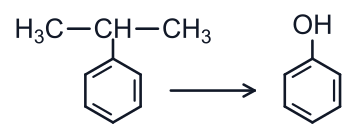
i) (i) Oleum; (ii) NaOH, ; (iii) H
b)
ii) (i) O; (ii) HO/H
c) propan-2-ol
iii) (i) CHOH, H; (ii) H, catalyst
d)
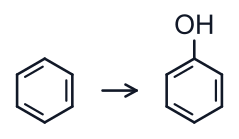
iv) (i) conc. HSO, ; (ii) H/HO
Answer and explanation
Answer: (2)
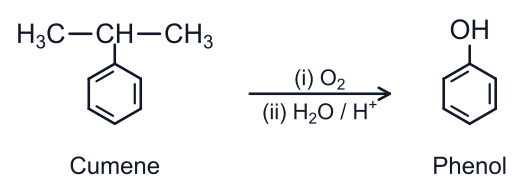
Cumene gives phenol by air oxidation () to cumene hydroperoxide then acid hydrolysis (/), so A-II. Acetic acid is converted to ethanol by esterification (/) followed by reduction (/catalyst), so B-III. Propan-1-ol is dehydrated (conc. , heat) to propene, which on Markovnikov hydration (/) gives propan-2-ol, so C-IV. Benzene is converted to phenol by sulphonation (oleum), NaOH fusion, then acidification, so D-I. Hence A-II, B-III, C-IV, D-I.
The functional group that can be identified through phthalein dye test is:
Answer and explanation
Answer: (2)
In the phthalein dye test a phenol is heated with phthalic anhydride and concentrated HSO to form phenolphthalein, which turns pink on addition of NaOH; this confirms a phenolic -OH group. Aldehydes are detected by Tollens'/Fehling's tests, carboxylic acids by effervescence with NaHCO, and alcohols by the ceric ammonium nitrate or Lucas tests.
Anisole on cleavage with HI gives
Answer and explanation
Answer: (4)
HI protonates anisole at oxygen, then attacks the methyl group by substitution nucleophilic bimolecular (S2) cleavage. The products are phenol and methyl iodide (CHI); the aryl C-O bond is not cleaved by S2. Chapter: Alcohols, Phenols and Ethers.
Why the other options are wrong:
- (1) Iodobenzene and : this needs to attack the ring carbon, but S2 cannot occur at an sp aryl carbon, so the aryl C-O bond stays intact.
- (2) Phenol and : anisole is a methyl ether, so the alkyl iodide formed is ; ethyl iodide would come from phenetole.
- (3) Iodobenzene and : the aryl C-O bond is not broken, and anisole has no ethyl group to give ethanol.
Your result
0 / 12
Keep practising with NEET PYQs, review explanations and track your chapter accuracy in the app. Free until the 2027 exam.