

Alcohols, Phenols and Ethers: NEET previous year questions
Every Alcohols, Phenols and Ethers question from the official NEET papers on this site, with the answer and a worked solution.
The questions come from NEET 2026 and NEET 2020. Each shows its answer and solution when you open it, so you can attempt it first. For what the chapter covers and how NEET tests it, see the Alcohols, Phenols and Ethers guide.
NEET 2026
NEET 2026 · Q65
Match List-I (conversions) with List-II (reagents/conditions) and choose the correct answer from the options given below:
List I
List II
a)
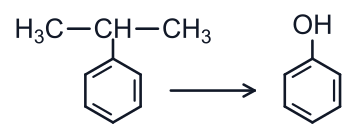
i) (i) Oleum; (ii) NaOH, ; (iii) H
b)
ii) (i) O; (ii) HO/H
c) propan-2-ol
iii) (i) CHOH, H; (ii) H, catalyst
d)
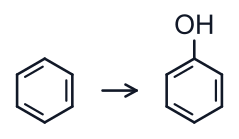
iv) (i) conc. HSO, ; (ii) H/HO
- (1)
A-II, B-III, C-I, D-IV
- (2)
A-II, B-III, C-IV, D-I
- (3)
A-II, B-IV, C-III, D-I
- (4)
A-I, B-III, C-IV, D-II
Answer and solution
Answer: (2)
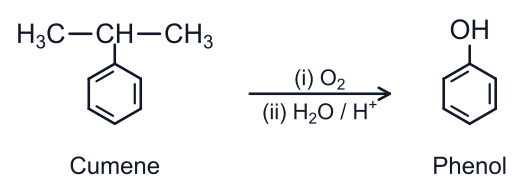
Cumene gives phenol by air oxidation () to cumene hydroperoxide then acid hydrolysis (/), so A-II. Acetic acid is converted to ethanol by esterification (/) followed by reduction (/catalyst), so B-III. Propan-1-ol is dehydrated (conc. , heat) to propene, which on Markovnikov hydration (/) gives propan-2-ol, so C-IV. Benzene is converted to phenol by sulphonation (oleum), NaOH fusion, then acidification, so D-I. Hence A-II, B-III, C-IV, D-I.
- (1)
NEET 2026 · Q69
The functional group that can be identified through phthalein dye test is:
- (1)
Aldehyde
- (2)
Phenolic
- (3)
Carboxylic acid
- (4)
Alcohol
Answer and solution
Answer: (2)
In the phthalein dye test a phenol is heated with phthalic anhydride and concentrated HSO to form phenolphthalein, which turns pink on addition of NaOH; this confirms a phenolic -OH group. Aldehydes are detected by Tollens'/Fehling's tests, carboxylic acids by effervescence with NaHCO, and alcohols by the ceric ammonium nitrate or Lucas tests.
- (1)
NEET 2020
NEET 2020 · Q132
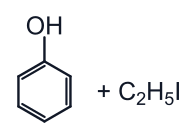
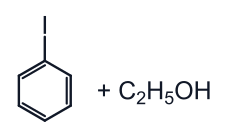
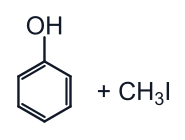
Anisole on cleavage with HI gives
- (1)
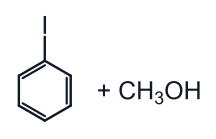
- (2)
- (3)
- (4)
Answer and solution
Answer: (4)
HI protonates anisole at oxygen, then attacks the methyl group by substitution nucleophilic bimolecular (S2) cleavage. The products are phenol and methyl iodide (CHI); the aryl C-O bond is not cleaved by S2. Chapter: Alcohols, Phenols and Ethers.
Why the other options are wrong:
- (1) Iodobenzene and : this needs to attack the ring carbon, but S2 cannot occur at an sp aryl carbon, so the aryl C-O bond stays intact.
- (2) Phenol and : anisole is a methyl ether, so the alkyl iodide formed is ; ethyl iodide would come from phenetole.
- (3) Iodobenzene and : the aryl C-O bond is not broken, and anisole has no ethyl group to give ethanol.- (1)
Practise Alcohols, Phenols and Ethers in the app: it brings back the questions you get wrong, so the chapter improves, not just your memory of these. Or try the free CBT mock. All chapters: NEET chapter-wise PYQs.
Questions
Are these the official NEET questions on Alcohols, Phenols and Ethers?
Yes. They are the questions NTA set in each paper, in its wording. The solutions are written by BrainIt.
Something here wrong or out of date? Email hello@brainit.pro and a person will read it.