
Chemistry · chapter PYQs
Chemical Bonding and Molecular Structure, on the exam screen.
6 questions from NEET 2026, Re-NEET 2026, NEET 2020, 6 minutes, marked +4 / −1. See them with solutions.
Chemical Bonding and Molecular Structure · PYQs
Candidate: You
Time Left
Q1/6
Match List-I with List-II and choose the correct answer from the options given below:
List I
List II
P)
I) 3 bonds, 2 bonds
Q)
II) 3 bonds, one lone pair
R)
III) 4 bonds
S)
IV) 5 bonds, 1 bond
Answer and explanation
Answer: (2)
Ethene () has 4 C-H plus 1 C-C sigma bonds (5 sigma) and 1 pi bond (IV). Ethyne () has 2 C-H plus 1 C-C sigma (3 sigma) and 2 pi bonds (I). Methane () has 4 C-H sigma bonds (III). Ammonia () has 3 N-H sigma bonds and one lone pair on nitrogen (II). Hence P-IV, Q-I, R-III, S-II.
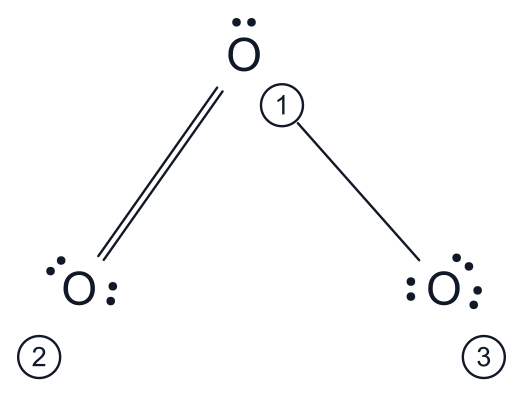
For the given Lewis (resonance) structure of ozone, the correct formal charges on the oxygen atoms numbered 2, 1 and 3 respectively are:
Answer and explanation
Answer: (2)
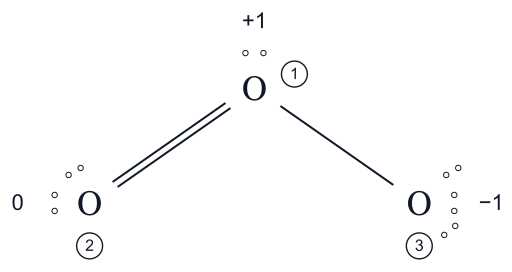
Formal charge = (valence electrons) (non-bonding electrons) (bonding electrons). For the doubly bonded terminal O (atom 2): ; the central O (atom 1): ; the singly bonded terminal O (atom 3): . This gives 0, +1, , matching option (2).
Match the species in List-I with their geometry in List-II.
List I
List II
P)
I) Tetrahedral
Q)
II) Square Planar
R)
III) Trigonal bipyramidal
S)
IV) Square pyramidal
Choose the correct answer from the options given below:
Answer and explanation
Answer: (2)
has five bond pairs and no lone pair, so it is trigonal bipyramidal (P-III). has five bond pairs plus one lone pair; the lone pair occupies one octahedral position and pushes the shape to square pyramidal (Q-IV). is four bond pairs with no lone pair, hence tetrahedral (R-I). is a complex with the strong-field cyanide ligand, forcing hybridisation and a square planar geometry (S-II). NCERT Class 11, Chemical Bonding and Molecular Structure; NCERT Class 12, Coordination Compounds.
The highest occupied molecular orbital for is
Answer and explanation
Answer: (4)
has 20 electrons, enough to fill every molecular orbital derived from the 1s, 2s and 2p atomic orbitals. Filling in order, , the last two electrons enter , which is therefore the HOMO. With every bonding orbital matched by its antibonding partner the bond order is zero, which is why does not exist as a stable molecule. NCERT Class 11, Chemical Bonding and Molecular Structure.
Which of the following set of molecules will have zero dipole moment?
Answer and explanation
Answer: (3)
Boron trifluoride, beryllium difluoride, and carbon dioxide have symmetrical structures leading to zero net dipole moments. 1,4-dichlorobenzene also has a symmetrical structure, making the net dipole moment zero. Chapter: Chemical Bonding and Molecular Structure.
Identify a molecule which does not exist.
Answer and explanation
Answer: (4)
does not exist because helium atoms have a complete outer shell and do not form stable bonds with each other. In contrast, , , and can form stable molecules. Chapter: Chemical Bonding and Molecular Structure.
Your result
0 / 24
Keep practising with NEET PYQs, review explanations and track your chapter accuracy in the app. Free until the 2027 exam.