

Chemical Bonding and Molecular Structure: NEET previous year questions
Every Chemical Bonding and Molecular Structure question from the official NEET papers on this site, with the answer and a worked solution.
The questions come from NEET 2026, Re-NEET 2026 and NEET 2020. Each shows its answer and solution when you open it, so you can attempt it first. For what the chapter covers and how NEET tests it, see the Chemical Bonding and Molecular Structure guide.
NEET 2026
NEET 2026 · Q59
Match List-I with List-II and choose the correct answer from the options given below:
List I
List II
P)
I) 3 bonds, 2 bonds
Q)
II) 3 bonds, one lone pair
R)
III) 4 bonds
S)
IV) 5 bonds, 1 bond
- (1)
P-III, Q-IV, R-II, S-I
- (2)
P-IV, Q-I, R-III, S-II
- (3)
P-I, Q-II, R-IV, S-III
- (4)
P-II, Q-III, R-I, S-IV
Answer and solution
Answer: (2)
Ethene () has 4 C-H plus 1 C-C sigma bonds (5 sigma) and 1 pi bond (IV). Ethyne () has 2 C-H plus 1 C-C sigma (3 sigma) and 2 pi bonds (I). Methane () has 4 C-H sigma bonds (III). Ammonia () has 3 N-H sigma bonds and one lone pair on nitrogen (II). Hence P-IV, Q-I, R-III, S-II.
- (1)
NEET 2026 · Q82
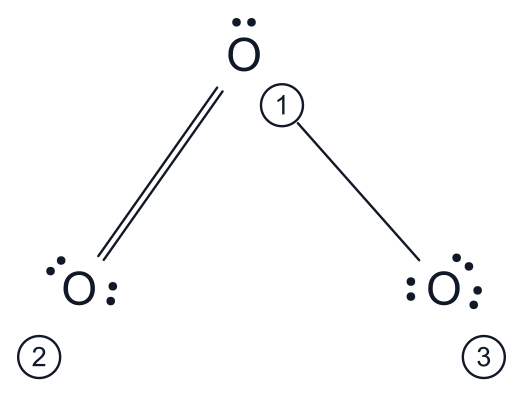
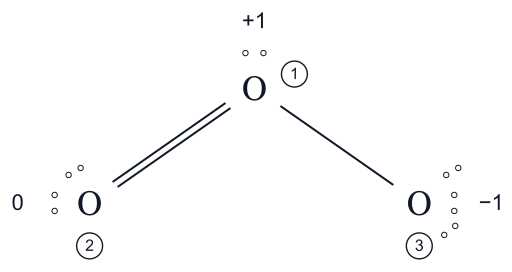
For the given Lewis (resonance) structure of ozone, the correct formal charges on the oxygen atoms numbered 2, 1 and 3 respectively are:
- (1)
- (2)
- (3)
- (4)
Answer and solution
Answer: (2)
Formal charge = (valence electrons) (non-bonding electrons) (bonding electrons). For the doubly bonded terminal O (atom 2): ; the central O (atom 1): ; the singly bonded terminal O (atom 3): . This gives 0, +1, , matching option (2).
- (1)
Re-NEET 2026
Re-NEET 2026 · Q75
Match the species in List-I with their geometry in List-II.
List I
List II
P)
I) Tetrahedral
Q)
II) Square Planar
R)
III) Trigonal bipyramidal
S)
IV) Square pyramidal
Choose the correct answer from the options given below:
- (1)
P-IV, Q-III, R-I, S-II
- (2)
P-III, Q-IV, R-I, S-II
- (3)
P-III, Q-I, R-II, S-IV
- (4)
P-III, Q-II, R-I, S-IV
Answer and solution
Answer: (2)
has five bond pairs and no lone pair, so it is trigonal bipyramidal (P-III). has five bond pairs plus one lone pair; the lone pair occupies one octahedral position and pushes the shape to square pyramidal (Q-IV). is four bond pairs with no lone pair, hence tetrahedral (R-I). is a complex with the strong-field cyanide ligand, forcing hybridisation and a square planar geometry (S-II). NCERT Class 11, Chemical Bonding and Molecular Structure; NCERT Class 12, Coordination Compounds.
- (1)
Re-NEET 2026 · Q90
The highest occupied molecular orbital for is
- (1)
- (2)
- (3)
- (4)
Answer and solution
Answer: (4)
has 20 electrons, enough to fill every molecular orbital derived from the 1s, 2s and 2p atomic orbitals. Filling in order, , the last two electrons enter , which is therefore the HOMO. With every bonding orbital matched by its antibonding partner the bond order is zero, which is why does not exist as a stable molecule. NCERT Class 11, Chemical Bonding and Molecular Structure.
- (1)
NEET 2020
NEET 2020 · Q100
Which of the following set of molecules will have zero dipole moment?
- (1)
Boron trifluoride, hydrogen fluoride, carbon dioxide, 1,3-dichlorobenzene
- (2)
Nitrogen trifluoride, beryllium difluoride, water, 1,3-dichlorobenzene
- (3)
Boron trifluoride, beryllium difluoride, carbon dioxide, 1,4-dichlorobenzene
- (4)
Ammonia, beryllium difluoride, water, 1,4-dichlorobenzene
Answer and solution
Answer: (3)
Boron trifluoride, beryllium difluoride, and carbon dioxide have symmetrical structures leading to zero net dipole moments. 1,4-dichlorobenzene also has a symmetrical structure, making the net dipole moment zero. Chapter: Chemical Bonding and Molecular Structure.
- (1)
NEET 2020 · Q126
Identify a molecule which does not exist.
- (1)
Li
- (2)
C
- (3)
O
- (4)
He
Answer and solution
Answer: (4)
does not exist because helium atoms have a complete outer shell and do not form stable bonds with each other. In contrast, , , and can form stable molecules. Chapter: Chemical Bonding and Molecular Structure.
- (1)
Practise Chemical Bonding and Molecular Structure in the app: it brings back the questions you get wrong, so the chapter improves, not just your memory of these. Or try the free CBT mock. All chapters: NEET chapter-wise PYQs.
Questions
Are these the official NEET questions on Chemical Bonding and Molecular Structure?
Yes. They are the questions NTA set in each paper, in its wording. The solutions are written by BrainIt.
Something here wrong or out of date? Email hello@brainit.pro and a person will read it.