
Chemistry · chapter PYQs
Haloalkanes and Haloarenes, on the exam screen.
3 questions from NEET 2026, Re-NEET 2026, NEET 2020, 3 minutes, marked +4 / −1. See them with solutions.
Haloalkanes and Haloarenes · PYQs
Candidate: You
Time Left
Q1/3
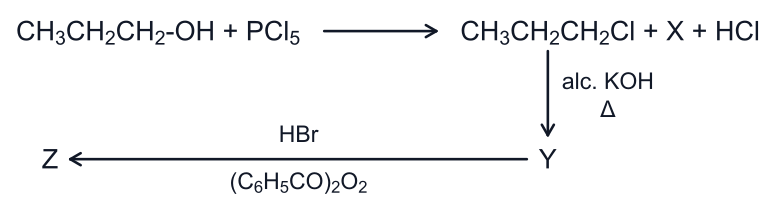
In the following reaction sequence, X and Z respectively are:
Answer and explanation
Answer: (2)
Propan-1-ol reacting with gives 1-chloropropane together with phosphoryl chloride () and HCl, so X = . Alcoholic KOH dehydrohalogenates 1-chloropropane to propene (Y). Addition of HBr in the presence of a peroxide follows the anti-Markovnikov (peroxide/Kharasch) effect, placing Br on the terminal carbon to give 1-bromopropane, so Z = . Hence X = , Z = .
Why the other options are wrong:
- (1) Wrong: peroxide effect gives 1-bromopropane, not isopropyl bromide.
- (3) Wrong: gives (not ) and Z is the primary bromide.
- (4) Wrong: gives , not ( comes from ).One of the products formed in the following reaction is

Answer and explanation
Answer: (4)
The reactants are cyclohexylmagnesium bromide and cyclohexylamine. A Grignard reagent is a very strong base and is destroyed by an acidic N-H proton: . The organic product derived from the Grignard reagent is therefore cyclohexane, option (4); no new C-C or C-N bond is formed. NCERT Class 12, Haloalkanes and Haloarenes (Grignard reagents).
Why the other options are wrong:
- (1) assumes the Grignard carbon substitutes at nitrogen; proton transfer occurs instead
- (2) assumes C-C coupling while retaining the amino group, but there is no electrophilic carbon or coupling catalyst
- (3) assumes direct coupling of the two cyclohexyl groups rather than acid-base proton transferElimination reaction of 2-Bromo-pentane to form pent-2-ene is
Statement I: β-Elimination reaction
Statement II: Follows Zaitsev rule
Statement III: Dehydrohalogenation reaction
Statement IV: Dehydration reactionAnswer and explanation
Answer: (4)
The elimination reaction of 2-Bromo-pentane to form pent-2-ene is a -elimination reaction, follows Zaitsev's rule, and is a dehydrohalogenation reaction. Dehydration involves removing a water molecule, which is not the case here. Chapter: Haloalkanes and Haloarenes.
Your result
0 / 12
Keep practising with NEET PYQs, review explanations and track your chapter accuracy in the app. Free until the 2027 exam.