

Haloalkanes and Haloarenes: NEET previous year questions
Every Haloalkanes and Haloarenes question from the official NEET papers on this site, with the answer and a worked solution.
The questions come from NEET 2026, Re-NEET 2026 and NEET 2020. Each shows its answer and solution when you open it, so you can attempt it first. For what the chapter covers and how NEET tests it, see the Haloalkanes and Haloarenes guide.
NEET 2026
NEET 2026 · Q67
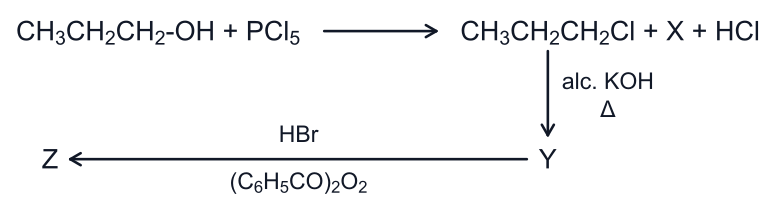
In the following reaction sequence, X and Z respectively are:
- (1)
- (2)
- (3)
- (4)
Answer and solution
Answer: (2)
Propan-1-ol reacting with gives 1-chloropropane together with phosphoryl chloride () and HCl, so X = . Alcoholic KOH dehydrohalogenates 1-chloropropane to propene (Y). Addition of HBr in the presence of a peroxide follows the anti-Markovnikov (peroxide/Kharasch) effect, placing Br on the terminal carbon to give 1-bromopropane, so Z = . Hence X = , Z = .
Why the other options are wrong:
- (1) Wrong: peroxide effect gives 1-bromopropane, not isopropyl bromide.
- (3) Wrong: gives (not ) and Z is the primary bromide.
- (4) Wrong: gives , not ( comes from ).- (1)
Re-NEET 2026
Re-NEET 2026 · Q72
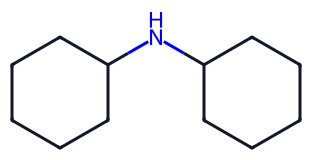
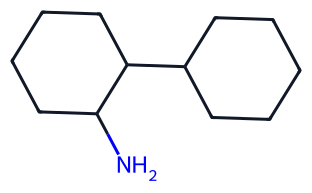
One of the products formed in the following reaction is

- (1)
- (2)
- (3)

- (4)

Answer and solution
Answer: (4)
The reactants are cyclohexylmagnesium bromide and cyclohexylamine. A Grignard reagent is a very strong base and is destroyed by an acidic N-H proton: . The organic product derived from the Grignard reagent is therefore cyclohexane, option (4); no new C-C or C-N bond is formed. NCERT Class 12, Haloalkanes and Haloarenes (Grignard reagents).
Why the other options are wrong:
- (1) assumes the Grignard carbon substitutes at nitrogen; proton transfer occurs instead
- (2) assumes C-C coupling while retaining the amino group, but there is no electrophilic carbon or coupling catalyst
- (3) assumes direct coupling of the two cyclohexyl groups rather than acid-base proton transfer- (1)
NEET 2020
NEET 2020 · Q92
Elimination reaction of 2-Bromo-pentane to form pent-2-ene is
Statement I: β-Elimination reaction
Statement II: Follows Zaitsev rule
Statement III: Dehydrohalogenation reaction
Statement IV: Dehydration reaction- (1)
(I), (III), (IV)
- (2)
(II), (III), (IV)
- (3)
(I), (II), (IV)
- (4)
(I), (II), (III)
Answer and solution
Answer: (4)
The elimination reaction of 2-Bromo-pentane to form pent-2-ene is a -elimination reaction, follows Zaitsev's rule, and is a dehydrohalogenation reaction. Dehydration involves removing a water molecule, which is not the case here. Chapter: Haloalkanes and Haloarenes.
- (1)
Practise Haloalkanes and Haloarenes in the app: it brings back the questions you get wrong, so the chapter improves, not just your memory of these. Or try the free CBT mock. All chapters: NEET chapter-wise PYQs.
Questions
Are these the official NEET questions on Haloalkanes and Haloarenes?
Yes. They are the questions NTA set in each paper, in its wording. The solutions are written by BrainIt.
Something here wrong or out of date? Email hello@brainit.pro and a person will read it.