
Chemistry · chapter PYQs
p-Block Elements (Groups 15-18), on the exam screen.
4 questions from NEET 2026, Re-NEET 2026, NEET 2020, 4 minutes, marked +4 / −1. See them with solutions.
p-Block Elements (Groups 15-18) · PYQs
Candidate: You
Time Left
Q1/4
Identify the incorrect statement from the following:
Answer and explanation
Answer: (4)
Both nitrogen and oxygen are period-2 elements lacking accessible d-orbitals, so nitrogen cannot form a d-p bond with oxygen, making statement D incorrect. Nitrogen does form p-p multiple bonds (as in ), the heavier elements P and As have vacant d-orbitals allowing d-d overlap with transition metals, and P, As, Sb show catenation, so those statements are correct.
Identify the correct statement about from the following options:
Answer and explanation
Answer: (1)
In ClF the central Cl has five electron domains (3 bond pairs + 2 lone pairs) and spd hybridisation, giving a trigonal bipyramidal electron arrangement. The two lone pairs occupy equatorial positions, leaving a T-shaped molecular geometry. Hence ClF is T-shaped with two lone pairs on the Cl atom.
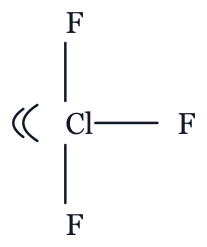
Why the other options are wrong:
- (2) ClF has two, not three, lone pairs on chlorine.
- (3) Trigonal pyramidal (like NH) has 3 bond pairs + 1 lone pair, not the case here.
- (4) Planar trigonal (like BF) has no lone pairs on the central atom.Given below are two statements.
Statement I: Heating with concentrated and results in oxidation of Mn.
Statement II: Heating with concentrated and results in reduction of Mn.
In light of the above statements, choose the most appropriate answer from the options given below.Answer and explanation
Answer: (4)
In both reactions acts as the OXIDISING agent on the halide, so manganese itself goes from +4 down to +2 - it is REDUCED, not oxidised. Statement-I therefore states the opposite of what happens and is wrong, while Statement-II describes the same reduction correctly for the iodide. This is the classic laboratory route to chlorine, . NCERT Class 12, The p-Block Elements (Group 17, preparation of chlorine).
Which of the following oxoacid of sulphur has - O - O - linkage?
Answer and explanation
Answer: (2)
Peroxodisulphuric acid () contains the peroxide linkage (-O-O-), which is not present in the other oxoacids listed. Chapter: p-Block Elements (Groups 15-18).
Your result
0 / 16
Keep practising with NEET PYQs, review explanations and track your chapter accuracy in the app. Free until the 2027 exam.