

p-Block Elements (Groups 15-18): NEET previous year questions
Every p-Block Elements (Groups 15-18) question from the official NEET papers on this site, with the answer and a worked solution.
The questions come from NEET 2026, Re-NEET 2026 and NEET 2020. Each shows its answer and solution when you open it, so you can attempt it first. For what the chapter covers and how NEET tests it, see the p-Block Elements (Groups 15-18) guide.
NEET 2026
NEET 2026 · Q62
Identify the incorrect statement from the following:
- (1)
Nitrogen can form multiple bonds with itself.
- (2)
and form bond with transition metals.
- (3)
Phosphorus, arsenic and antimony show catenation property.
- (4)
Nitrogen can form bond with oxygen.
Answer and solution
Answer: (4)
Both nitrogen and oxygen are period-2 elements lacking accessible d-orbitals, so nitrogen cannot form a d-p bond with oxygen, making statement D incorrect. Nitrogen does form p-p multiple bonds (as in ), the heavier elements P and As have vacant d-orbitals allowing d-d overlap with transition metals, and P, As, Sb show catenation, so those statements are correct.
- (1)
NEET 2026 · Q76
Identify the correct statement about from the following options:
- (1)
It has T-shaped geometry with two lone pairs on Cl atom.
- (2)
It has T-shaped geometry with three lone pairs on Cl atom.
- (3)
It has a trigonal pyramidal geometry with two lone pairs on Cl atom.
- (4)
It has a planar trigonal geometry with two lone pairs on Cl atom.
Answer and solution
Answer: (1)
In ClF the central Cl has five electron domains (3 bond pairs + 2 lone pairs) and spd hybridisation, giving a trigonal bipyramidal electron arrangement. The two lone pairs occupy equatorial positions, leaving a T-shaped molecular geometry. Hence ClF is T-shaped with two lone pairs on the Cl atom.
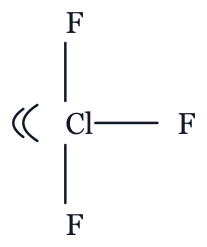
Why the other options are wrong:
- (2) ClF has two, not three, lone pairs on chlorine.
- (3) Trigonal pyramidal (like NH) has 3 bond pairs + 1 lone pair, not the case here.
- (4) Planar trigonal (like BF) has no lone pairs on the central atom.- (1)
Re-NEET 2026
Re-NEET 2026 · Q65
Given below are two statements.
Statement I: Heating with concentrated and results in oxidation of Mn.
Statement II: Heating with concentrated and results in reduction of Mn.
In light of the above statements, choose the most appropriate answer from the options given below.- (1)
Both Statement-I and Statement-II are correct
- (2)
Both Statement-I and Statement-II are incorrect
- (3)
Statement-I is correct but Statement-II is incorrect
- (4)
Statement-I is incorrect but Statement-II is correct
Answer and solution
Answer: (4)
In both reactions acts as the OXIDISING agent on the halide, so manganese itself goes from +4 down to +2 - it is REDUCED, not oxidised. Statement-I therefore states the opposite of what happens and is wrong, while Statement-II describes the same reduction correctly for the iodide. This is the classic laboratory route to chlorine, . NCERT Class 12, The p-Block Elements (Group 17, preparation of chlorine).
- (1)
NEET 2020
NEET 2020 · Q108
Which of the following oxoacid of sulphur has - O - O - linkage?
- (1)
, sulphuric acid
- (2)
, peroxodisulphuric acid
- (3)
, pyrosulphuric acid
- (4)
, sulphurous acid
Answer and solution
Answer: (2)
Peroxodisulphuric acid () contains the peroxide linkage (-O-O-), which is not present in the other oxoacids listed. Chapter: p-Block Elements (Groups 15-18).
- (1)
Practise p-Block Elements (Groups 15-18) in the app: it brings back the questions you get wrong, so the chapter improves, not just your memory of these. Or try the free CBT mock. All chapters: NEET chapter-wise PYQs.
Questions
Are these the official NEET questions on p-Block Elements (Groups 15-18)?
Yes. They are the questions NTA set in each paper, in its wording. The solutions are written by BrainIt.
Something here wrong or out of date? Email hello@brainit.pro and a person will read it.