
Physics · chapter PYQs
Current Electricity, on the exam screen.
10 questions from NEET 2026, Re-NEET 2026, NEET 2020, 10 minutes, marked +4 / −1. See them with solutions.
Current Electricity · PYQs
Candidate: You
Time Left
Q1/10
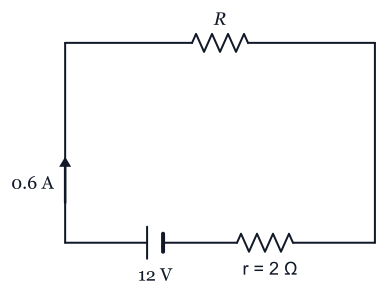
A resistor is connected to a battery of 12 V emf and internal resistance 2 . If the current in the circuit is 0.6 A, the terminal voltage of the battery is:
Answer and explanation
Answer: (4)
The terminal voltage is the electromotive force (emf) minus the drop across the internal resistance: V, option (4). The 1.2 V drop across the internal resistance is what is subtracted, and 12 V would only be the terminal voltage if no current flowed.
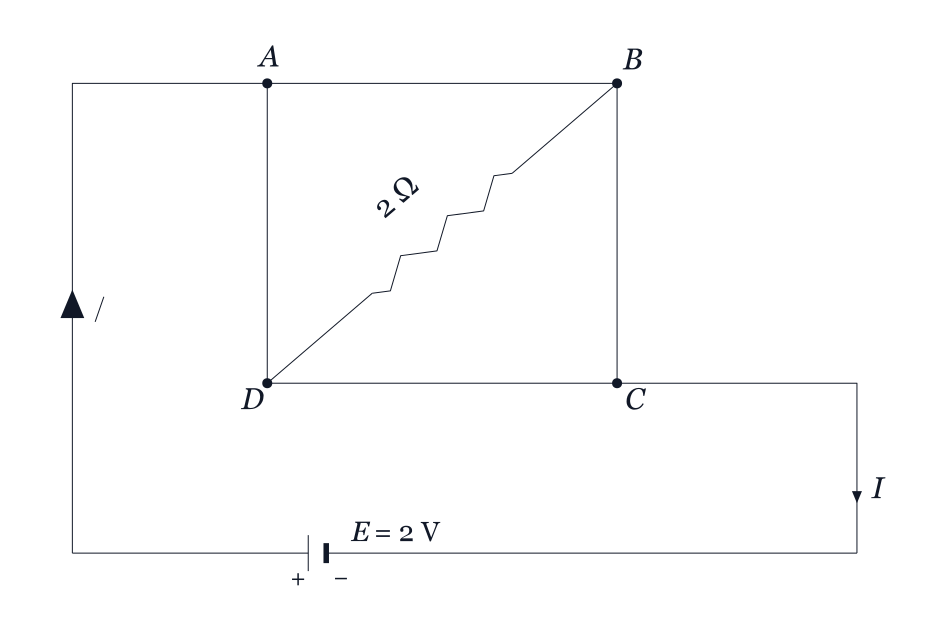
A uniform metallic wire having resistance 4 is bent to form a square loop (ABCD) (see figure). A resistance of 2 is connected between points B and D and a battery of 2 V is connected across points A and C as shown in the figure. Now the value of current () is:
Answer and explanation
Answer: (1)
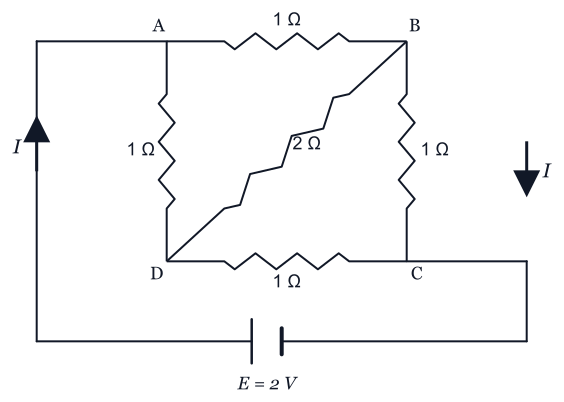
The 4 wire splits equally, so each side of the square is 1 . With the 2 across diagonal BD and the 2 V battery across A and C, the four 1 arms form a balanced Wheatstone bridge, so no current flows through the 2 branch. The effective resistance across AC is 1 , giving A.
Why the other options are wrong:
- (2) Assumes far too low a resistance.
- (3) Arbitrary value from mis-combining resistances.
- (4) Would need 0.5 , as if each path from A to C had one 1 side instead of two.A room heater is rated 400 W, 220 V. If the supply voltage drops to 200 V, what will be the power consumed (approximately)?
Answer and explanation
Answer: (3)
The heater resistance is fixed, so gives W. Power scales as the square of voltage, not linearly, so option (2) (unchanged) and option (1) (linear scaling) are wrong, and option (4) over-reduces.
In a metre bridge experiment (see figure), the positions of the cell, , and galvanometer, , are interchanged. We shall observe in the galvanometer:

Answer and explanation
Answer: (4)
A metre bridge is a Wheatstone network, whose balance (null) condition is symmetric with respect to interchanging the cell and the galvanometer, so the balance point does not move. Away from that point the bridge is unbalanced and the galvanometer deflects; the direction of deflection depends on which side of balance the jockey lies, and it reads zero exactly at the balance point.
Why the other options are wrong:
- (1) Deflection is not restricted to one side; it flips about the null point.
- (2) No deflection occurs only at balance, not everywhere.
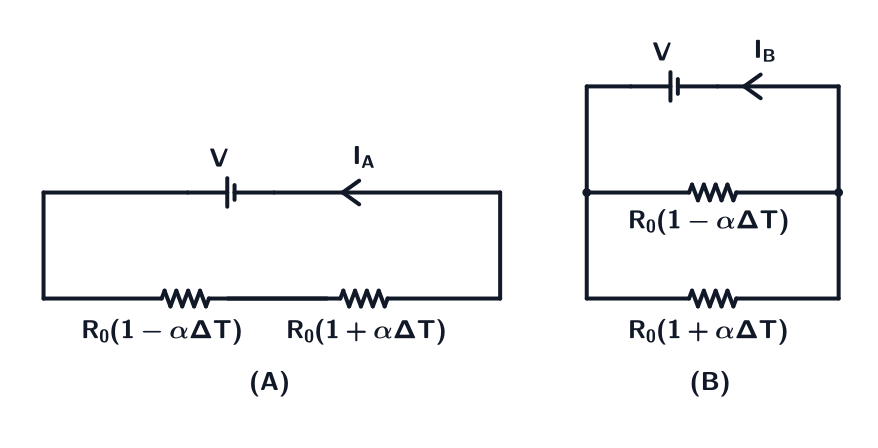
- (3) Same error as (1) but for the opposite side.Consider two circuits, (A) and (B), each having two resistors. One of them has a positive temperature coefficient of resistance, , while the other one has a negative temperature of coefficient, , as shown in the figure. The current through these circuits are denoted by and . At initial temperature, the resistance of the two resistors is . As the temperature is increased, the correct option that describes the variation of current in these circuits is:
Answer and explanation
Answer: (1)
In circuit (A) the resistors are in SERIES, so - the two temperature terms cancel exactly and is unchanged. In circuit (B) they are in PARALLEL, giving , which decreases as grows because of the term, so increases. NCERT Class 12, Current Electricity (temperature dependence of resistivity).
Why the other options are wrong:
- (2) assumes the series combination must heat up and resist more, missing the exact cancellation between and
- (3) swaps the two circuits, applying the parallel result to (A) and the series result to (B)
- (4) spots the cancellation in series and wrongly assumes the same cancellation holds for reciprocals in parallelWhich of the following graph represents the variation of resistivity (ρ) with temperature (T) for copper?
Answer and explanation
Answer: (2)
For copper, resistivity rises with temperature and is nearly linear over a limited ordinary-temperature range, but bends appreciably at very low temperatures. The source curve with that behaviour is option (2). Chapter: Current Electricity.
Why the other options are wrong:
- (1) Resistivity falling steeply and then levelling off as temperature rises is how a semiconductor behaves, not a metal like copper.
- (3) This curve shows resistivity decreasing with temperature, but the resistivity of copper increases with temperature.
- (4) A straight line treats copper as linear at every temperature, but the linear relation holds only over a limited range and the real curve bends at low temperatures.The color code of a resistance is given below
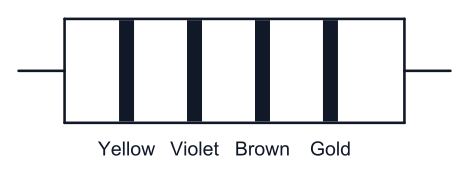
The values of resistance and tolerance, respectively, are
Answer and explanation
Answer: (3)
Yellow and violet give digits 4 and 7, brown is the ×10 multiplier, and gold means 5%. Therefore R = with 5% tolerance. Chapter: Current Electricity.
Why the other options are wrong:
- (1) 47 k would need an orange () multiplier band, and 10% tolerance is a silver band, not gold.
- (2) 4.7 k is , which needs a red multiplier band; brown only multiplies by 10.
- (4) 470 k is , which needs a yellow multiplier band; brown only multiplies by 10.A resistance wire connected in the left gap of a metre bridge balances a 10 resistance in the right gap at a point which divides the bridge wire in the ratio 3 : 2. If the length of the resistance wire is 1.5 m, then the length of 1 of the resistance wire is :
Answer and explanation
Answer: (1)
At balance, R/10 = 3/2, so the 1.5 m resistance wire has R = 15 . Its length per ohm is 1.5/15 = 0.10 m. Chapter: Current Electricity.
A charged particle having drift velocity of 7.5 × 10⁻⁴ m s⁻¹ in an electric field of 3 × 10⁻¹⁰ V m⁻¹ has a mobility in m² V⁻¹ s⁻¹ of
Answer and explanation
Answer: (1)
Mobility is given by , where is the drift velocity and is the electric field. Substituting the values, . Chapter: Current Electricity.
The solids which have the negative temperature coefficient of resistance are:
Answer and explanation
Answer: (3)
Metals have a positive temperature coefficient of resistance, while insulators and semiconductors have a negative temperature coefficient of resistance. This is due to the increase in carrier concentration in insulators and semiconductors with temperature. Chapter: Current Electricity.
Your result
0 / 40
Keep practising with NEET PYQs, review explanations and track your chapter accuracy in the app. Free until the 2027 exam.