
Physics · chapter PYQs
Electromagnetic Induction, on the exam screen.
4 questions from NEET 2026, Re-NEET 2026, 4 minutes, marked +4 / −1. See them with solutions.
Electromagnetic Induction · PYQs
Candidate: You
Time Left
Q1/4
A rectangular wire loop of sides 8 cm and 3 cm with a small cut, is moving out of a region of uniform magnetic field of magnitude 0.3 T directed normal to the plane of the loop. The emf developed across the cut, if the velocity of the loop is 2 cm s, in a direction normal to the shorter side of the loop, will be:
Answer and explanation
Answer: (4)
The motional electromotive force (emf) is , where is the side perpendicular to the velocity. Since the loop moves normal to the shorter side, the effective length is the shorter side (3 cm): V. Option (1) wrongly uses the 8 cm side.
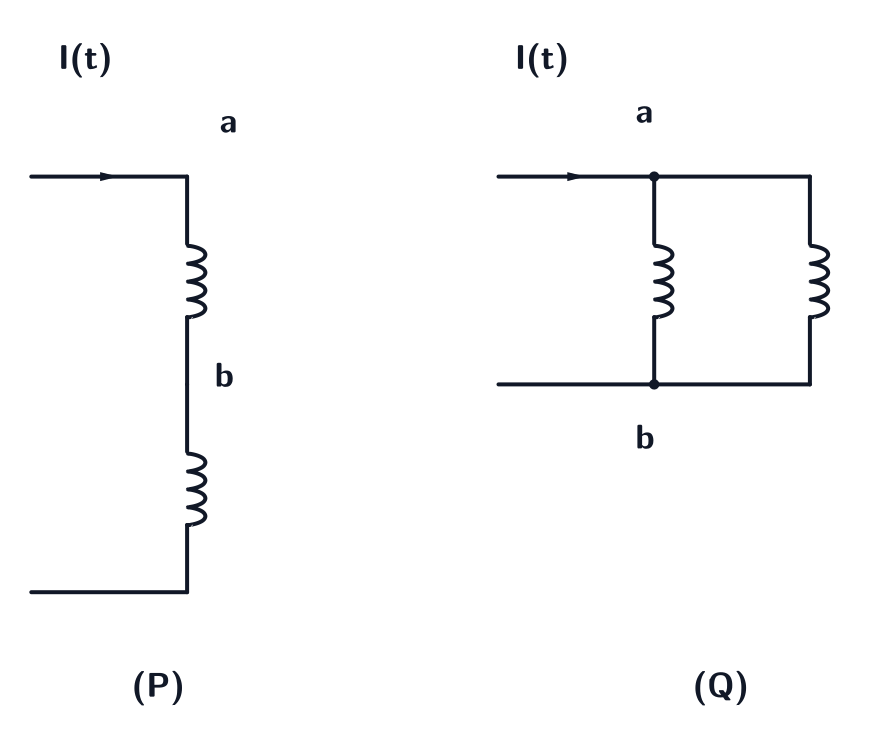
Two identical inductors are connected in two different configurations and , where a time varying current is flowing, as shown in the figure. The induced emf between points and for configuration is and that for configuration is . The ratio is: [Neglect the effect of mutual inductance.]
Answer and explanation
Answer: (4)
In configuration the two inductors are in series and the segment between and spans just ONE of them, carrying the full current, so . In configuration the points and straddle the parallel pair, whose equivalent inductance is , so . The ratio is therefore 2. NCERT Class 12, Electromagnetic Induction (self-inductance).
Why the other options are wrong:
- (1) takes across the series pair as and inverts the ratio
- (2) inverts the correct answer by swapping which configuration sits in the numerator
- (3) assumes identical inductors must produce identical electromotive forces (emfs) regardless of how and are placedConsider a long solenoid of length and radius . If is the number of turns per unit length and is the permeability of free space, the inductance of the solenoid is :
Answer and explanation
Answer: (1)
For a long solenoid , where is turns per unit length and the cross-sectional area. Substituting gives . NCERT Class 12, Electromagnetic Induction (self-inductance).
A conducting loop of finite resistance lies on the plane. There is a constant magnetic field in the direction. The area of the loop varies with time , as in appropriate units. The figure that correctly indicates the qualitative behaviour of the power dissipated in the loop as a function of time is:
Answer and explanation
Answer: (2)
Faraday's law gives , so the dissipated power is . Because is MAXIMUM at and touches zero at , the correct graph starts at a peak and dips to zero, unlike a curve which would start at zero. is never negative because the electromotive force (emf) is squared. NCERT Class 12, Electromagnetic Induction (Faraday's law).
Why the other options are wrong:
- (1) differentiates to rather than , producing a curve that starts at zero
- (3) assumes the constant field means a constant emf, forgetting that it is the CHANGING area that drives induction
- (4) confuses the growing area with growing power, ignoring that the flux change is periodic and bounded
Your result
0 / 16
Keep practising with NEET PYQs, review explanations and track your chapter accuracy in the app. Free until the 2027 exam.