

Electromagnetic Induction: NEET previous year questions
Every Electromagnetic Induction question from the official NEET papers on this site, with the answer and a worked solution.
The questions come from NEET 2026 and Re-NEET 2026. Each shows its answer and solution when you open it, so you can attempt it first. For what the chapter covers and how NEET tests it, see the Electromagnetic Induction guide.
NEET 2026
NEET 2026 · Q30
A rectangular wire loop of sides 8 cm and 3 cm with a small cut, is moving out of a region of uniform magnetic field of magnitude 0.3 T directed normal to the plane of the loop. The emf developed across the cut, if the velocity of the loop is 2 cm s, in a direction normal to the shorter side of the loop, will be:
- (1)
volt
- (2)
volt
- (3)
volt
- (4)
volt
Answer and solution
Answer: (4)
The motional electromotive force (emf) is , where is the side perpendicular to the velocity. Since the loop moves normal to the shorter side, the effective length is the shorter side (3 cm): V. Option (1) wrongly uses the 8 cm side.
- (1)
Re-NEET 2026
Re-NEET 2026 · Q3
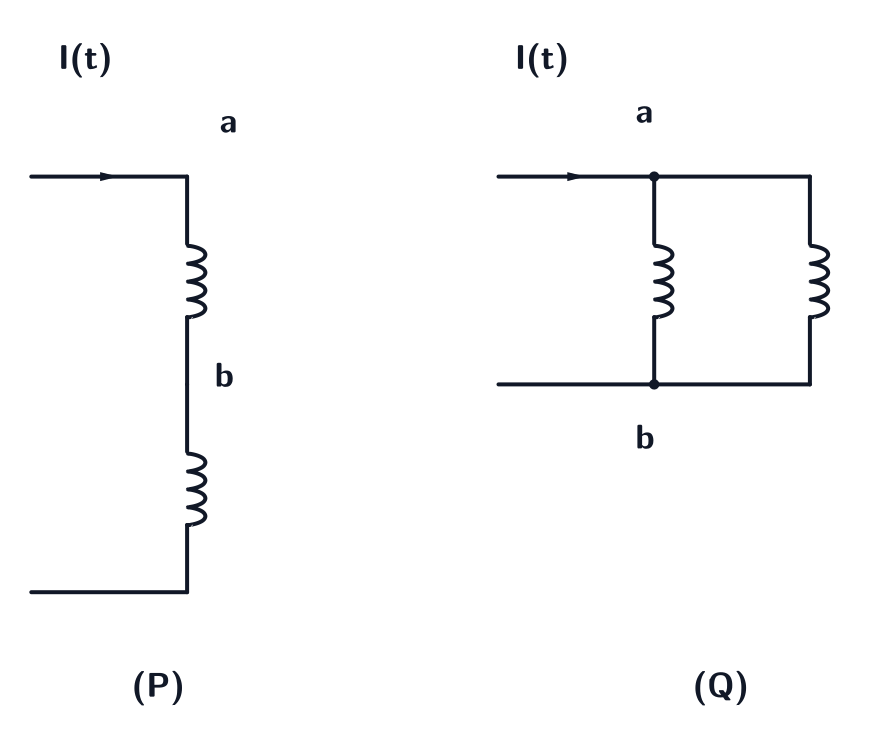
Two identical inductors are connected in two different configurations and , where a time varying current is flowing, as shown in the figure. The induced emf between points and for configuration is and that for configuration is . The ratio is: [Neglect the effect of mutual inductance.]
- (1)
- (2)
- (3)
1
- (4)
2
Answer and solution
Answer: (4)
In configuration the two inductors are in series and the segment between and spans just ONE of them, carrying the full current, so . In configuration the points and straddle the parallel pair, whose equivalent inductance is , so . The ratio is therefore 2. NCERT Class 12, Electromagnetic Induction (self-inductance).
Why the other options are wrong:
- (1) takes across the series pair as and inverts the ratio
- (2) inverts the correct answer by swapping which configuration sits in the numerator
- (3) assumes identical inductors must produce identical electromotive forces (emfs) regardless of how and are placed- (1)
Re-NEET 2026 · Q5
Consider a long solenoid of length and radius . If is the number of turns per unit length and is the permeability of free space, the inductance of the solenoid is :
- (1)
- (2)
- (3)
- (4)
Answer and solution
Answer: (1)
For a long solenoid , where is turns per unit length and the cross-sectional area. Substituting gives . NCERT Class 12, Electromagnetic Induction (self-inductance).
- (1)
Re-NEET 2026 · Q32
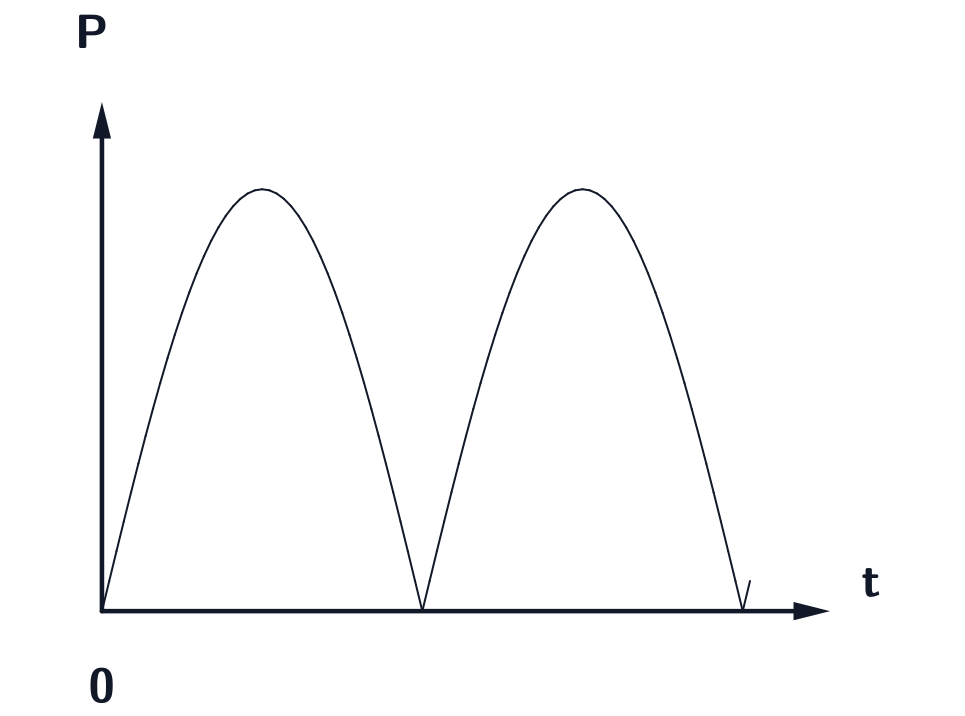
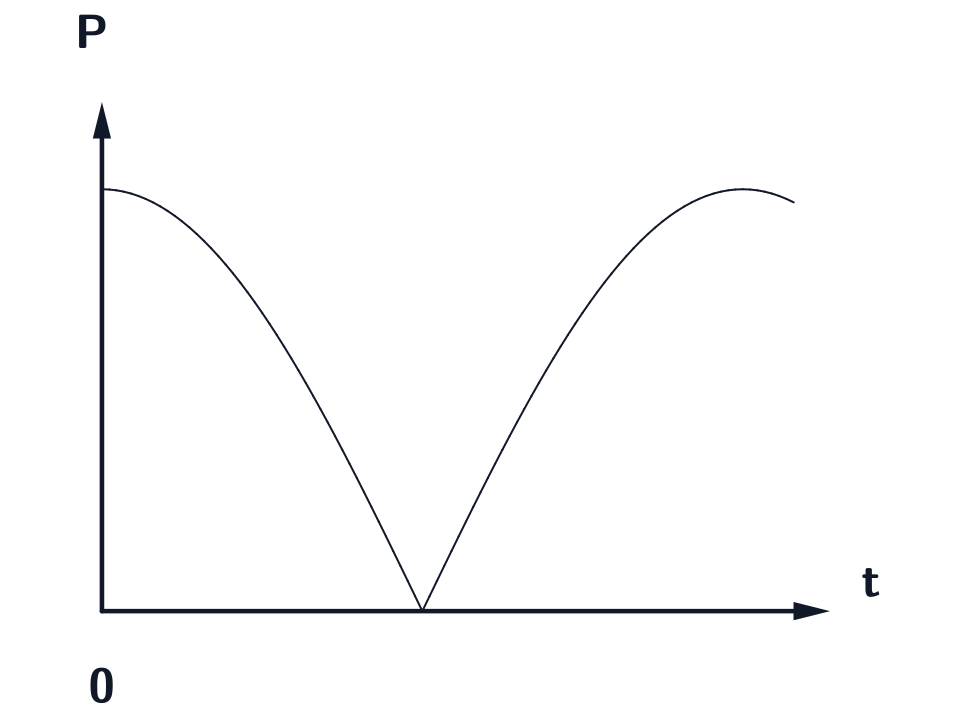
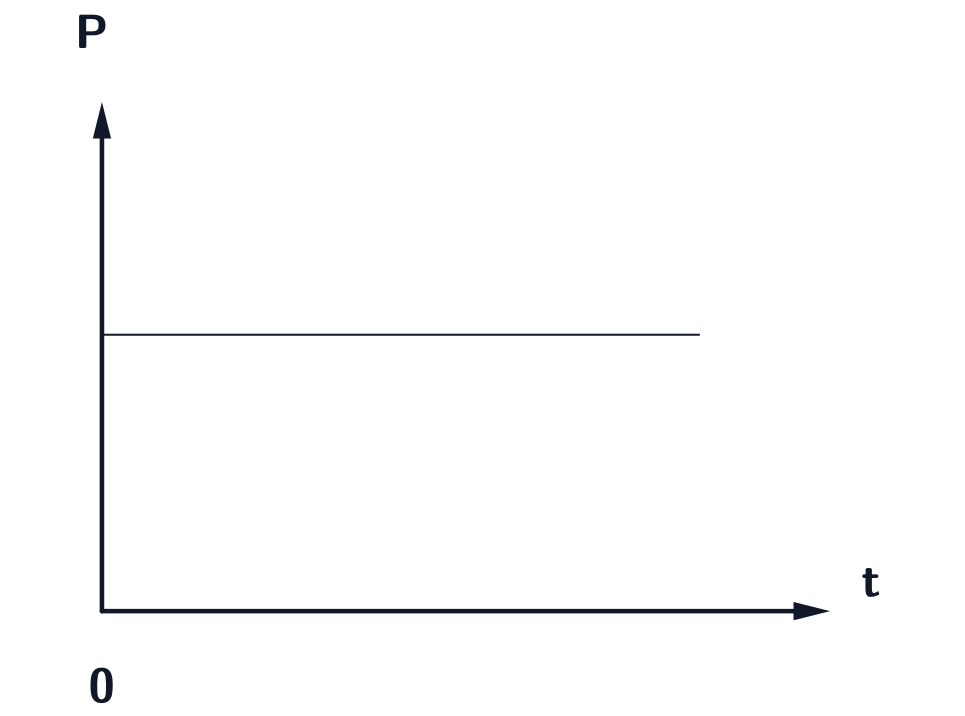
A conducting loop of finite resistance lies on the plane. There is a constant magnetic field in the direction. The area of the loop varies with time , as in appropriate units. The figure that correctly indicates the qualitative behaviour of the power dissipated in the loop as a function of time is:
- (1)
- (2)
- (3)
- (4)
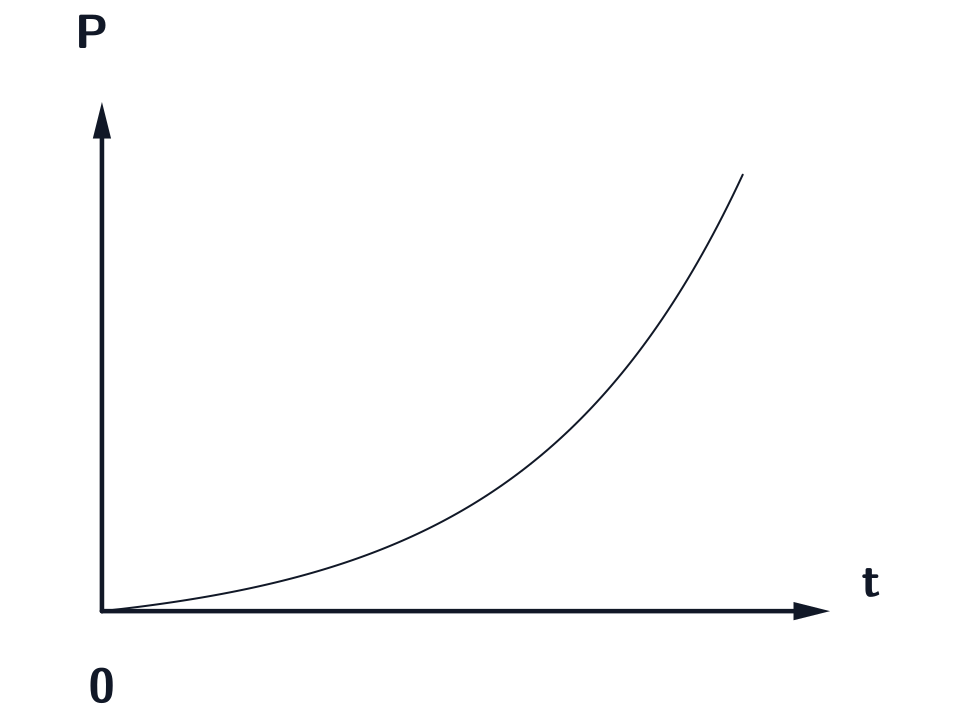
Answer and solution
Answer: (2)
Faraday's law gives , so the dissipated power is . Because is MAXIMUM at and touches zero at , the correct graph starts at a peak and dips to zero, unlike a curve which would start at zero. is never negative because the electromotive force (emf) is squared. NCERT Class 12, Electromagnetic Induction (Faraday's law).
Why the other options are wrong:
- (1) differentiates to rather than , producing a curve that starts at zero
- (3) assumes the constant field means a constant emf, forgetting that it is the CHANGING area that drives induction
- (4) confuses the growing area with growing power, ignoring that the flux change is periodic and bounded- (1)
Practise Electromagnetic Induction in the app: it brings back the questions you get wrong, so the chapter improves, not just your memory of these. Or try the free CBT mock. All chapters: NEET chapter-wise PYQs.
Questions
Are these the official NEET questions on Electromagnetic Induction?
Yes. They are the questions NTA set in each paper, in its wording. The solutions are written by BrainIt.
Something here wrong or out of date? Email hello@brainit.pro and a person will read it.