
Physics · chapter PYQs
Motion in a Straight Line, on the exam screen.
4 questions from NEET 2026, Re-NEET 2026, NEET 2020, 4 minutes, marked +4 / −1. See them with solutions.
Motion in a Straight Line · PYQs
Candidate: You
Time Left
Q1/4
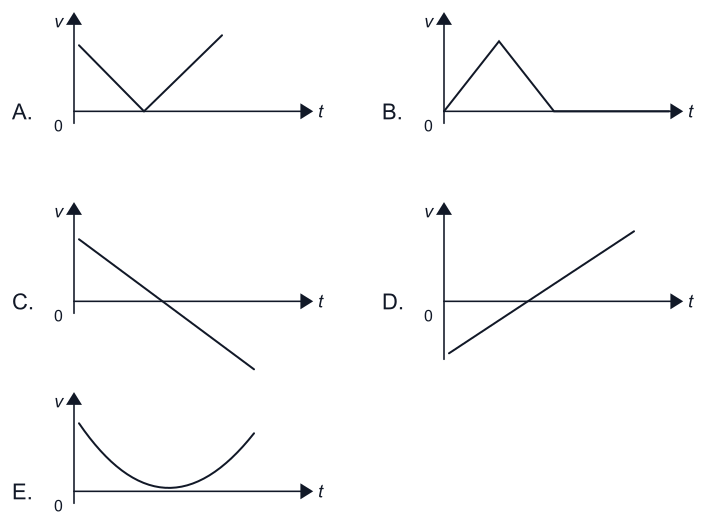
The following plots show variation of velocity () with time () of a ball thrown vertically upward, and falling back. Which of the following plots is/are correct?
Answer and explanation
Answer: (1)
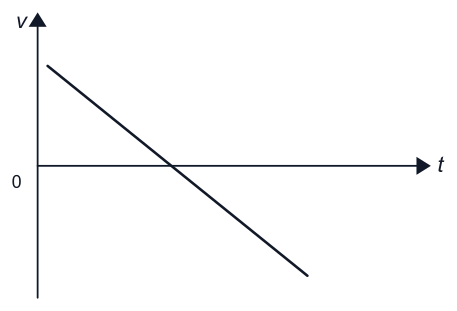
Throughout the flight the only acceleration is g directed downward, so stays a constant negative value. The velocity therefore decreases linearly, reaches zero at the highest point and turns negative on the way down, tracing a single straight line of constant negative slope, which is plot C. Hence option (1). Plots with a change of slope, a V-shape, or a positive slope contradict the constant downward acceleration.
When a ruler falls vertically, 5 different persons catch it with different reaction times ( m s). Person A has a reaction time of 0.20 s, Person B has 0.22 s, Person C has 0.18 s, Person D has 0.19 s, and Person E has 0.21 s. What is the correct order of the distance travelled by the ruler for each person?
Answer and explanation
Answer: (3)
The ruler falls freely, so distance increases monotonically with reaction time. Ranking the reaction times from largest to smallest gives B(0.22) > E(0.21) > A(0.20) > D(0.19) > C(0.18), which is the same order as the distances. Option (4) is the exact reverse (smallest first). Option (2) is also smallest first and swaps persons B and E as well. Option (1) swaps persons D and C.
Consider a particle moving along a straight line, whose position as a function of time is given by , where , and . The average speed of the particle, in from to s is:
Answer and explanation
Answer: (3)
Average speed uses total PATH LENGTH, not displacement, so the turning point must be located first. Here , which vanishes at s. Positions are , , , giving 9 m travelled in each leg and 18 m in total. Hence average speed . NCERT Class 11, Motion in a Straight Line.
A ball is thrown vertically downward with a velocity of 20 m s from the top of a tower. It hits the ground after some time with a velocity of 80 m s. The height of the tower is (g = 10 m s)
Answer and explanation
Answer: (3)
Using v = u + 2gh gives h = m. Chapter: Motion in a Straight Line.
Your result
0 / 16
Keep practising with NEET PYQs, review explanations and track your chapter accuracy in the app. Free until the 2027 exam.