

Motion in a Straight Line: NEET previous year questions
Every Motion in a Straight Line question from the official NEET papers on this site, with the answer and a worked solution.
The questions come from NEET 2026, Re-NEET 2026 and NEET 2020. Each shows its answer and solution when you open it, so you can attempt it first. For what the chapter covers and how NEET tests it, see the Motion in a Straight Line guide.
NEET 2026
NEET 2026 · Q15
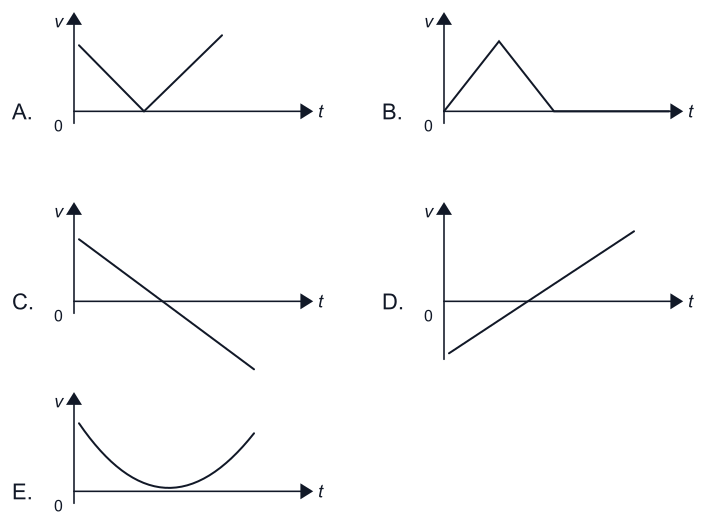
The following plots show variation of velocity () with time () of a ball thrown vertically upward, and falling back. Which of the following plots is/are correct?
- (1)
C only
- (2)
D only
- (3)
B only
- (4)
A and E only
Answer and solution
Answer: (1)
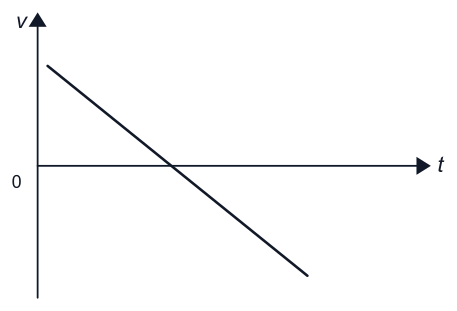
Throughout the flight the only acceleration is g directed downward, so stays a constant negative value. The velocity therefore decreases linearly, reaches zero at the highest point and turns negative on the way down, tracing a single straight line of constant negative slope, which is plot C. Hence option (1). Plots with a change of slope, a V-shape, or a positive slope contradict the constant downward acceleration.
- (1)
NEET 2026 · Q26
When a ruler falls vertically, 5 different persons catch it with different reaction times ( m s). Person A has a reaction time of 0.20 s, Person B has 0.22 s, Person C has 0.18 s, Person D has 0.19 s, and Person E has 0.21 s. What is the correct order of the distance travelled by the ruler for each person?
- (1)
B > E > A > C > D
- (2)
C > D > A > B > E
- (3)
B > E > A > D > C
- (4)
C > D > A > E > B
Answer and solution
Answer: (3)
The ruler falls freely, so distance increases monotonically with reaction time. Ranking the reaction times from largest to smallest gives B(0.22) > E(0.21) > A(0.20) > D(0.19) > C(0.18), which is the same order as the distances. Option (4) is the exact reverse (smallest first). Option (2) is also smallest first and swaps persons B and E as well. Option (1) swaps persons D and C.
- (1)
Re-NEET 2026
Re-NEET 2026 · Q6
Consider a particle moving along a straight line, whose position as a function of time is given by , where , and . The average speed of the particle, in from to s is:
- (1)
12
- (2)
6
- (3)
3
- (4)
0
Answer and solution
Answer: (3)
Average speed uses total PATH LENGTH, not displacement, so the turning point must be located first. Here , which vanishes at s. Positions are , , , giving 9 m travelled in each leg and 18 m in total. Hence average speed . NCERT Class 11, Motion in a Straight Line.
- (1)
NEET 2020
NEET 2020 · Q149
A ball is thrown vertically downward with a velocity of 20 m s from the top of a tower. It hits the ground after some time with a velocity of 80 m s. The height of the tower is (g = 10 m s)
- (1)
340 m
- (2)
320 m
- (3)
300 m
- (4)
360 m
Answer and solution
Answer: (3)
Using v = u + 2gh gives h = m. Chapter: Motion in a Straight Line.
- (1)
Practise Motion in a Straight Line in the app: it brings back the questions you get wrong, so the chapter improves, not just your memory of these. Or try the free CBT mock. All chapters: NEET chapter-wise PYQs.
Questions
Are these the official NEET questions on Motion in a Straight Line?
Yes. They are the questions NTA set in each paper, in its wording. The solutions are written by BrainIt.
Something here wrong or out of date? Email hello@brainit.pro and a person will read it.