
Physics · chapter PYQs
Moving Charges and Magnetism, on the exam screen.
6 questions from NEET 2026, Re-NEET 2026, NEET 2020, 6 minutes, marked +4 / −1. See them with solutions.
Moving Charges and Magnetism · PYQs
Candidate: You
Time Left
Q1/6
A 100-turn closely wound circular coil of radius 5 cm has a magnetic field of T at its centre. The current flowing through the coil, and the magnitude of the magnetic moment of this coil are, respectively: (Take T m/A)
Answer and explanation
Answer: (4)
From , the current is A. The magnetic moment A m. Only option (4) gives both correct values.
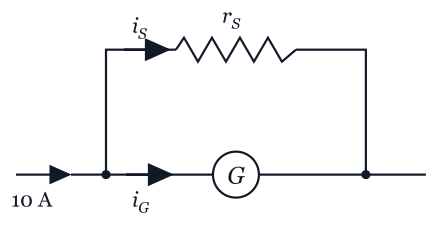
A galvanometer of resistance 100 gives full scale deflection for a current of 1 mA. It is converted into an ammeter of range 0 - 10 A. The shunt required is:
Answer and explanation
Answer: (1)
The shunt is in parallel with the galvanometer, so , where A and mA. Thus , giving . The other values come from misplacing the factor of ten in the current ratio.
Why the other options are wrong:
- (2) Off by a factor of 10.
- (3) Off by a factor of 100.
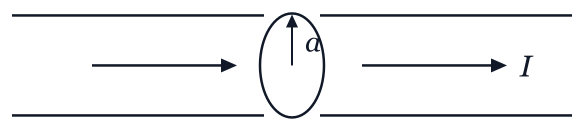
- (4) Off by a factor of 10 (too small).The figure shows a long straight solid wire of circular cross-section of radius carrying steady current . The current is uniformly distributed across its cross-section. The plot which correctly represents the variation of magnetic field with distance from the axis of the conductor is:
Answer and explanation
Answer: (1)
By Ampere's law, inside the wire () only the enclosed fraction of current contributes, giving , so (a straight line rising to a maximum at ). Outside () the full current is enclosed, giving , so . Only graph (1) shows this linear rise followed by a decay.
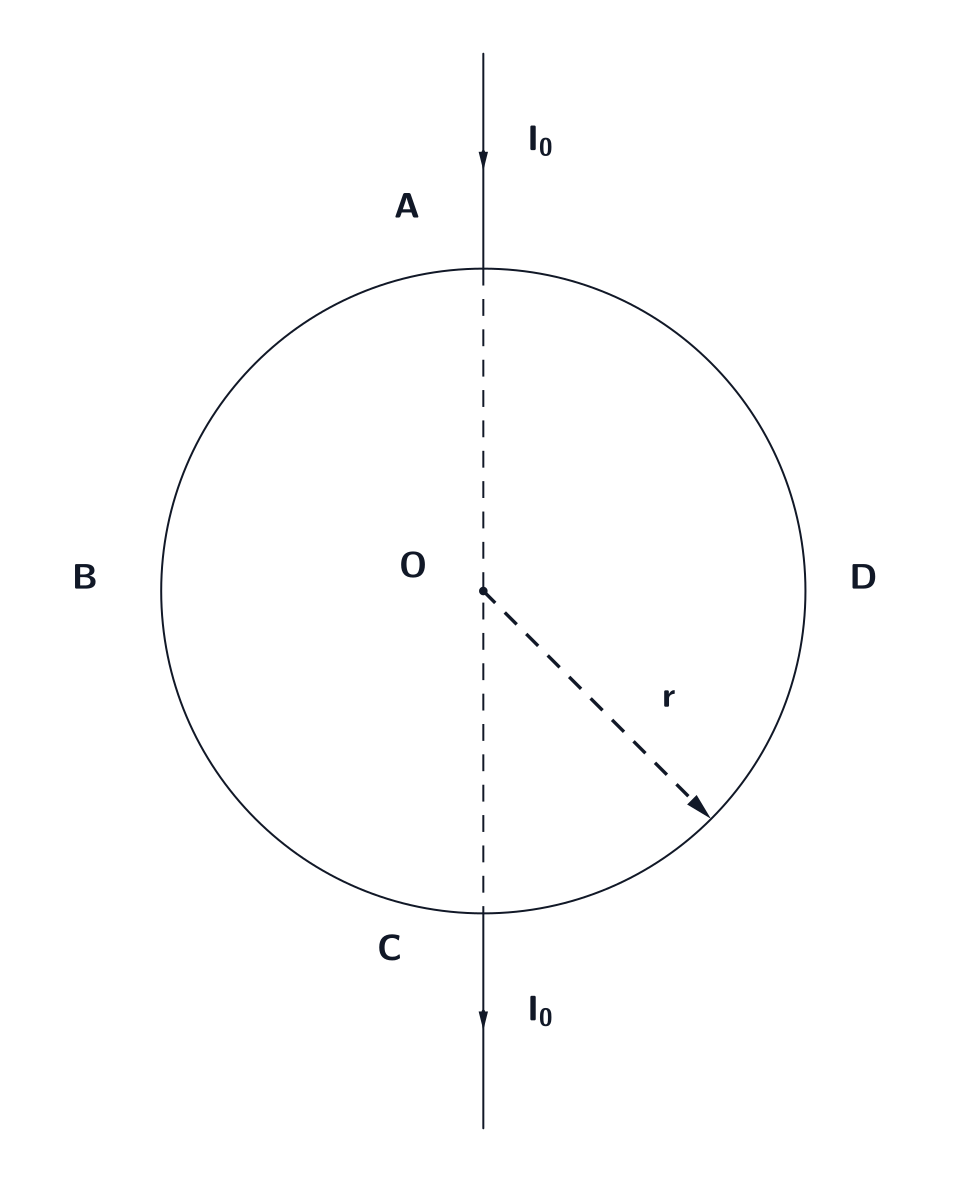
A current flows through a metallic circular loop of radius as shown in the figure. Resistance of the segment is half that of . Magnitude of magnetic field at the centre of the loop is :
Answer and explanation
Answer: (1)
The current entering at divides between the two arcs in INVERSE proportion to their resistances, so with the currents are and . Each arc is a semicircle ( at the top, at the bottom), contributing but in OPPOSITE directions at . The net field is . NCERT Class 12, Moving Charges and Magnetism (Biot-Savart law).
Why the other options are wrong:
- (2) sends the whole current round one semicircle and ignores the opposing contribution from the other arc
- (3) uses the full-loop result without splitting the current or accounting for cancellation
- (4) applies the formula for a long straight wire, , instead of an arcTwo infinitely long parallel conducting wires and carry currents and , respectively, in the same direction. The wire has uniform mass per unit length and lies on an insulated floor. The wire is kept fixed at a height above the floor. The minimum magnitude of so that the wire does not rise from the floor is: [ is the acceleration due to gravity and is the permeability of free space.]
Answer and explanation
Answer: (2)
Parallel currents in the SAME direction attract, so wire pulls wire upwards with force per unit length . Wire stays on the floor as long as this does not exceed its weight per unit length , so and . NCERT Class 12, Moving Charges and Magnetism (force between two parallel currents).
A long solenoid of 50 cm length having 100 turns carries a current of 2.5 A. The magnetic field at the centre of the solenoid is ( T m A)
Answer and explanation
Answer: (4)
The magnetic field B inside a solenoid is given by . Substituting the values, . Chapter: Moving Charges and Magnetism.
Your result
0 / 24
Keep practising with NEET PYQs, review explanations and track your chapter accuracy in the app. Free until the 2027 exam.