

Moving Charges and Magnetism: NEET previous year questions
Every Moving Charges and Magnetism question from the official NEET papers on this site, with the answer and a worked solution.
The questions come from NEET 2026, Re-NEET 2026 and NEET 2020. Each shows its answer and solution when you open it, so you can attempt it first. For what the chapter covers and how NEET tests it, see the Moving Charges and Magnetism guide.
NEET 2026
NEET 2026 · Q29
A 100-turn closely wound circular coil of radius 5 cm has a magnetic field of T at its centre. The current flowing through the coil, and the magnitude of the magnetic moment of this coil are, respectively: (Take T m/A)
- (1)
2 A, 10 A m
- (2)
2.5 A, 20 A m
- (3)
2 A, 4 A m
- (4)
2.5 A, 2 A m
Answer and solution
Answer: (4)
From , the current is A. The magnetic moment A m. Only option (4) gives both correct values.
- (1)
NEET 2026 · Q36
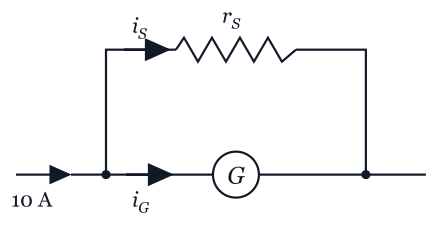
A galvanometer of resistance 100 gives full scale deflection for a current of 1 mA. It is converted into an ammeter of range 0 - 10 A. The shunt required is:
- (1)
0.01
- (2)
0.10
- (3)
1.0
- (4)
0.001
Answer and solution
Answer: (1)
The shunt is in parallel with the galvanometer, so , where A and mA. Thus , giving . The other values come from misplacing the factor of ten in the current ratio.
Why the other options are wrong:
- (2) Off by a factor of 10.
- (3) Off by a factor of 100.
- (4) Off by a factor of 10 (too small).- (1)
NEET 2026 · Q39
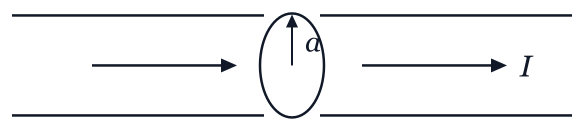
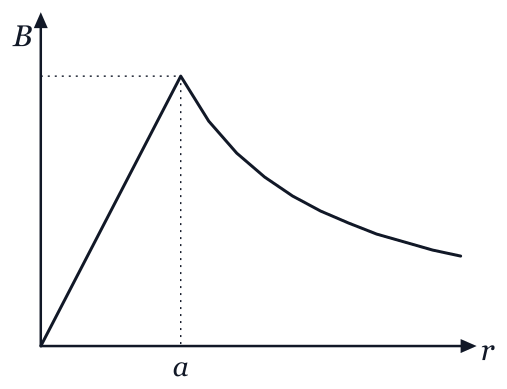
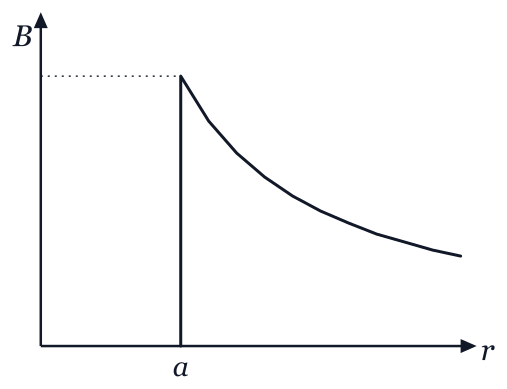
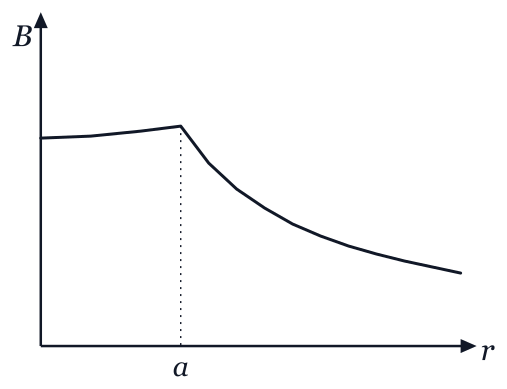
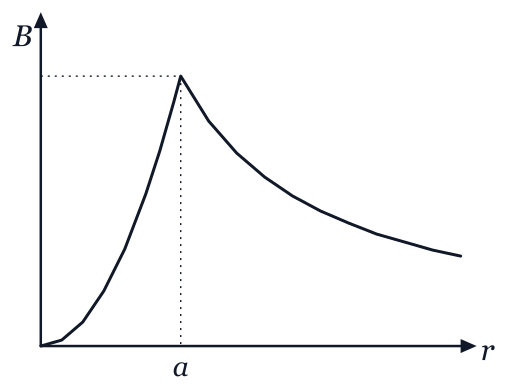
The figure shows a long straight solid wire of circular cross-section of radius carrying steady current . The current is uniformly distributed across its cross-section. The plot which correctly represents the variation of magnetic field with distance from the axis of the conductor is:
- (1)
- (2)
- (3)
- (4)
Answer and solution
Answer: (1)
By Ampere's law, inside the wire () only the enclosed fraction of current contributes, giving , so (a straight line rising to a maximum at ). Outside () the full current is enclosed, giving , so . Only graph (1) shows this linear rise followed by a decay.
- (1)
Re-NEET 2026
Re-NEET 2026 · Q11
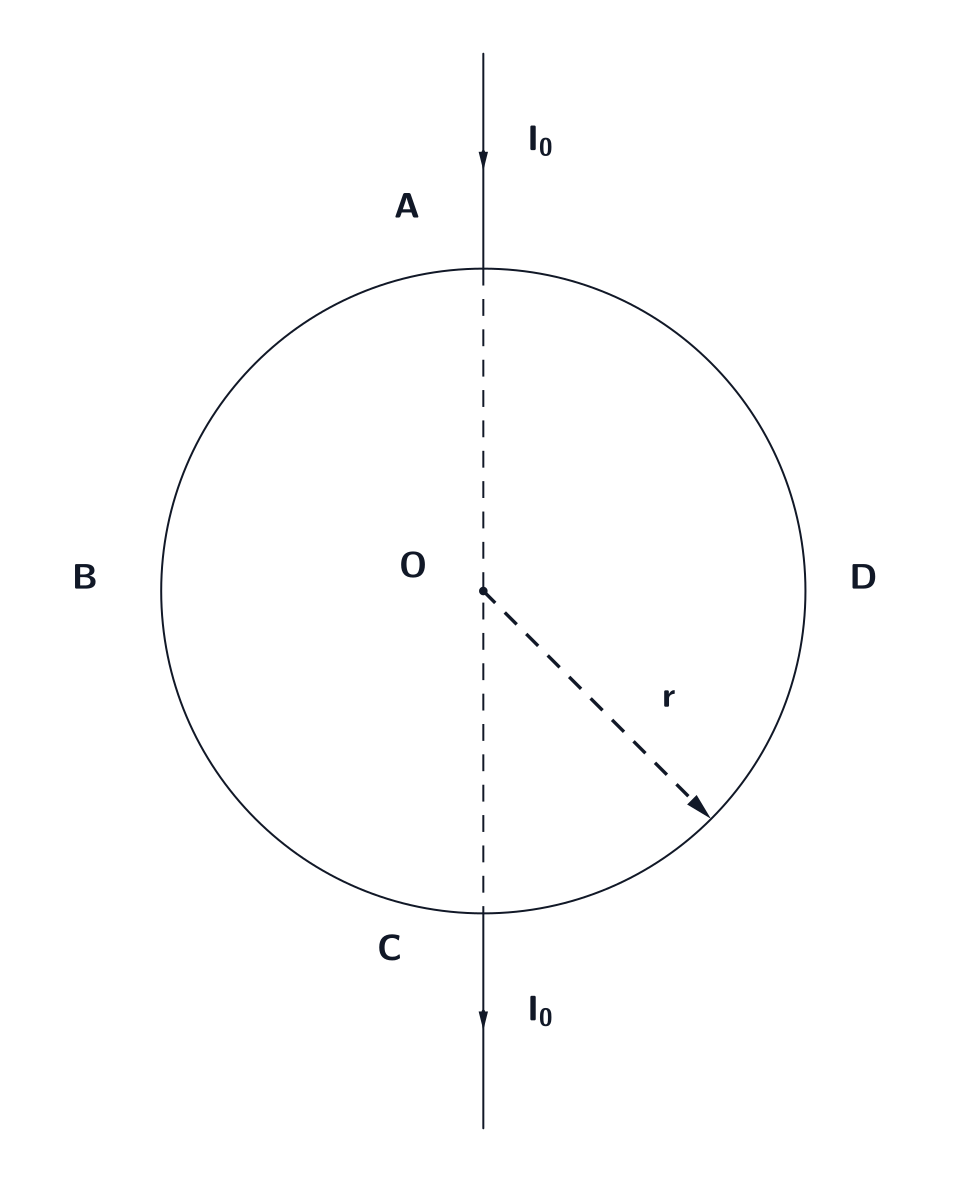
A current flows through a metallic circular loop of radius as shown in the figure. Resistance of the segment is half that of . Magnitude of magnetic field at the centre of the loop is :
- (1)
- (2)
- (3)
- (4)
Answer and solution
Answer: (1)
The current entering at divides between the two arcs in INVERSE proportion to their resistances, so with the currents are and . Each arc is a semicircle ( at the top, at the bottom), contributing but in OPPOSITE directions at . The net field is . NCERT Class 12, Moving Charges and Magnetism (Biot-Savart law).
Why the other options are wrong:
- (2) sends the whole current round one semicircle and ignores the opposing contribution from the other arc
- (3) uses the full-loop result without splitting the current or accounting for cancellation
- (4) applies the formula for a long straight wire, , instead of an arc- (1)
Re-NEET 2026 · Q15
Two infinitely long parallel conducting wires and carry currents and , respectively, in the same direction. The wire has uniform mass per unit length and lies on an insulated floor. The wire is kept fixed at a height above the floor. The minimum magnitude of so that the wire does not rise from the floor is: [ is the acceleration due to gravity and is the permeability of free space.]
- (1)
- (2)
- (3)
- (4)
Answer and solution
Answer: (2)
Parallel currents in the SAME direction attract, so wire pulls wire upwards with force per unit length . Wire stays on the floor as long as this does not exceed its weight per unit length , so and . NCERT Class 12, Moving Charges and Magnetism (force between two parallel currents).
- (1)
NEET 2020
NEET 2020 · Q138
A long solenoid of 50 cm length having 100 turns carries a current of 2.5 A. The magnetic field at the centre of the solenoid is ( T m A)
- (1)
T
- (2)
T
- (3)
T
- (4)
T
Answer and solution
Answer: (4)
The magnetic field B inside a solenoid is given by . Substituting the values, . Chapter: Moving Charges and Magnetism.
- (1)
Practise Moving Charges and Magnetism in the app: it brings back the questions you get wrong, so the chapter improves, not just your memory of these. Or try the free CBT mock. All chapters: NEET chapter-wise PYQs.
Questions
Are these the official NEET questions on Moving Charges and Magnetism?
Yes. They are the questions NTA set in each paper, in its wording. The solutions are written by BrainIt.
Something here wrong or out of date? Email hello@brainit.pro and a person will read it.