
Physics · chapter PYQs
System of Particles and Rotational Motion, on the exam screen.
7 questions from NEET 2026, Re-NEET 2026, NEET 2020, 7 minutes, marked +4 / −1. See them with solutions.
System of Particles and Rotational Motion · PYQs
Candidate: You
Time Left
Q1/7
The angular speed of a flywheel is increased from 600 rpm to 1200 rpm in 10 s. The number of revolutions completed by the flywheel during this time is:
Answer and explanation
Answer: (3)
With uniform angular acceleration the number of revolutions equals the average angular speed times the time: revolutions per minute (rpm) over min = min, giving revolutions, option (3). Equivalently, using gives rad, so .
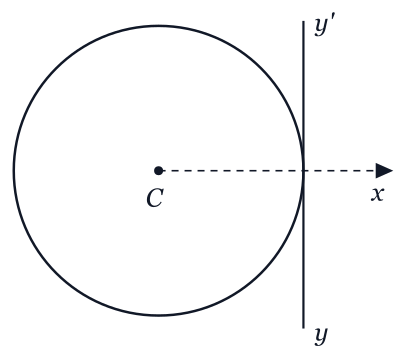
A thin wire of length '' and linear mass density '' is bent into a circular ring (in - plane) with centre '' as shown in figure. The moment of inertia of the ring about an axis will be:
Answer and explanation
Answer: (2)
The ring's mass is and its radius (since ). The axis is tangential to the ring in its plane, so by the parallel axis theorem . The correct expression has and , eliminating the other options.
Why the other options are wrong:
- (1) Uses instead of in the denominator.
- (3) Wrong power of L and .
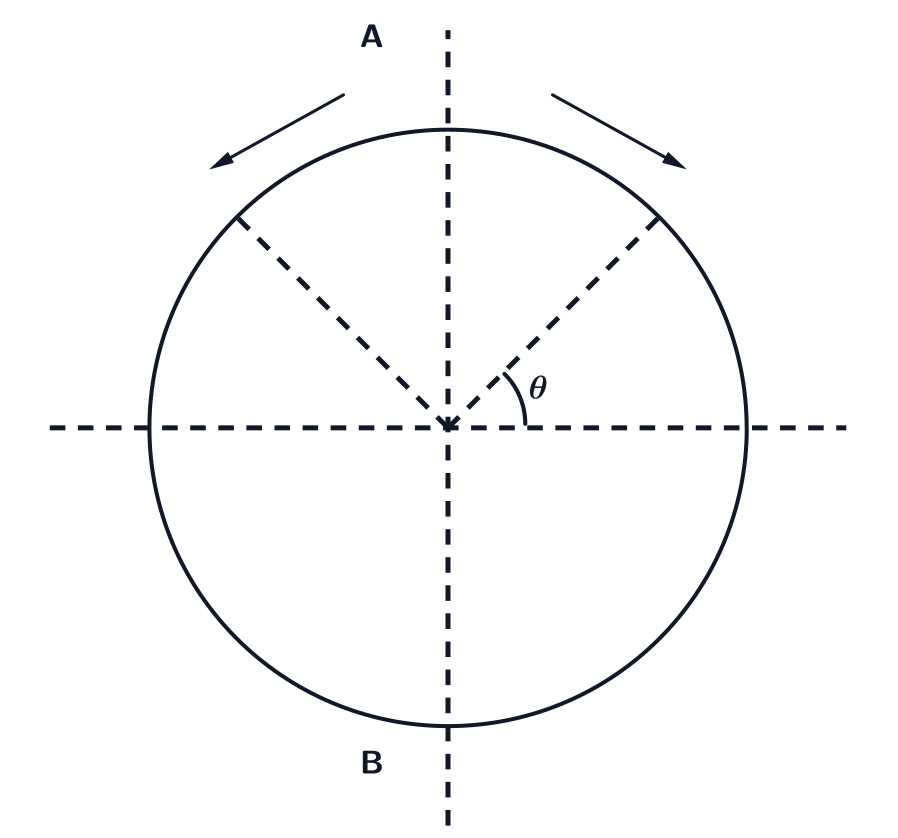
- (4) Wrong power of L.A frictionless circular wire of unit radius is fixed on the horizontal plane. Two-point particles of unit mass start moving simultaneously from point with identical uniform angular speeds in opposite directions, and meet again at point . During this time, which of the following figures schematically represent the magnitude of the total linear momentum of the system, as a function of ?
Answer and explanation
Answer: (3)
By symmetry the two particles sit at mirror-image angles about the vertical, so their tangential velocities have equal and opposite horizontal components while their vertical components add. Writing the particles at and , the resultant works out to , which is zero at the start (), peaks when the particles are diametrically opposite the meeting point (), and returns to zero as they collide at . That single smooth hump is option (3). NCERT Class 11, System of Particles and Rotational Motion (motion of the centre of mass).
Why the other options are wrong:
- (1) assumes momentum is conserved as a constant because the SPEEDS are constant, forgetting that momentum is a vector whose direction keeps changing
- (2) inverts the phase - takes , i.e. maximum where the particles start rather than where they are farthest apart
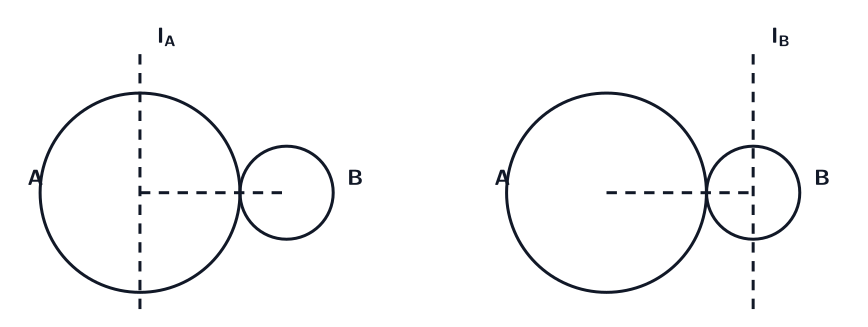
- (4) assumes falls off linearly with angle instead of following the cosine of the half-separationA solid sphere of radius and mass is attached at a point to a smaller solid sphere of radius and mass . Assume that the line joining their centres lies along the horizontal. The moment of inertia of the system calculated about a vertical axis passing through the centre of is and that calculated about a vertical axis passing through the centre of is . The difference is:
Answer and explanation
Answer: (2)
The spheres touch, so their centres are separated by . About the axis through : ; about the axis through : . The two spin terms are common to both and cancel, leaving , a negative quantity as expected since the heavier sphere sits off-axis in the second case. NCERT Class 11, System of Particles and Rotational Motion (parallel axis theorem).
Why the other options are wrong:
- (1) gets the separation right but flips the sign - attaches the parallel-axis term to the wrong body in each case
- (3) uses as the centre separation, as if the small sphere were embedded in the large one rather than attached externally
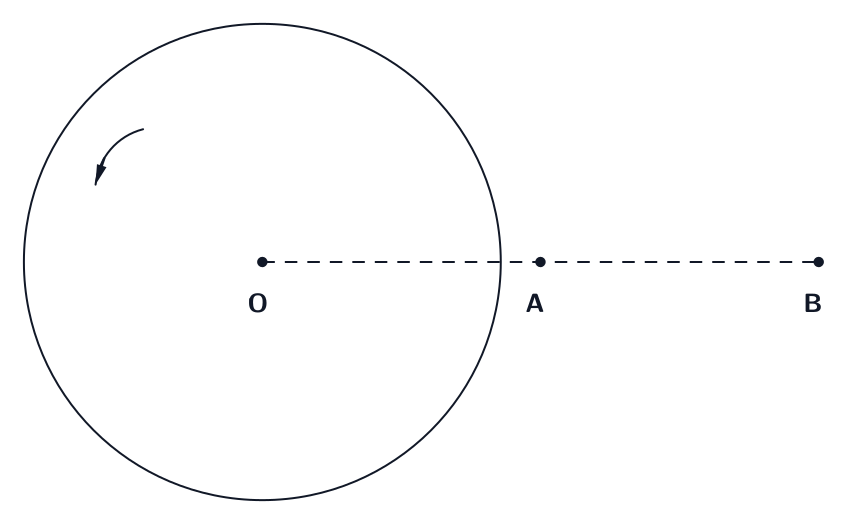
- (4) assumes the moment of inertia is independent of the choice of axis, ignoring the parallel axis theorem altogetherA thin horizontal disc is rotating about a vertical axis passing through its fixed centre . Its angular momentum is and computed about points and , respectively, with . The value of is:
Answer and explanation
Answer: (3)
The angular momentum of a rigid body about any point splits as . Here the centre is FIXED, so and the orbital term vanishes for every reference point. Only the spin term survives, which is the same whether you compute about or , so the ratio is 1 regardless of the distances. NCERT Class 11, System of Particles and Rotational Motion (angular momentum of a rotating rigid body).
Why the other options are wrong:
- (1) assumes , importing an inverse-square intuition that does not apply
- (2) assumes scales inversely with the distance to the reference point
- (4) assumes grows in proportion to the distance, as it would for a single particle moving in a straight lineFind the torque about the origin when a force 3ĵ N acts on a particle whose position vector is 2k̂ m.
Answer and explanation
Answer: (2)
Torque = r × F = (2k̂) × (3ĵ) = 6(k̂ × ĵ) = -6î N m. Chapter: System of Particles and Rotational Motion.
Two particles of mass 5 kg and 10 kg respectively are attached to the two ends of a rigid rod of length 1 m with negligible mass. The centre of mass of the system from the 5 kg particle is nearly at a distance of :
Answer and explanation
Answer: (2)
The center of mass is given by . Substituting, . Chapter: System of Particles and Rotational Motion.
Your result
0 / 28
Keep practising with NEET PYQs, review explanations and track your chapter accuracy in the app. Free until the 2027 exam.