

System of Particles and Rotational Motion: NEET previous year questions
Every System of Particles and Rotational Motion question from the official NEET papers on this site, with the answer and a worked solution.
The questions come from NEET 2026, Re-NEET 2026 and NEET 2020. Each shows its answer and solution when you open it, so you can attempt it first. For what the chapter covers and how NEET tests it, see the System of Particles and Rotational Motion guide.
NEET 2026
NEET 2026 · Q4
The angular speed of a flywheel is increased from 600 rpm to 1200 rpm in 10 s. The number of revolutions completed by the flywheel during this time is:
- (1)
900
- (2)
600
- (3)
150
- (4)
300
Answer and solution
Answer: (3)
With uniform angular acceleration the number of revolutions equals the average angular speed times the time: revolutions per minute (rpm) over min = min, giving revolutions, option (3). Equivalently, using gives rad, so .
- (1)
NEET 2026 · Q35
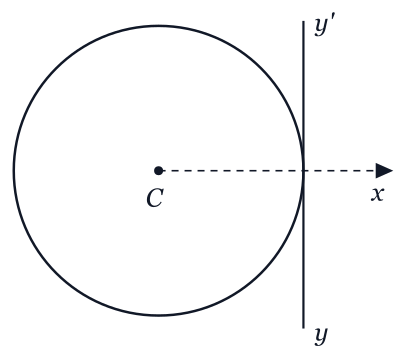
A thin wire of length '' and linear mass density '' is bent into a circular ring (in - plane) with centre '' as shown in figure. The moment of inertia of the ring about an axis will be:
- (1)
- (2)
- (3)
- (4)
Answer and solution
Answer: (2)
The ring's mass is and its radius (since ). The axis is tangential to the ring in its plane, so by the parallel axis theorem . The correct expression has and , eliminating the other options.
Why the other options are wrong:
- (1) Uses instead of in the denominator.
- (3) Wrong power of L and .
- (4) Wrong power of L.- (1)
Re-NEET 2026
Re-NEET 2026 · Q23
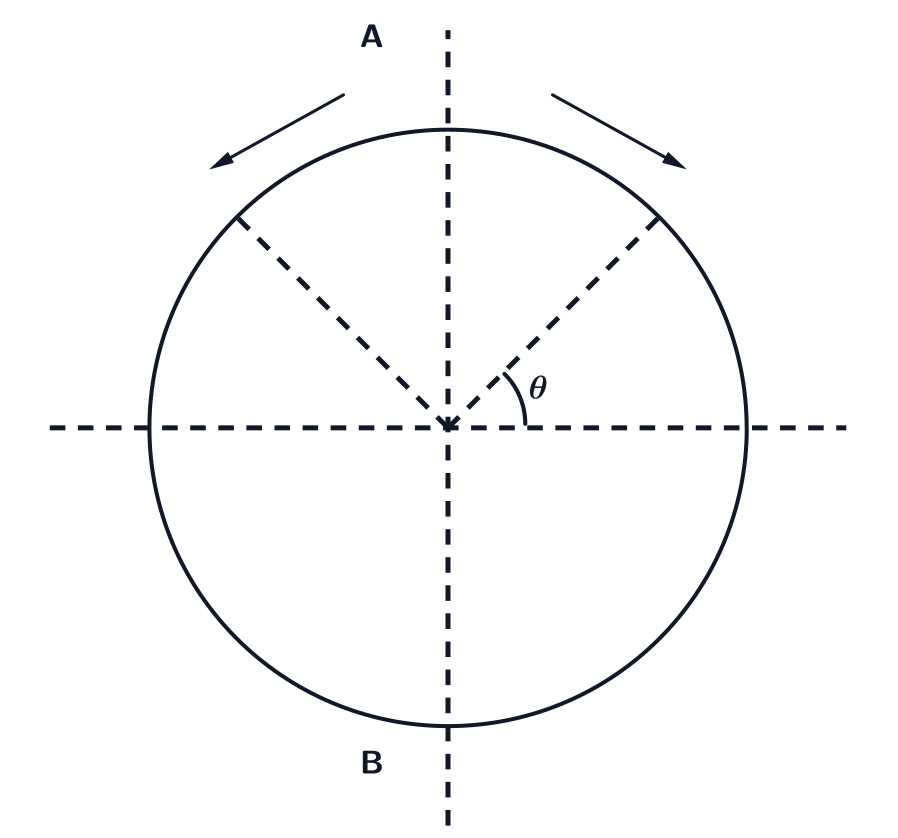
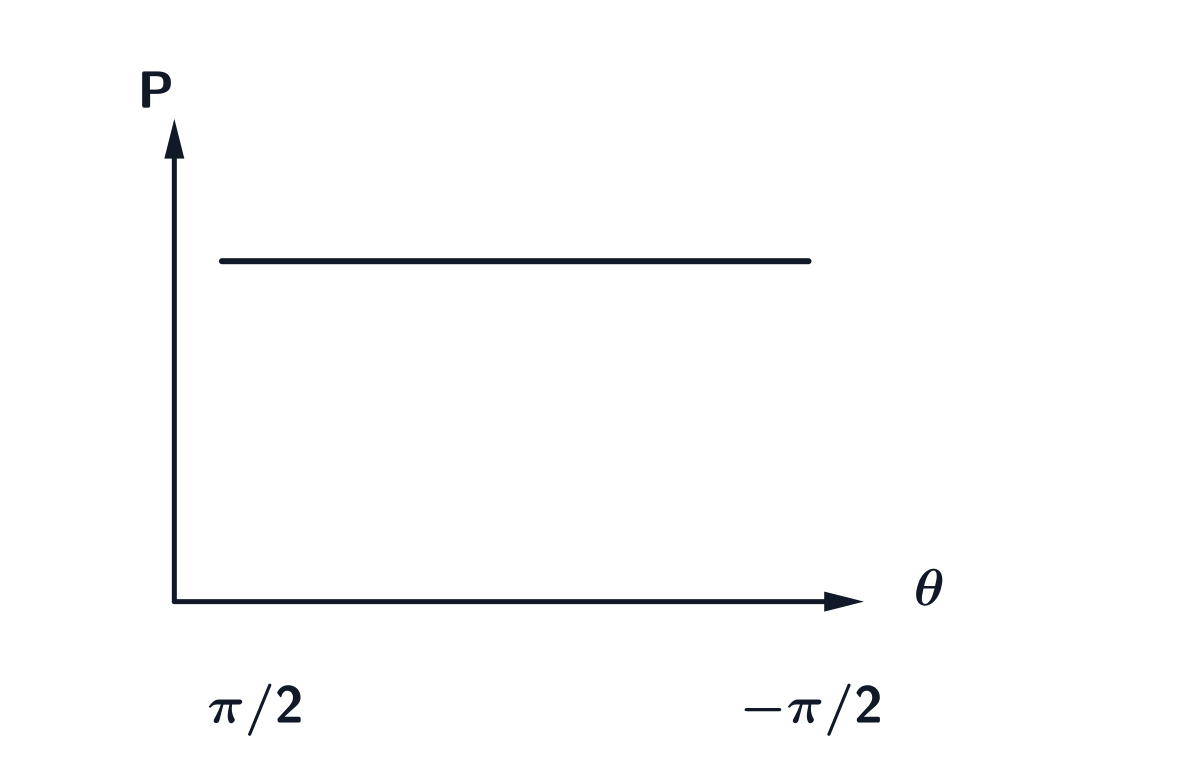
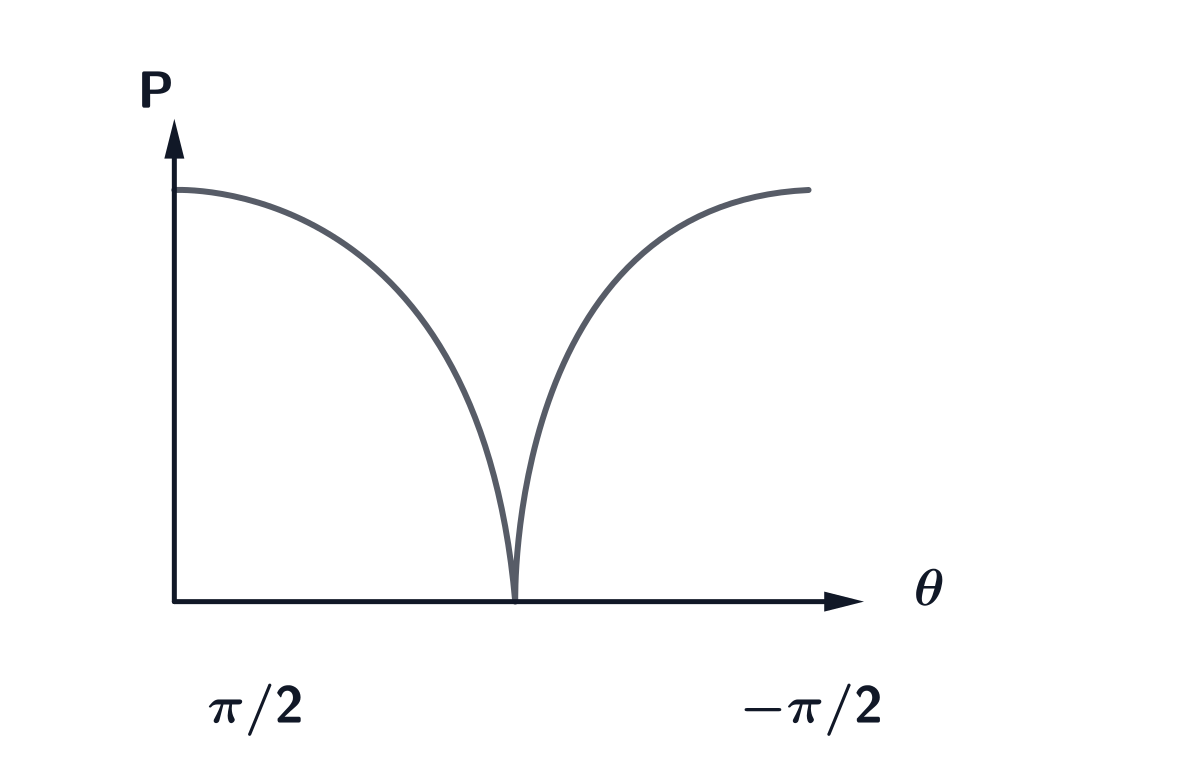
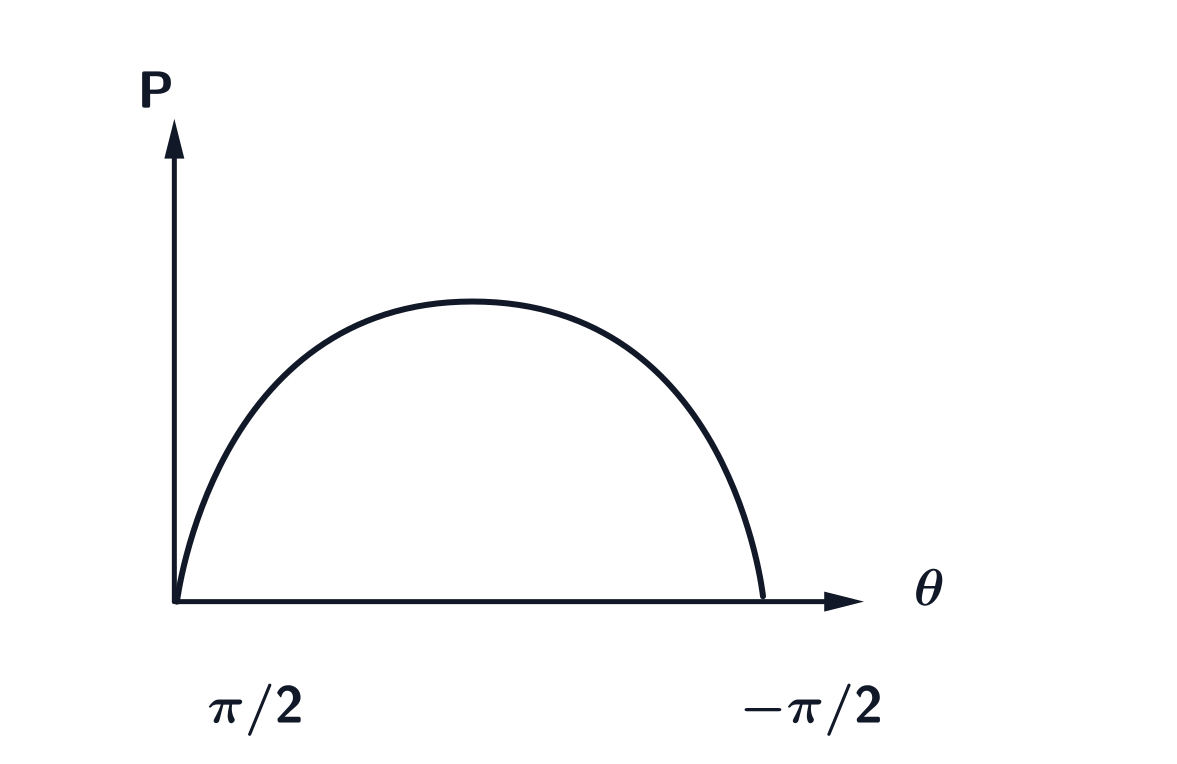
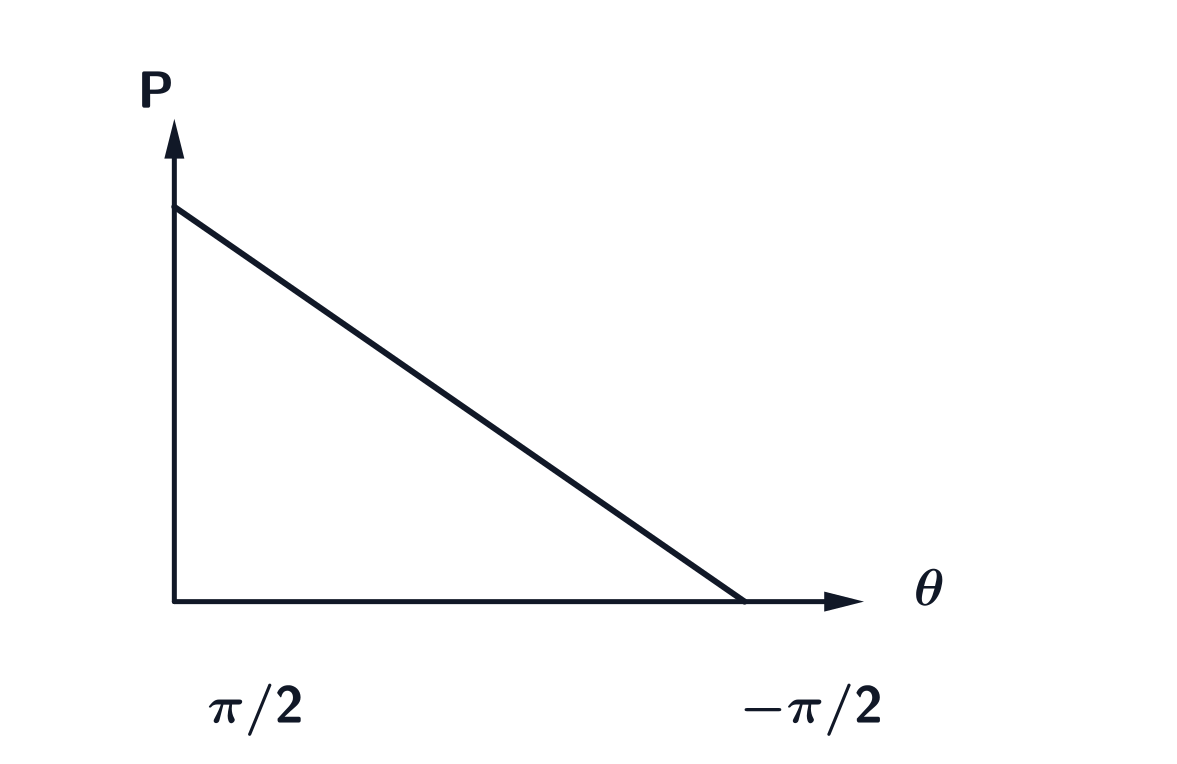
A frictionless circular wire of unit radius is fixed on the horizontal plane. Two-point particles of unit mass start moving simultaneously from point with identical uniform angular speeds in opposite directions, and meet again at point . During this time, which of the following figures schematically represent the magnitude of the total linear momentum of the system, as a function of ?
- (1)
- (2)
- (3)
- (4)
Answer and solution
Answer: (3)
By symmetry the two particles sit at mirror-image angles about the vertical, so their tangential velocities have equal and opposite horizontal components while their vertical components add. Writing the particles at and , the resultant works out to , which is zero at the start (), peaks when the particles are diametrically opposite the meeting point (), and returns to zero as they collide at . That single smooth hump is option (3). NCERT Class 11, System of Particles and Rotational Motion (motion of the centre of mass).
Why the other options are wrong:
- (1) assumes momentum is conserved as a constant because the SPEEDS are constant, forgetting that momentum is a vector whose direction keeps changing
- (2) inverts the phase - takes , i.e. maximum where the particles start rather than where they are farthest apart
- (4) assumes falls off linearly with angle instead of following the cosine of the half-separation- (1)
Re-NEET 2026 · Q27
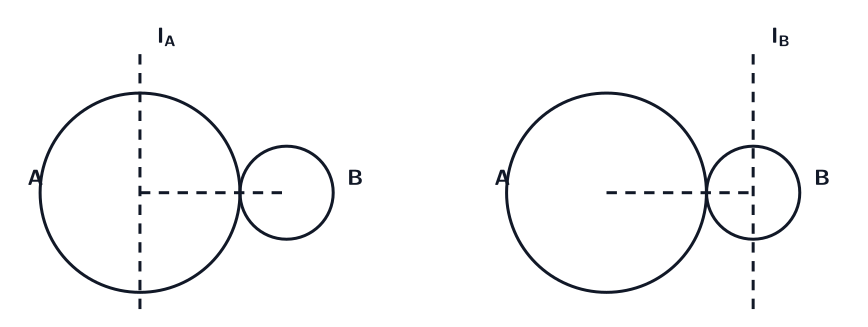
A solid sphere of radius and mass is attached at a point to a smaller solid sphere of radius and mass . Assume that the line joining their centres lies along the horizontal. The moment of inertia of the system calculated about a vertical axis passing through the centre of is and that calculated about a vertical axis passing through the centre of is . The difference is:
- (1)
- (2)
- (3)
- (4)
0
Answer and solution
Answer: (2)
The spheres touch, so their centres are separated by . About the axis through : ; about the axis through : . The two spin terms are common to both and cancel, leaving , a negative quantity as expected since the heavier sphere sits off-axis in the second case. NCERT Class 11, System of Particles and Rotational Motion (parallel axis theorem).
Why the other options are wrong:
- (1) gets the separation right but flips the sign - attaches the parallel-axis term to the wrong body in each case
- (3) uses as the centre separation, as if the small sphere were embedded in the large one rather than attached externally
- (4) assumes the moment of inertia is independent of the choice of axis, ignoring the parallel axis theorem altogether- (1)
Re-NEET 2026 · Q31
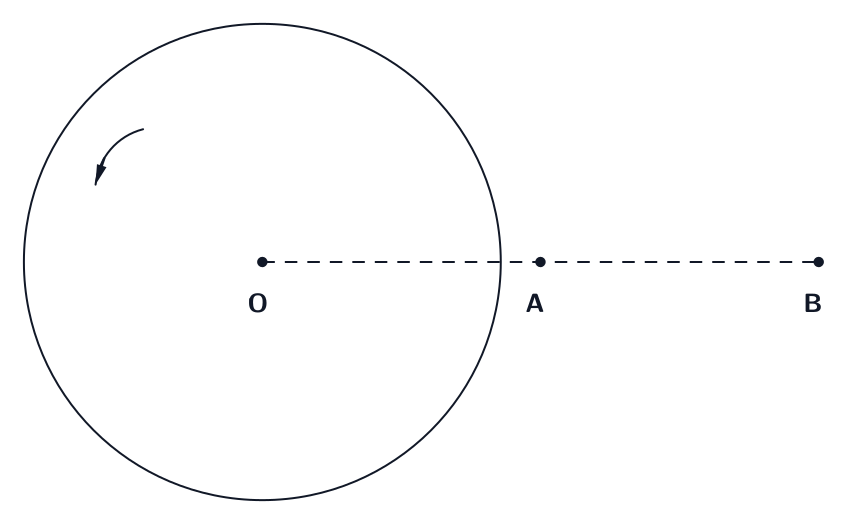
A thin horizontal disc is rotating about a vertical axis passing through its fixed centre . Its angular momentum is and computed about points and , respectively, with . The value of is:
- (1)
- (2)
- (3)
1
- (4)
2
Answer and solution
Answer: (3)
The angular momentum of a rigid body about any point splits as . Here the centre is FIXED, so and the orbital term vanishes for every reference point. Only the spin term survives, which is the same whether you compute about or , so the ratio is 1 regardless of the distances. NCERT Class 11, System of Particles and Rotational Motion (angular momentum of a rotating rigid body).
Why the other options are wrong:
- (1) assumes , importing an inverse-square intuition that does not apply
- (2) assumes scales inversely with the distance to the reference point
- (4) assumes grows in proportion to the distance, as it would for a single particle moving in a straight line- (1)
NEET 2020
NEET 2020 · Q165
Find the torque about the origin when a force 3ĵ N acts on a particle whose position vector is 2k̂ m.
- (1)
6ĵ N m
- (2)
-6î N m
- (3)
6k̂ N m
- (4)
6î N m
Answer and solution
Answer: (2)
Torque = r × F = (2k̂) × (3ĵ) = 6(k̂ × ĵ) = -6î N m. Chapter: System of Particles and Rotational Motion.
- (1)
NEET 2020 · Q180
Two particles of mass 5 kg and 10 kg respectively are attached to the two ends of a rigid rod of length 1 m with negligible mass. The centre of mass of the system from the 5 kg particle is nearly at a distance of :
- (1)
50 cm
- (2)
67 cm
- (3)
80 cm
- (4)
33 cm
Answer and solution
Answer: (2)
The center of mass is given by . Substituting, . Chapter: System of Particles and Rotational Motion.
- (1)
Practise System of Particles and Rotational Motion in the app: it brings back the questions you get wrong, so the chapter improves, not just your memory of these. Or try the free CBT mock. All chapters: NEET chapter-wise PYQs.
Questions
Are these the official NEET questions on System of Particles and Rotational Motion?
Yes. They are the questions NTA set in each paper, in its wording. The solutions are written by BrainIt.
Something here wrong or out of date? Email hello@brainit.pro and a person will read it.