

Electric Charges and Fields: NEET previous year questions
Every Electric Charges and Fields question from the official NEET papers on this site, with the answer and a worked solution.
The questions come from Re-NEET 2026 and NEET 2020. Each shows its answer and solution when you open it, so you can attempt it first. For what the chapter covers and how NEET tests it, see the Electric Charges and Fields guide.
Re-NEET 2026
Re-NEET 2026 · Q33
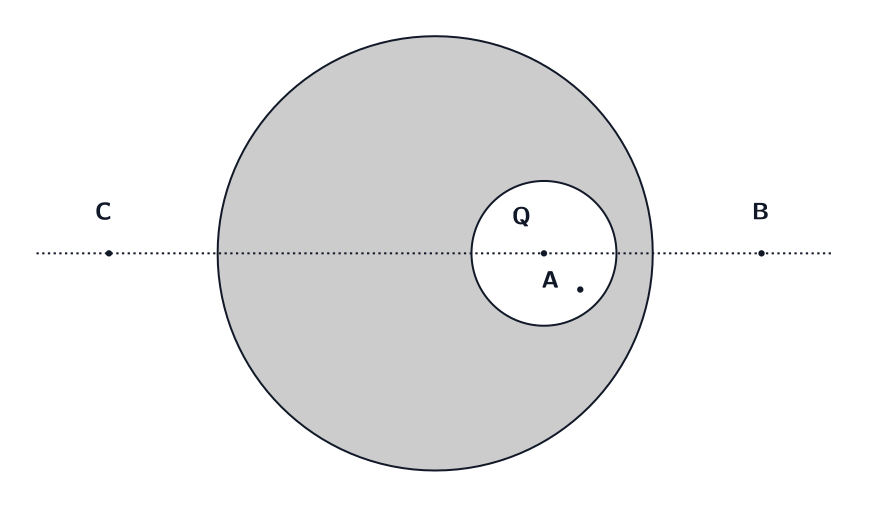
A point charge is placed inside a cavity within a solid isolated conducting sphere. Consider points , and as shown in the figure, where the magnitudes of the electric fields are , , , respectively. The points and are at the same distance from the center of the solid sphere. The correct option is :
- (1)
- (2)
- (3)
- (4)
Answer and solution
Answer: (2)
Point lies in the empty cavity, not in the conducting material, so the field of is fully present there and . The induced on the cavity wall and on the outer surface arrange themselves so that the outer surface charge is UNIFORM regardless of where the cavity sits, so outside the sphere the field is exactly that of a point charge at the centre. Since and are equidistant from that centre, . NCERT Class 12, Electric Charges and Fields (electrostatics of conductors).
Why the other options are wrong:
- (1) confuses the cavity with the conducting material - the field vanishes inside the METAL, not inside the hollow
- (3) combines the cavity error with the idea that the off-centre cavity biases the external field towards
- (4) correctly sees but wrongly assumes the external field is skewed away from the cavity side- (1)
NEET 2020
NEET 2020 · Q170
A spherical conductor of radius 10 cm has a charge of 3.2 × 10⁻⁷ C distributed uniformly. What is the magnitude of electric field at a point 15 cm from the centre of the sphere? (1/(4πε₀) = 9 × 10⁹ N m² C⁻²)
- (1)
N C
- (2)
N C
- (3)
N C
- (4)
N C
Answer and solution
Answer: (1)
The electric field outside a charged spherical conductor is given by . Substituting the values, . Chapter: Electric Charges and Fields.
- (1)
Practise Electric Charges and Fields in the app: it brings back the questions you get wrong, so the chapter improves, not just your memory of these. Or try the free CBT mock. All chapters: NEET chapter-wise PYQs.
Questions
Are these the official NEET questions on Electric Charges and Fields?
Yes. They are the questions NTA set in each paper, in its wording. The solutions are written by BrainIt.
Something here wrong or out of date? Email hello@brainit.pro and a person will read it.