

Human Reproduction: NEET previous year questions
Every Human Reproduction question from the official NEET papers on this site, with the answer and a worked solution.
The questions come from NEET 2026, Re-NEET 2026 and NEET 2020. Each shows its answer and solution when you open it, so you can attempt it first. For what the chapter covers and how NEET tests it, see the Human Reproduction guide.
NEET 2026
NEET 2026 · Q163
Spermatogonia undergo a series of cell divisions to produce sperms. Select the correct statements from the following and choose the correct answer from the options given below.
Statement I: Spermatogonia always undergo meiotic cell division.
Statement II: Primary spermatocytes divide mitotically to produce secondary spermatocytes.
Statement III: Secondary spermatocytes, through their second meiotic division, produce haploid spermatids.
Statement IV: Spermatids produce spermatozoa through mitosis.
Statement V: Spermatids transform into spermatozoa by spermiogenesis.- (1)
I and V only
- (2)
III and V only
- (3)
I, III and V only
- (4)
II, III and IV only
Answer and solution
Answer: (2)
Secondary spermatocytes complete the second meiotic division to give haploid spermatids (III correct), and spermatids differentiate into spermatozoa by spermiogenesis (V correct). Statement I is wrong because spermatogonia divide mitotically, Statement II is wrong because primary spermatocytes undergo meiosis I, and Statement IV is wrong because spermatids transform (not divide by mitosis) into sperm. So only Statements III and V are correct, option (2).
- (1)
NEET 2026 · Q167
Match List-I with List-II related to embryonic development at various months of pregnancy:
List I
List II
P) The foetus movement starts and hair appears on the head
I) 24 weeks of pregnancy
Q) The foetus develops limbs and digits
II) 20 weeks of pregnancy
R) The foetus develops external genital organs
III) 8 weeks of pregnancy
S) The foetus body is covered with fine hair; eyelids separate and eyelashes are formed
IV) 12 weeks of pregnancy
Choose the correct answer from the options given below:
- (1)
P-IV, Q-II, R-III, S-I
- (2)
P-II, Q-III, R-IV, S-I
- (3)
P-III, Q-II, R-IV, S-I
- (4)
P-II, Q-IV, R-III, S-I
Answer and solution
Answer: (2)
Limbs and digits form by the end of the second month (about 8 weeks), so Q-III. Most major organ systems and the external genital organs are formed by the end of the first trimester (about 12 weeks), so R-IV. The first foetal movements and hair on the head appear around the fifth month (about 20 weeks), so P-II. By about 24 weeks the body is covered with fine hair with separated eyelids and eyelashes, so S-I. Hence P-II, Q-III, R-IV, S-I.
- (1)
NEET 2026 · Q170
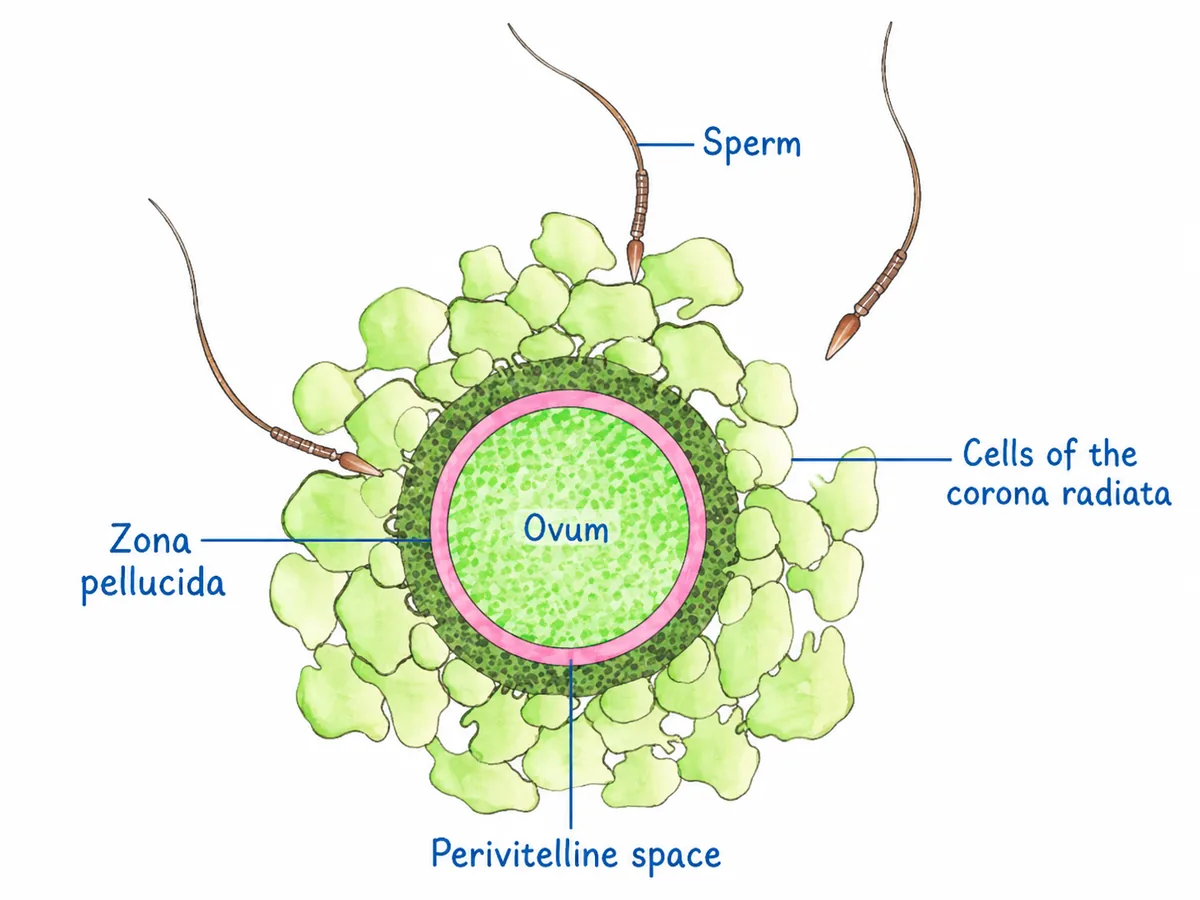
Arrange the following cell layers/structures around the female gamete, from outer to inner side.
I. A. Zona pellucida
II. B. Perivitelline space
III. C. Corona radiata
IV. D. Plasma membrane of ovum
Choose the correct answer from the options given below:- (1)
D, B, A, C
- (2)
C, A, D, B
- (3)
C, A, B, D
- (4)
A, C, B, D
Answer and solution
Answer: (3)
Moving inward from the outside of the secondary oocyte, the layers occur in the order corona radiata, then zona pellucida, then the perivitelline space, and finally the plasma membrane of the ovum. This corresponds to the sequence C, A, B, D. Hence option (3).
- (1)
Re-NEET 2026
Re-NEET 2026 · Q140
Sperm motility is due to ___________.
- (1)
flagellar movement
- (2)
ciliary movement
- (3)
amoeboid movement
- (4)
muscular movement
Answer and solution
Answer: (1)
The sperm tail is a single long FLAGELLUM whose whip-like beating propels the cell forward. The energy comes from the mitochondria spiralled around the middle piece, which is why that region is packed with them. NCERT Class 12, Human Reproduction.
- (1)
Re-NEET 2026 · Q143
Which of the following structures is not a part of the male reproductive system?
- (1)
Rete testis
- (2)
Epididymis
- (3)
Vasa efferentia
- (4)
Infundibulum
Answer and solution
Answer: (4)
The infundibulum is the funnel-shaped opening of the FALLOPIAN TUBE, fringed with fimbriae that collect the ovum after ovulation - a female structure. The male duct system runs seminiferous tubules → rete testis → vasa efferentia → epididymis → vas deferens, and the other three options are all stages along it. NCERT Class 12, Human Reproduction.
- (1)
Re-NEET 2026 · Q145
Given below are two statements:
Statement I: Ovulation is caused by LH surge leading to rupture of Graafian follicles.
Statement II: Graafian follicle remaining after ovulation transform into corpus luteum and secretes large amount of estrogen.
In the light of the above statements, choose the most appropriate answer from the options given below:- (1)
Both Statement I and Statement II are correct
- (2)
Both Statement I and Statement II are incorrect
- (3)
Statement I is correct but Statement II is incorrect
- (4)
Statement I is incorrect but Statement II is correct
Answer and solution
Answer: (3)
A mid-cycle surge of luteinising hormone ruptures the mature Graafian follicle and releases the ovum. The remaining follicle forms the corpus luteum, whose main secretion is progesterone; it helps maintain the endometrium for implantation. Statement I is true, while statement II wrongly names oestrogen as the principal secretion.
- (1)
Re-NEET 2026 · Q166
Which of the following hormone is not secreted by human placenta?
- (1)
hCG
- (2)
Estrogen
- (3)
Progesterone
- (4)
LH
Answer and solution
Answer: (4)
The placenta functions as a temporary endocrine gland, producing human chorionic gonadotropin (hCG), human placental lactogen, oestrogens, progestogens and later relaxin. Luteinising hormone is not among them - LH is a gonadotropin secreted by the ANTERIOR PITUITARY. The placental hormone that mimics its role early in pregnancy is hCG, which sustains the corpus luteum. NCERT Class 12, Human Reproduction.
- (1)
Re-NEET 2026 · Q173
The covering of ovum at ovulation is _________.
- (1)
endometrium
- (2)
zona radiata
- (3)
zona pellucida
- (4)
chorion
Answer and solution
Answer: (3)
The zona pellucida is the transparent glycoprotein layer laid down around the oocyte during its growth, and it is the covering carried by the ovum at ovulation. It plays an active role at fertilisation, binding sperm and then hardening to block polyspermy once one sperm has entered. NCERT Class 12, Human Reproduction.
- (1)
NEET 2020
NEET 2020 · Q31
Which of the following hormone levels will cause release of ovum (ovulation) from the graffian follicle?
- (1)
High concentration of Progesterone
- (2)
Low concentration of LH
- (3)
Low concentration of FSH
- (4)
High concentration of Estrogen
Answer and solution
Answer: (4)
High concentrations of estrogen trigger the release of luteinizing hormone (LH), which in turn causes ovulation. Chapter: Human Reproduction.
- (1)
NEET 2020 · Q40
Meiotic division of the secondary oocyte is completed
- (1)
At the time of copulation
- (2)
After zygote formation
- (3)
At the time of fusion of a sperm with an ovum
- (4)
Prior to ovulation
Answer and solution
Answer: (3)
Meiotic division of the secondary oocyte is completed at the time of fusion of a sperm with an ovum, forming the second polar body. Chapter: Human Reproduction.
- (1)
NEET 2020 · Q90
Match the following columns and select the correct option.
List I
List II
P) Placenta
I) Androgens
Q) Zona pellucida
II) Human chorionic gonadotropin (hCG)
R) Bulbo-urethral glands
III) Layer of the ovum
S) Leydig cells
IV) Lubrication of the penis
- (1)
P-I, Q-IV, R-II, S-III
- (2)
P-III, Q-II, R-IV, S-I
- (3)
P-II, Q-III, R-IV, S-I
- (4)
P-IV, Q-III, R-I, S-II
Answer and solution
Answer: (3)
The placenta secretes hCG; zona pellucida is the ovum's glycoprotein layer; bulbo-urethral secretions lubricate the penis; and Leydig cells secrete androgens. Thus P-II, Q-III, R-IV, S-I. Chapter: Human Reproduction.
- (1)
Practise Human Reproduction in the app: it brings back the questions you get wrong, so the chapter improves, not just your memory of these. Or try the free CBT mock. All chapters: NEET chapter-wise PYQs.
Questions
Are these the official NEET questions on Human Reproduction?
Yes. They are the questions NTA set in each paper, in its wording. The solutions are written by BrainIt.
Something here wrong or out of date? Email hello@brainit.pro and a person will read it.