

NEET 2026 Question Paper with Solutions
The official paper set by NTA: all 180 questions, each with its answer and a worked solution written by BrainIt.
Last updated 2026-10-23
Each question shows its answer and solution when you open it, so you can attempt it first. The two papers of 2026 side by side: NEET 2026 vs Re-NEET 2026.
Physics Questions 1 to 45
The speed of light in vacuum is taken as unity. If light takes 6 min 40 s to reach the Earth from the Sun, the distance between the Sun and the Earth in new unit is:
- (1)
- (2)
500
- (3)
- (4)
400
Answer and solution
Answer: (4)
In the new system the speed of light itself is 1 unit, so distance = speed time = . Converting the time, 6 min 40 s = 360 + 40 = 400 s, giving a distance of 400 new units, so (4) is correct. Options and wrongly re-insert the SI value of c even though c is now unity, and 500 comes from mis-converting the time.
- (1)
Match List I with List II and choose the correct answer from the options given below:
List I
List II
P) Young's Modulus
I)
Q) Compressibility
II)
R) Bulk Modulus
III)
S) Poisson's Ratio
IV)
- (1)
P-IV, Q-I, R-II, S-III
- (2)
P-III, Q-II, R-I, S-IV
- (3)
P-I, Q-IV, R-III, S-II
- (4)
P-II, Q-III, R-IV, S-I
Answer and solution
Answer: (4)
Young's modulus is stress/strain (II); compressibility is the reciprocal of bulk modulus (III); bulk modulus (IV); and Poisson's ratio is lateral strain over longitudinal strain (I). Hence P-II, Q-III, R-IV, S-I, which is option (4).
- (1)
The current in the circuit shown below is: (All diodes are ideal and identical)
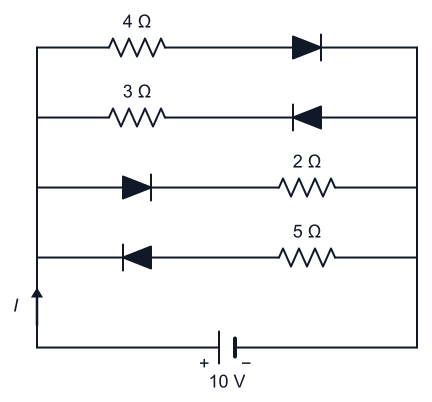
- (1)
A
- (2)
A
- (3)
A
- (4)
A
Answer and solution
Answer: (4)
An ideal diode has zero forward resistance and infinite reverse resistance, so only the branches whose diodes are forward biased conduct; here that leaves the 4 and 2 resistors in parallel across the 10 V battery. The current is A, giving (4). The other options wrongly include the reverse-biased 3 and 5 branches that actually carry no current.
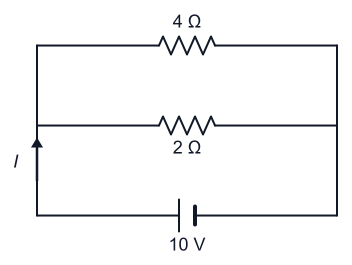
- (1)
The angular speed of a flywheel is increased from 600 rpm to 1200 rpm in 10 s. The number of revolutions completed by the flywheel during this time is:
- (1)
900
- (2)
600
- (3)
150
- (4)
300
Answer and solution
Answer: (3)
With uniform angular acceleration the number of revolutions equals the average angular speed times the time: revolutions per minute (rpm) over min = min, giving revolutions, option (3). Equivalently, using gives rad, so .
- (1)
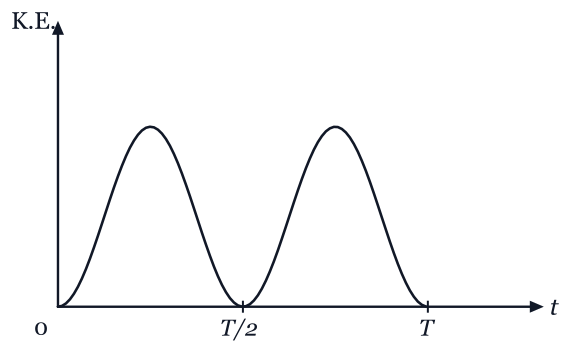
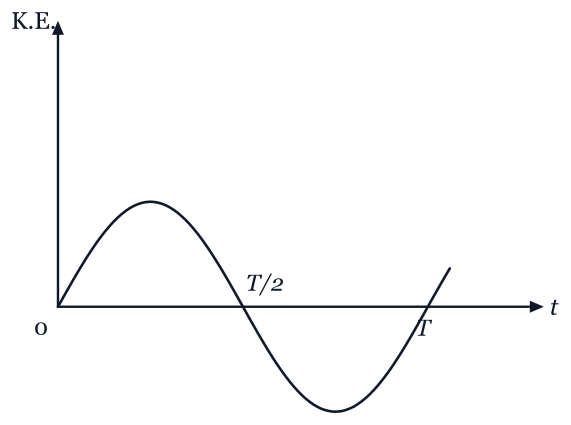
For a simple pendulum, having time period , the variation of kinetic energy (K.E.) with time () is represented by:
- (1)
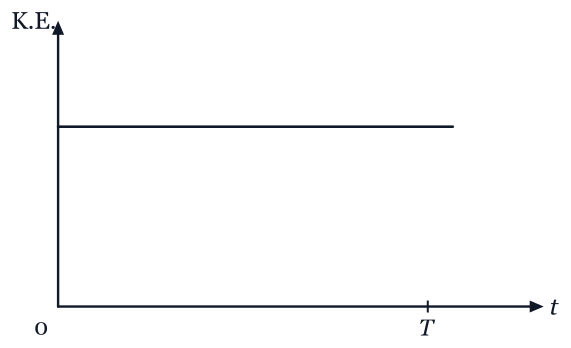
- (2)
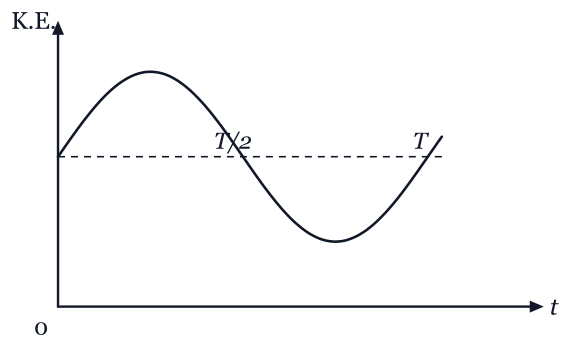
- (3)
- (4)
Answer and solution
Answer: (3)
The velocity in simple harmonic motion (SHM) is , so the kinetic energy is proportional to . This is always non-negative and repeats with period , producing two identical humps between 0 and that fall to zero at the extreme positions. Graph (3) shows exactly this, so the answer is (3).
- (1)
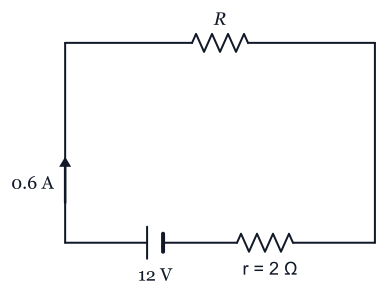
A resistor is connected to a battery of 12 V emf and internal resistance 2 . If the current in the circuit is 0.6 A, the terminal voltage of the battery is:
- (1)
10 V
- (2)
1.2 V
- (3)
12 V
- (4)
10.8 V
Answer and solution
Answer: (4)
The terminal voltage is the electromotive force (emf) minus the drop across the internal resistance: V, option (4). The 1.2 V drop across the internal resistance is what is subtracted, and 12 V would only be the terminal voltage if no current flowed.
- (1)
A flask contains argon and chlorine in the ratio of 2 : 1 by mass. The temperature of the mixture is 27C. The ratio of root mean square speed of the molecules of the two gases is: (Atomic mass of argon = 40.0 u and molecular mass of chlorine = 70.0 u)
- (1)
- (2)
- (3)
- (4)
Answer and solution
Answer: (1)
Since , at the same temperature . Therefore , option (1). The 2:1 mass ratio of the gases does not affect the rms speed, which depends only on temperature and molar mass.
- (1)
A ray of monochromatic light is passing through an equilateral prism () as shown in the figure. The refracted ray () is parallel to its base () and the angle of incidence () is 50. Then the angle of deviation () is:

- (1)
45
- (2)
35
- (3)
40
- (4)
55
Answer and solution
Answer: (3)
When the ray inside an equilateral prism () travels parallel to the base, the prism is in the minimum-deviation condition where the angle of incidence equals the angle of emergence (). Using gives , option (3).

- (1)
Match List I with List II:
List I
List II
P)
I) de Broglie wavelength
Q) Diffraction and Interference
II) Particle nature of light
R)
III) Wave nature of light
S) Compton effect
IV) Energy of photon
Choose the correct answer from the options given below:
- (1)
P-IV, Q-I, R-II, S-III
- (2)
P-IV, Q-III, R-II, S-I
- (3)
P-I, Q-IV, R-III, S-II
- (4)
P-IV, Q-III, R-I, S-II
Answer and solution
Answer: (4)
gives the energy of a photon (IV); diffraction and interference demonstrate the wave nature of light (III); is the de Broglie wavelength of a particle (I); and the Compton effect confirms the particle nature of light (II). Hence P-IV, Q-III, R-I, S-II, which is option (4).
- (1)
In the first excited state of hydrogen atom, the energy of its electron is eV. The radial distance of the electron from the hydrogen nucleus in this case is approximately:
(Take 1 eV = J, e = C and N m/C)- (1)
m
- (2)
m
- (3)
m
- (4)
m
Answer and solution
Answer: (3)
For the hydrogen atom the magnitude of the total energy equals half the magnitude of the potential energy, so eV. Solving, m, option (3). This is the Bohr orbit radius, i.e. angstrom.
- (1)
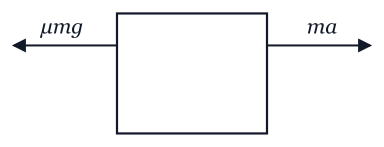
A box of mass 15 kg is kept on the floor of a stationary trolley. The coefficient of static friction between the box and the trolley is 0.12. Keeping the box in stationary state over the trolley, the maximum acceleration with which the trolley can be moved horizontally in m s is: ( m/s)
- (1)
2.1
- (2)
1.8
- (3)
1.5
- (4)
1.2
Answer and solution
Answer: (4)
The box stays with the trolley only while static friction can supply the force needed to accelerate it. The maximum friction is , so the greatest common acceleration is m/s, option (4). The mass cancels out, and beyond this acceleration the box slips relative to the trolley.
- (1)
Five capacitors of capacitances and are connected as shown, along with a battery of 50 V.
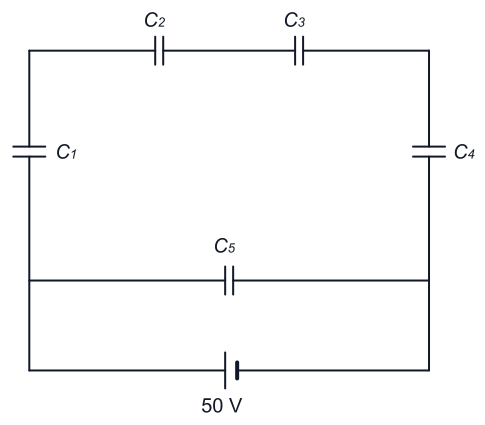
The equivalent capacitance and the charges on each capacitor respectively are:
- (1)
5 , 125 on to and 25 on
- (2)
5 , 125 on all capacitors
- (3)
5 , 250 on all capacitors
- (4)
4 , 250 on to and 125 on
Answer and solution
Answer: (2)
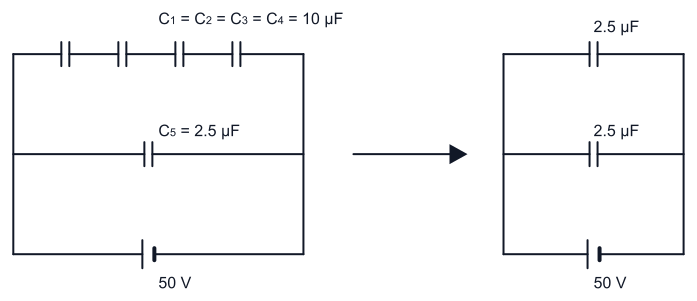
The four 10 capacitors are in series, giving , and this branch is in parallel with , so . Each branch has 50 V across it, so the series branch carries (the same charge flows through to ) and also holds . Every capacitor therefore stores 125 , option (2).
- (1)
The amount of work done to raise a mass '' from the surface of the Earth to a height equal to the radius of the Earth '' will be
- (1)
- (2)
- (3)
- (4)
Answer and solution
Answer: (4)
The work done equals the change in gravitational potential energy: . Using , this becomes , option (4). It is not the naive because gravity weakens with height, so less work is needed than if g stayed constant.
- (1)
Each side of a metallic cube of mass 5.580 kg is measured to be 9.0 cm. Keeping the significant figures in view, the density of the material of the cube can be best expressed as where the value of is:
- (1)
7.654
- (2)
7.6
- (3)
7.65
- (4)
7.7
Answer and solution
Answer: (4)
Density = mass/volume = which numerically gives about . The side is measured to only two significant figures (9.0 cm), so the final answer must be rounded to two significant figures, giving . Hence X = 7.7 (option (4)); the other values retain more significant figures than the data justify.
- (1)
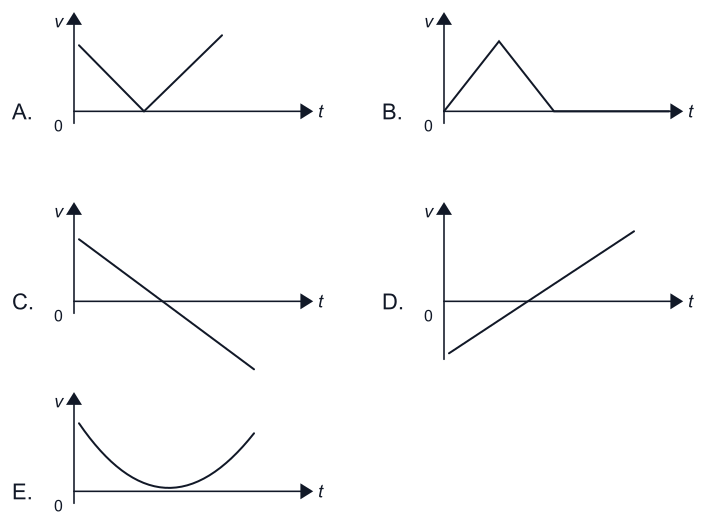
The following plots show variation of velocity () with time () of a ball thrown vertically upward, and falling back. Which of the following plots is/are correct?
- (1)
C only
- (2)
D only
- (3)
B only
- (4)
A and E only
Answer and solution
Answer: (1)
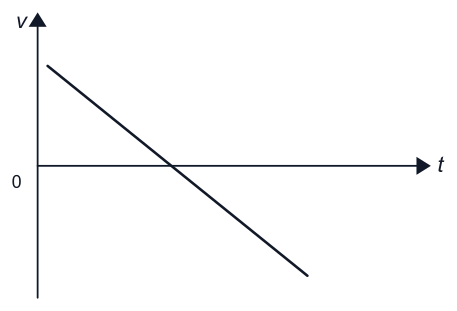
Throughout the flight the only acceleration is g directed downward, so stays a constant negative value. The velocity therefore decreases linearly, reaches zero at the highest point and turns negative on the way down, tracing a single straight line of constant negative slope, which is plot C. Hence option (1). Plots with a change of slope, a V-shape, or a positive slope contradict the constant downward acceleration.
- (1)
The sum of kinetic energy and potential energy of a simple pendulum bob is 0.02 joule. The speed of the simple pendulum bob at equilibrium position is approximately: (Consider mass of the bob = 20 g)
- (1)
0.2 m/s
- (2)
1.41 m/s
- (3)
14.1 m/s
- (4)
2.0 m/s
Answer and solution
Answer: (2)
At the equilibrium (lowest) point the bob's energy is entirely kinetic, so equals the total energy 0.02 J. With m = 20 g = 0.02 kg, , giving (option (2)). Forgetting to divide by the mass gives (option (1)).
- (1)
In Young's double slit experiment, using monochromatic light of wavelength , the intensity of light at a point on the screen where the path difference is , is units. The intensity of light at a point where the path difference is will be
- (1)
- (2)
- (3)
- (4)
Answer and solution
Answer: (1)
The interference intensity follows . A path difference of gives , so , i.e. . For a path difference , , giving (option (1)). The other choices ignore the dependence on phase.
- (1)
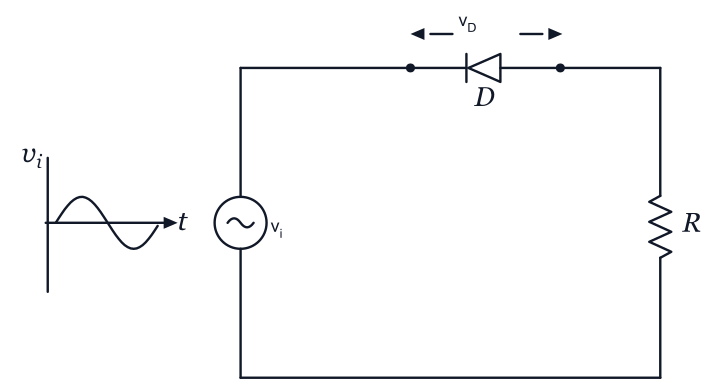
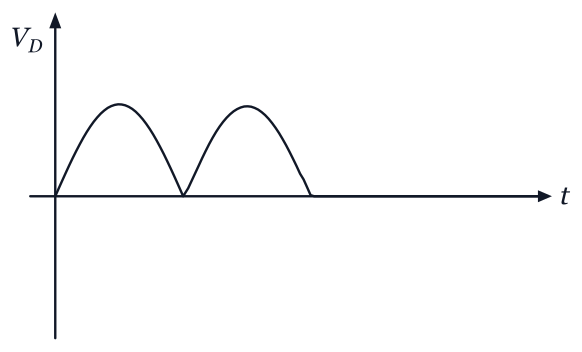
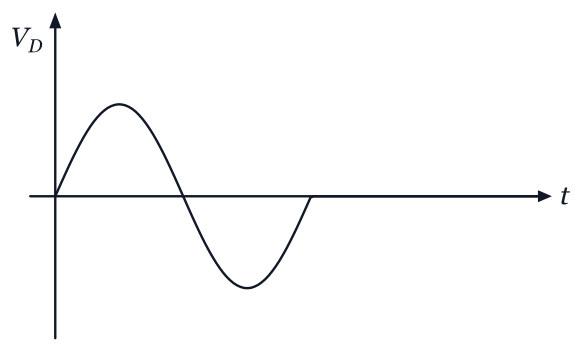
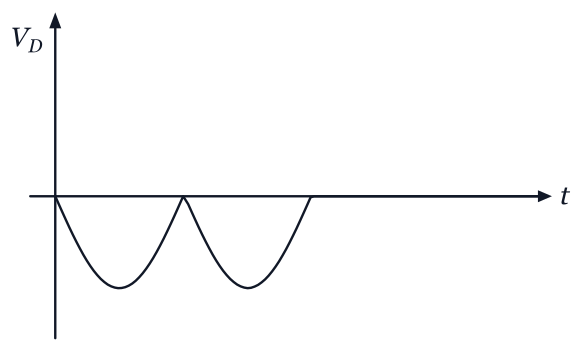
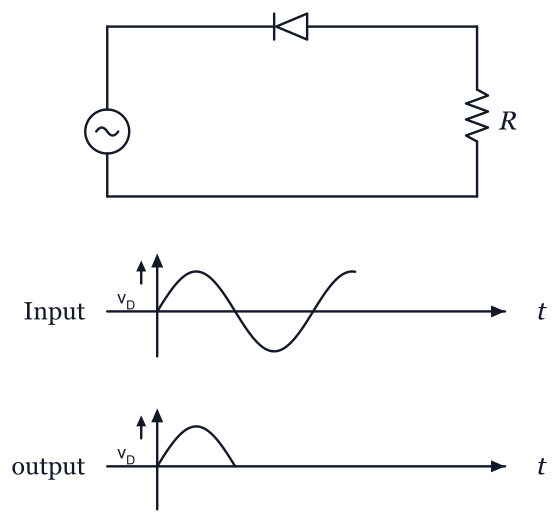
In the circuit shown below, the voltage appearing across the diode will be of the form:
- (1)
- (2)
- (3)
- (4)
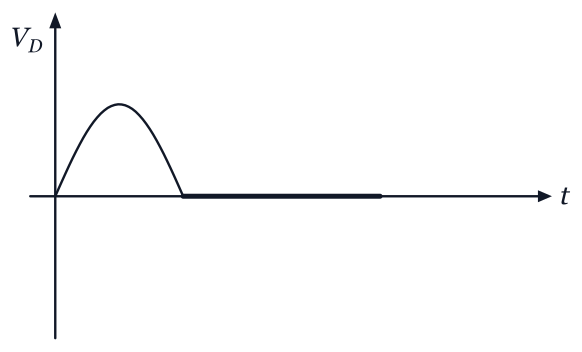
Answer and solution
Answer: (4)
The applied alternating current (ac) voltage drives current through the diode and R in series. During the half-cycle that reverse-biases the diode, almost the entire source voltage appears across the non-conducting diode, whereas in the forward-biased half-cycle the diode drop is nearly zero. So consists of one-sided humps with flat (near-zero) gaps, matching option (4). A full sine or a double-hump trace would wrongly imply the diode never blocks the current.
- (1)
An ac circuit contains a resistance of 1 k, a capacitor of 0.1 F and an inductor of 1 mH connected in series. The resonance frequency of the circuit is approximately:
- (1)
13.5 kHz
- (2)
10.1 kHz
- (3)
20.7 kHz
- (4)
15.9 kHz
Answer and solution
Answer: (4)
Series resonance occurs at , which is independent of the resistance. With and , (option (4)). The resistance value is a distractor since it does not enter the resonance formula.
- (1)
In interference and diffraction, the light energy is redistributed. If it reduces in one region, producing a dark fringe, it increases in another region, producing a bright fringe. Evaluate the following statements and choose the correct answer:
Statement I: As there is no gain or loss of energy, these phenomena are consistent with the principle of conservation of energy.
Statement II: Diffraction and interference are characteristics exhibited only by light waves.- (1)
I is true and II is also true
- (2)
I is false, but II is true
- (3)
I is true, but II is false
- (4)
Both I and II are false
Answer and solution
Answer: (3)
Interference and diffraction only redistribute light energy, so darkening of one region is compensated by brightening of another, keeping total energy unchanged. This makes statement I consistent with conservation of energy, i.e. Statement I is true. However, interference and diffraction are general wave phenomena shown by sound, water and other waves, not only light, so statement II is false. Hence 'I true, II false' (option (3)).
- (1)
For a travelling harmonic wave , where and are in cm and in s, the phase difference between oscillatory motion of two points separated by a distance of 0.5 m is:
- (1)
rad
- (2)
rad
- (3)
rad
- (4)
rad
Answer and solution
Answer: (2)
The spatial part of the phase is with x in cm, so the wave number term gives phase difference . Converting the separation to centimetres, , so rad (option (2)). The wrong answers arise from failing to convert 0.5 m into 50 cm.
- (1)
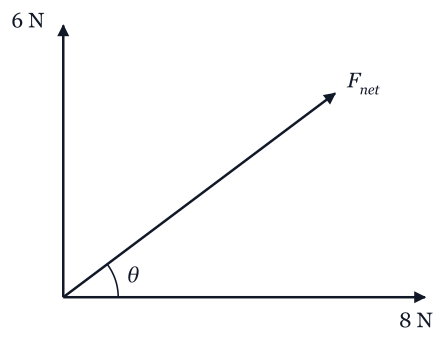
The magnitude and direction of the acceleration produced in a body of mass 5 kg when two mutually perpendicular forces 8 N and 6 N act on it, are respectively:
- (1)
; with 8 N force
- (2)
; with 6 N force
- (3)
; with 8 N force
- (4)
; with 8 N force
Answer and solution
Answer: (4)
The two perpendicular forces give a resultant , so . The resultant makes an angle with the 8 N force where , i.e. measured from the 8 N force (option (4)). Option (1) forgets to divide by the mass, and the others attach the angle to the wrong force or invert the ratio.
- (1)
Consider two uncharged capacitors of equal capacitance 200 pF. One of them is charged by a 100 V supply and disconnected. Now this capacitor is connected to the uncharged capacitor. The amount of electrostatic energy lost in the process is:
- (1)
J
- (2)
1.0 J
- (3)
J
- (4)
0.5 J
Answer and solution
Answer: (1)
When a charged capacitor shares its charge with an identical uncharged one, the energy dissipated is . With and , this equals (option (1)). The loss is real and independent of the connecting-wire resistance; answers in whole joules mishandle the pico-farad factor.
- (1)
The power of a crane, which lifts a mass of 1000 kg to a height of 20 m in 10 s is: ()
- (1)
19.6 W
- (2)
39.2 W
- (3)
19.6 kW
- (4)
39.2 kW
Answer and solution
Answer: (3)
The useful power is work done against gravity divided by time, . Substituting, (option (3)). The 19.6 W answer drops a factor of 1000, and the 39.2 values double-count g or the height.
- (1)
In a vernier calliper, 20 VSD coincide with 16 MSD (each division of length 1 mm). The least count of the vernier callipers is:
- (1)
0.2 cm
- (2)
0.01 cm
- (3)
0.02 cm
- (4)
0.1 cm
Answer and solution
Answer: (3)
Least count = 1 main scale division (MSD) - 1 VSD. Since 20 VSD = 16 MSD, one VSD equals MSD, so L.C. = MSD = MSD = mm = 0.2 mm = 0.02 cm (option (3)). Forgetting to convert millimetres to centimetres gives the distractor 0.2 cm.
- (1)
When a ruler falls vertically, 5 different persons catch it with different reaction times ( m s). Person A has a reaction time of 0.20 s, Person B has 0.22 s, Person C has 0.18 s, Person D has 0.19 s, and Person E has 0.21 s. What is the correct order of the distance travelled by the ruler for each person?
- (1)
B > E > A > C > D
- (2)
C > D > A > B > E
- (3)
B > E > A > D > C
- (4)
C > D > A > E > B
Answer and solution
Answer: (3)
The ruler falls freely, so distance increases monotonically with reaction time. Ranking the reaction times from largest to smallest gives B(0.22) > E(0.21) > A(0.20) > D(0.19) > C(0.18), which is the same order as the distances. Option (4) is the exact reverse (smallest first). Option (2) is also smallest first and swaps persons B and E as well. Option (1) swaps persons D and C.
- (1)
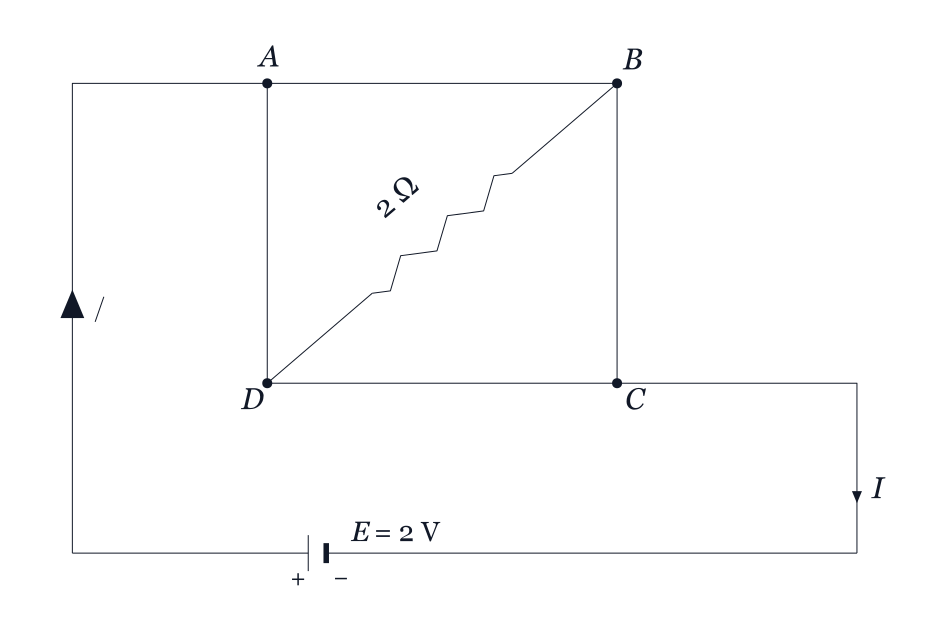
A uniform metallic wire having resistance 4 is bent to form a square loop (ABCD) (see figure). A resistance of 2 is connected between points B and D and a battery of 2 V is connected across points A and C as shown in the figure. Now the value of current () is:
- (1)
2 A
- (2)
8 A
- (3)
4.5 A
- (4)
4 A
Answer and solution
Answer: (1)
The 4 wire splits equally, so each side of the square is 1 . With the 2 across diagonal BD and the 2 V battery across A and C, the four 1 arms form a balanced Wheatstone bridge, so no current flows through the 2 branch. The effective resistance across AC is 1 , giving A.
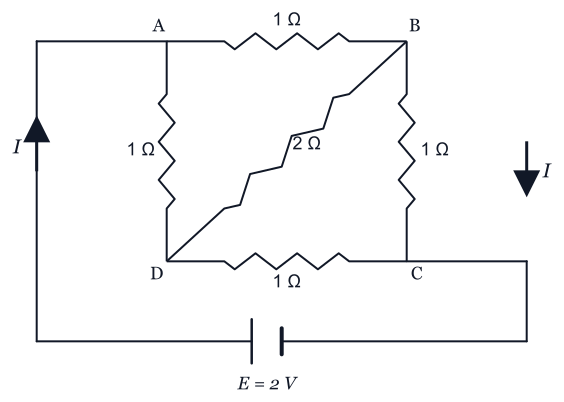
Why the other options are wrong:
- (2) Assumes far too low a resistance.
- (3) Arbitrary value from mis-combining resistances.
- (4) Would need 0.5 , as if each path from A to C had one 1 side instead of two.- (1)
A room heater is rated 400 W, 220 V. If the supply voltage drops to 200 V, what will be the power consumed (approximately)?
- (1)
200 W
- (2)
400 W
- (3)
331 W
- (4)
121 W
Answer and solution
Answer: (3)
The heater resistance is fixed, so gives W. Power scales as the square of voltage, not linearly, so option (2) (unchanged) and option (1) (linear scaling) are wrong, and option (4) over-reduces.
- (1)
A 100-turn closely wound circular coil of radius 5 cm has a magnetic field of T at its centre. The current flowing through the coil, and the magnitude of the magnetic moment of this coil are, respectively: (Take T m/A)
- (1)
2 A, 10 A m
- (2)
2.5 A, 20 A m
- (3)
2 A, 4 A m
- (4)
2.5 A, 2 A m
Answer and solution
Answer: (4)
From , the current is A. The magnetic moment A m. Only option (4) gives both correct values.
- (1)
A rectangular wire loop of sides 8 cm and 3 cm with a small cut, is moving out of a region of uniform magnetic field of magnitude 0.3 T directed normal to the plane of the loop. The emf developed across the cut, if the velocity of the loop is 2 cm s, in a direction normal to the shorter side of the loop, will be:
- (1)
volt
- (2)
volt
- (3)
volt
- (4)
volt
Answer and solution
Answer: (4)
The motional electromotive force (emf) is , where is the side perpendicular to the velocity. Since the loop moves normal to the shorter side, the effective length is the shorter side (3 cm): V. Option (1) wrongly uses the 8 cm side.
- (1)
Four statements are given ( is mass number). Choose the correct answer from the options given below:
Statement I: The volume of a nucleus is proportional to .
Statement II: The volume of a nucleus is proportional to .
Statement III: The difference in mass of an atom and its nucleus is called the mass defect.
Statement IV: The difference in mass of a nucleus and its constituents is called the mass defect.- (1)
I and III are true, but II and IV are false
- (2)
II and III are true, but I and IV are false
- (3)
I and IV are true, but II and III are false
- (4)
II and IV are true, but I and III are false
Answer and solution
Answer: (4)
Nuclear radius , so volume (statement II correct, I wrong). The mass defect is the difference between the total mass of the constituent nucleons and the actual mass of the nucleus (statement IV correct, III wrong). Hence only II and IV are true.
- (1)
An unknown nucleus has a nuclear density of kg/m and mass of kg. Its mass number is approximately: (Take m, )
- (1)
12
- (2)
20
- (3)
16
- (4)
19
Answer and solution
Answer: (1)
Using density = mass/volume with volume and , we get . Solving, .
- (1)
Savitha, a XI standard student, while conducting an experiment to determine the effective length of a simple pendulum , notes down the data of time taken to complete 30 oscillations as 60 s and hence calculates the length of the simple pendulum as: (Take , and m/s)
- (1)
0.75 m
- (2)
1.5 m
- (3)
2 m
- (4)
1 m
Answer and solution
Answer: (4)
The time period is s. From , the length is m. The other options result from arithmetic or period errors.
- (1)
An electric heater supplies heat to a system at a rate of 100 W. If the system performs work at a rate of 75 J/s, then the rate at which internal energy increases will be:
- (1)
75 W
- (2)
100 W
- (3)
125 W
- (4)
25 W
Answer and solution
Answer: (4)
By the first law of thermodynamics . Differentiating with respect to time, , so W. The distractors correspond to the given work rate (1), heat rate (2), or the incorrect sum (3).
- (1)
A thin wire of length '' and linear mass density '' is bent into a circular ring (in - plane) with centre '' as shown in figure. The moment of inertia of the ring about an axis will be:
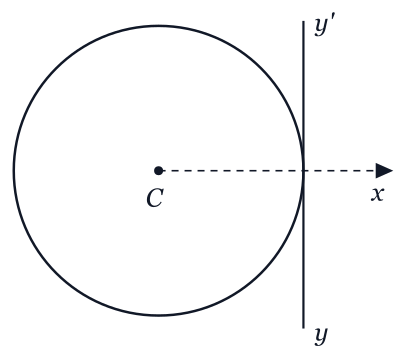
- (1)
- (2)
- (3)
- (4)
Answer and solution
Answer: (2)
The ring's mass is and its radius (since ). The axis is tangential to the ring in its plane, so by the parallel axis theorem . The correct expression has and , eliminating the other options.
Why the other options are wrong:
- (1) Uses instead of in the denominator.
- (3) Wrong power of L and .
- (4) Wrong power of L.- (1)
A galvanometer of resistance 100 gives full scale deflection for a current of 1 mA. It is converted into an ammeter of range 0 - 10 A. The shunt required is:
- (1)
0.01
- (2)
0.10
- (3)
1.0
- (4)
0.001
Answer and solution
Answer: (1)
The shunt is in parallel with the galvanometer, so , where A and mA. Thus , giving . The other values come from misplacing the factor of ten in the current ratio.
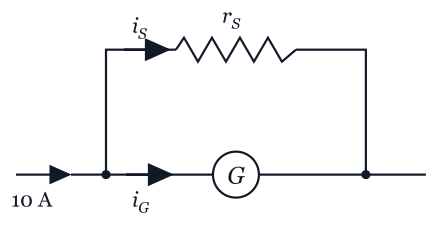
Why the other options are wrong:
- (2) Off by a factor of 10.
- (3) Off by a factor of 100.
- (4) Off by a factor of 10 (too small).- (1)
In a metre bridge experiment (see figure), the positions of the cell, , and galvanometer, , are interchanged. We shall observe in the galvanometer:

- (1)
Only the left-sided deflection
- (2)
There will be no deflection irrespective of the position of the jockey
- (3)
Only the right-sided deflection
- (4)
Both right-sided and left-sided deflection and at balance point, no deflection
Answer and solution
Answer: (4)
A metre bridge is a Wheatstone network, whose balance (null) condition is symmetric with respect to interchanging the cell and the galvanometer, so the balance point does not move. Away from that point the bridge is unbalanced and the galvanometer deflects; the direction of deflection depends on which side of balance the jockey lies, and it reads zero exactly at the balance point.
Why the other options are wrong:
- (1) Deflection is not restricted to one side; it flips about the null point.
- (2) No deflection occurs only at balance, not everywhere.
- (3) Same error as (1) but for the opposite side.- (1)
The peak value of an alternating current is and frequency is . How long will the current, starting from zero, take to reach the peak value?
- (1)
- (2)
- (3)
- (4)
Answer and solution
Answer: (4)
With and , the current first equals its peak when , i.e. . This gives (a quarter of the period).
- (1)
The figure shows a long straight solid wire of circular cross-section of radius carrying steady current . The current is uniformly distributed across its cross-section. The plot which correctly represents the variation of magnetic field with distance from the axis of the conductor is:
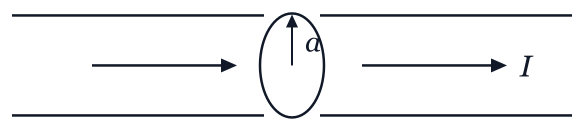
- (1)
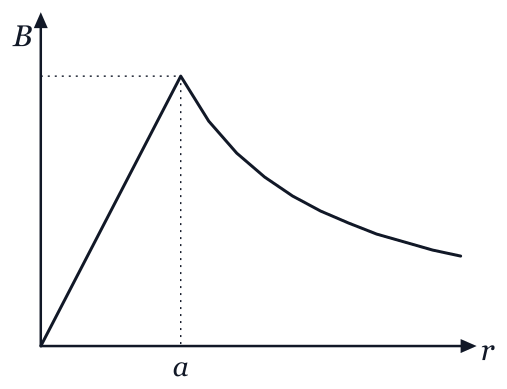
- (2)
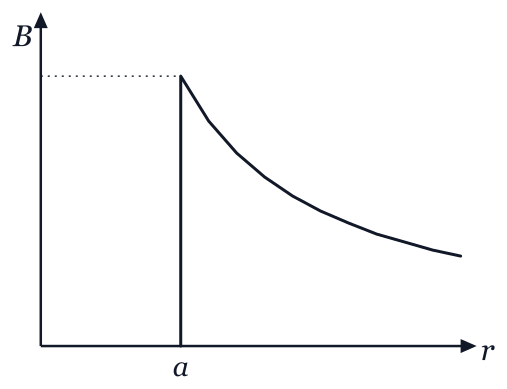
- (3)
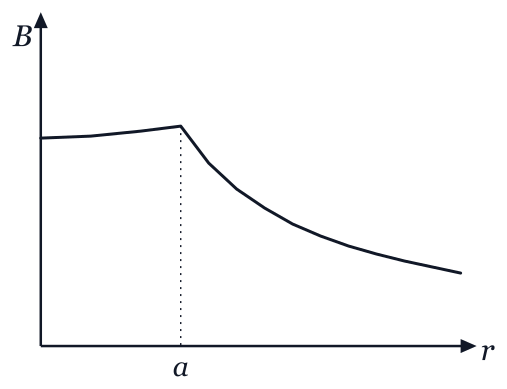
- (4)
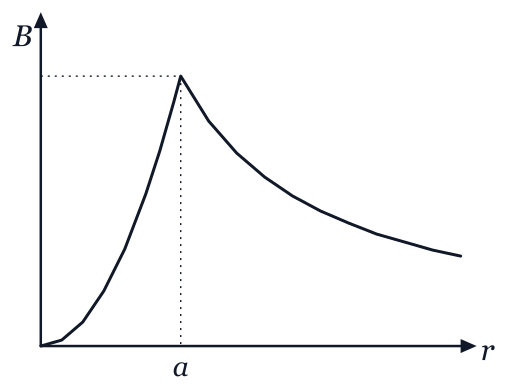
Answer and solution
Answer: (1)
By Ampere's law, inside the wire () only the enclosed fraction of current contributes, giving , so (a straight line rising to a maximum at ). Outside () the full current is enclosed, giving , so . Only graph (1) shows this linear rise followed by a decay.
- (1)
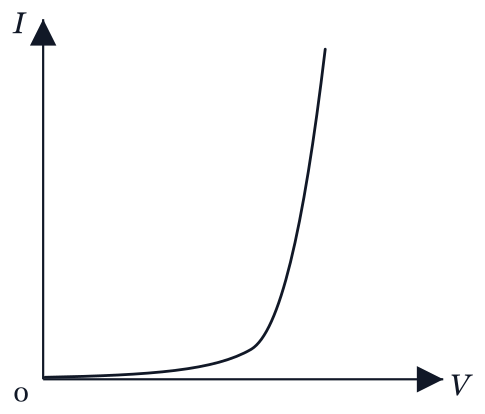
Two statements are given below. Choose the correct answer from the options given below.
I. A. When the forward bias voltage across a p-n junction diode increases above a certain threshold voltage, the diode current increases significantly.
II. B. This current is called reverse saturation current.- (1)
Both Statements A and B are true
- (2)
Statement A is true, but Statement B is false
- (3)
Both Statements A and B are false
- (4)
Statement A is false, but Statement B is true
Answer and solution
Answer: (2)
Statement A is correct: beyond the threshold (knee) voltage in forward bias, the diode current rises steeply, as seen in the forward V-I characteristic. Statement B is wrong: this rapidly increasing current is the forward current, whereas reverse saturation current is the very small, nearly constant current that flows under reverse bias.
- (1)
Which of the following statements are correct? Choose the correct answer from the options given below.
Statement I: Inside a conductor, the electrostatic field is zero.
Statement II: Electric field at the surface of a charged conductor does not depend on its surface charge density.
Statement III: The interior of a charged conductor can have no excess charge in the static situation.
Statement IV: At the surface of a charged conductor, the electrostatic field must be normal to the surface at every point.
Statement V: The electrostatic potential is zero everywhere inside a charged conductor.- (1)
I, II and IV only
- (2)
I, III and V only
- (3)
I, III and IV only
- (4)
III, IV and V only
Answer and solution
Answer: (3)
In electrostatic equilibrium, the electric field inside a conductor is zero, and any excess charge lies on its surface. The field just outside is normal to the surface and depends on the local surface charge density, . The potential is constant inside but need not be zero. Therefore internal statements I, III and IV hold; II and V do not.
- (1)
For a metal of work function , which of the following wavelengths of incident radiation does not give rise to the photoelectric effect? (Take Planck's constant as )
- (1)
100 nm
- (2)
150 nm
- (3)
200 nm
- (4)
50 nm
Answer and solution
Answer: (3)
Photoemission requires photon energy , i.e. wavelength . Here . Any wavelength longer than this cannot eject electrons; , so it produces no photoelectric effect.
- (1)
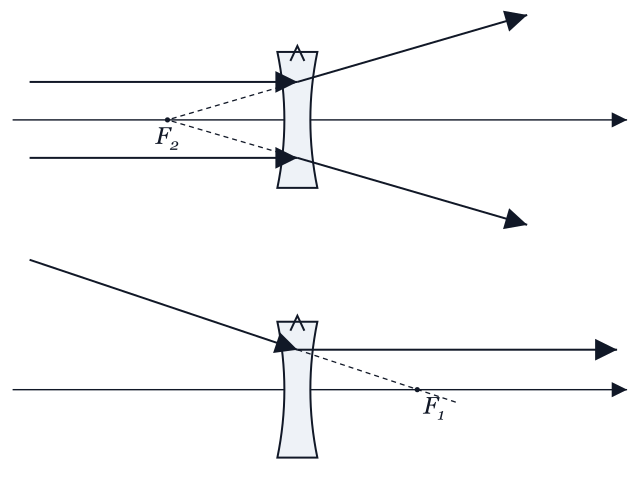
In a concave lens, a ray of light emanating from the object parallel to the principal axis of the lens after refraction:
- (1)
passes through , which is the radius of curvature of the lens.
- (2)
appears to diverge from the first principal focus.
- (3)
emerges parallel to the principal axis.
- (4)
passes through the second principal focus.
Answer and solution
Answer: (2)
A concave lens is diverging, so a ray incident parallel to the principal axis bends away from the axis and travels as though it originated from the focal point on the same (incident) side of the lens. Traced backwards, the emergent ray appears to diverge from that near-side focus. Strictly, this near-side point is the second principal focus ( in the figure), but option (2) is still the best answer, because it is the only option where the ray appears to diverge from a focus.
Why the other options are wrong:
- (1) A parallel ray relates to the focus, not to ; this describes a different ray.
- (3) It does not stay parallel; a diverging lens spreads a parallel beam.
- (4) The emergent ray only appears to come from the second principal focus on the incident side; it moves away from that point and never passes through it.- (1)
A submarine is designed to withstand an absolute pressure of . How deep can it go below the water surface? (Consider the density of water , and gravitational acceleration )
- (1)
990 m
- (2)
9900 m
- (3)
99 m
- (4)
9000 m
Answer and solution
Answer: (1)
Absolute pressure at depth is . So , giving , hence .
- (1)
Match List-I (Electromagnetic wave) with List-II (Production) and choose the correct answer from the options given below.
List I
List II
P) Microwave
I) Electrons in atoms emit light when they move from a higher energy level to a lower energy level
Q) Visible light
II) Radioactive decay of nucleus
R) Gamma rays
III) Vibration of atoms and molecules
S) Infra-red rays
IV) Klystron valve or magnetron valve
- (1)
P-III, Q-I, R-II, S-IV
- (2)
P-III, Q-IV, R-I, S-II
- (3)
P-IV, Q-I, R-II, S-III
- (4)
P-IV, Q-III, R-II, S-I
Answer and solution
Answer: (3)
Microwaves are generated by klystron or magnetron valves (P-IV). Visible light is emitted when atomic electrons drop from higher to lower energy levels (Q-I). Gamma rays are produced in radioactive decay of the nucleus (R-II). Infra-red radiation arises from the vibration of atoms and molecules (S-III). This matches option (3).
- (1)
Chemistry Questions 46 to 90
Select the reagents that reduce nitriles to primary amines. Choose the correct answer from the options given below.
Statement I: (i) ; (ii)
Statement II:
Statement III:
Statement IV:
Statement V: /aq.- (1)
II, IV and V only
- (2)
I, III and IV only
- (3)
I, IV and V only
- (4)
I, II and III only
Answer and solution
Answer: (2)
Nitriles are reduced to primary amines by followed by hydrolysis, by catalytic hydrogenation , and by (sodium amalgam in ethanol). So Statements I, III and IV are correct. (Stephen reduction) stops at the aldehyde, and /aq. NaOH is the Hoffmann bromamide reaction on amides, not a nitrile reduction.
- (1)
Match List I with List II:
List I
List II
P)
I) Preparation of ammonia from / mixture
Q)
II) Polymerisation of alkynes
R)
III) Preparation of and
S) Ni complex
IV) Oxidation of ethyne to ethanal
- (1)
P-III, Q-IV, R-I, S-II
- (2)
P-IV, Q-I, R-III, S-II
- (3)
P-II, Q-I, R-IV, S-III
- (4)
P-III, Q-I, R-IV, S-II
Answer and solution
Answer: (4)
is the contact-process catalyst linked with / chemistry (III); Fe is the Haber-process catalyst for ammonia from / (I); catalyses Wacker oxidation of ethyne/ethene to ethanal (IV); and Ni complexes catalyse polymerisation of alkynes (II). Hence P-III, Q-I, R-IV, S-II.
- (1)
Consider the following reaction: . and at 298 K. Identify the correct option with for the reaction and the spontaneity of the reaction at 298 K. (Given: )
- (1)
, spontaneous
- (2)
, spontaneous
- (3)
, non-spontaneous
- (4)
, non-spontaneous
Answer and solution
Answer: (3)
With , . Then . A positive means the reaction is non-spontaneous.
- (1)
Match List I (Quantum Numbers, given as n and l) with List II (Orbital):
List I
List II
P) n = 2, l = 1
I) 3d
Q) n = 4, l = 0
II) 2p
R) n = 5, l = 3
III) 4s
S) n = 3, l = 2
IV) 5f
- (1)
P-IV, Q-II, R-III, S-I
- (2)
P-II, Q-III, R-I, S-IV
- (3)
P-II, Q-III, R-IV, S-I
- (4)
P-I, Q-II, R-III, S-IV
Answer and solution
Answer: (3)
The orbital is named by n and the subshell letter for l (l = 0,1,2,3 -> s,p,d,f). So n=2,l=1 is 2p (II); n=4,l=0 is 4s (III); n=5,l=3 is 5f (IV); n=3,l=2 is 3d (I). This gives P-II, Q-III, R-IV, S-I.
- (1)
In a qualitative analysis, is detected by appearance of precipitate of . Calculate pH when the following equilibrium exists at 298 K. , . (Given: )
- (1)
8.714
- (2)
4.699
- (3)
5.286
- (4)
9.301
Answer and solution
Answer: (4)
For the dissolution, since a solid gives equal amounts of and . So . Then and .
- (1)
The correct statement with regard to the secondary structure of DNA/RNA is
- (1)
RNA possesses a single strand helix structure and contains thymine as one of the four bases
- (2)
DNA possesses a double strand helix structure and contains thymine as one of the four bases
- (3)
RNA possesses a double strand helix structure and contains uracil as one of the four bases
- (4)
DNA possesses a single strand helix structure and contains uracil as one of the four bases
Answer and solution
Answer: (2)
DNA has a double-stranded helical secondary structure (two antiparallel polynucleotide chains) and its four bases are adenine, guanine, cytosine and thymine. RNA is generally single-stranded and contains uracil in place of thymine, so only the DNA statement pairing double-strand + thymine is correct.
- (1)
The pair of molecules that are metamers among the following is:
- (1)
and
- (2)
and
- (3)
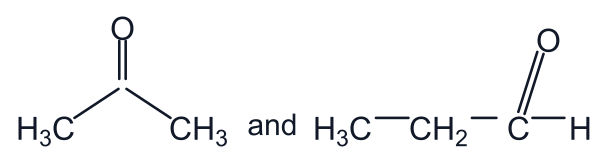
- (4)
and
Answer and solution
Answer: (4)
Metamers have the same molecular formula and same functional group but differ in the alkyl groups attached on either side of that group. Methyl n-propyl ether and diethyl ether are both ethers differing only in the distribution of carbons about the oxygen, so they are metamers.
Why the other options are wrong:
- (1) 1-propanol and 2-propanol are position isomers, not metamers.
- (2) n-Pentane and isopentane are chain isomers.
- (3) Propanone and propanal are functional-group isomers.- (1)
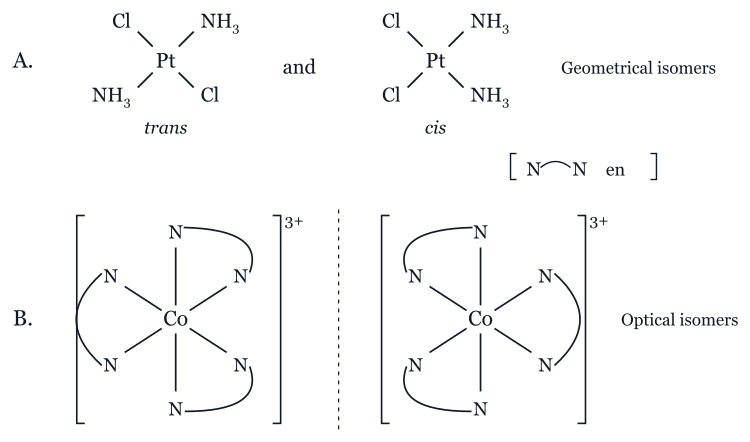
Match List I (Complex) with List II (Type of isomerism):
List I
List II
a)
i) Optical
b)
ii) Solvate
c)
iii) Geometrical
d)
iv) Linkage
- (1)
A-III, B-I, C-II, D-IV
- (2)
A-I, B-III, C-II, D-IV
- (3)
A-II, B-IV, C-III, D-I
- (4)
A-III, B-I, C-IV, D-II
Answer and solution
Answer: (4)
shows cis/trans (geometrical) isomerism (III); is a tris-chelate that is chiral, showing optical isomerism (I); shows linkage isomerism through the ambidentate / ligand (IV); and shows solvate (hydrate) isomerism (II). Hence A-III, B-I, C-IV, D-II.
- (1)
Match List I (Order of reaction) with List II (Unit of rate constant):
List I
List II
P) Zero order
I)
Q) First order
II)
R) Second order
III)
S) Third order
IV)
- (1)
P-IV, Q-II, R-I, S-III
- (2)
P-IV, Q-III, R-I, S-II
- (3)
P-IV, Q-III, R-II, S-I
- (4)
P-I, Q-II, R-III, S-IV
Answer and solution
Answer: (2)
The unit of the rate constant of an nth-order reaction is . For n=0 this is (IV); n=1 gives (III); n=2 gives (I); n=3 gives (II). Hence P-IV, Q-III, R-I, S-II.
- (1)
The correct IUPAC name of the following compound is:
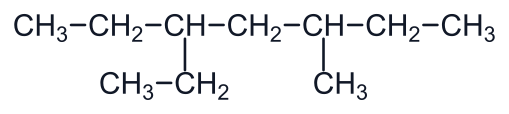
- (1)
3-ethyl-5-methylheptane
- (2)
2,4-diethylhexane
- (3)
3-methyl-5-ethylheptane
- (4)
3,5-diethylhexane
Answer and solution
Answer: (1)
The longest continuous carbon chain has seven carbons, so the parent is heptane. Numbering to give the lowest set of locants places an ethyl group at C-3 and a methyl group at C-5. Listing substituents alphabetically (ethyl before methyl) gives 3-ethyl-5-methylheptane.
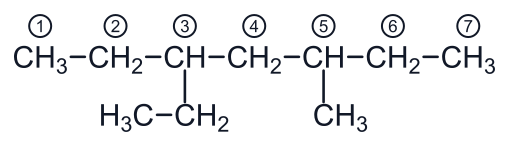
Why the other options are wrong:
- (2) Chooses a 6-carbon parent, missing the longest chain.
- (3) Right parent but substituents not in alphabetical order and wrong locants.
- (4) Wrong parent chain length and substituent identification.- (1)
A bulb is rated at 150 watt, converting 8% energy into light. If energy of one photon is , how many photons are emitted by the bulb per second?
- (1)
- (2)
- (3)
- (4)
Answer and solution
Answer: (1)
In one second the bulb consumes 150 J; only 8% becomes light, so light energy per second = J. The number of photons n = (light energy)/(energy per photon) = . The other options come from omitting the 8% factor or arithmetic errors.
- (1)
Methane reacts with steam at 1273 K in the presence of nickel catalyst to form:
- (1)
and
- (2)
and
- (3)
and
- (4)
and
Answer and solution
Answer: (3)
Steam reforming of methane over a nickel catalyst at about 1273 K gives carbon monoxide and dihydrogen (synthesis gas): . This is the industrial route to dihydrogen. The other options do not match the primary products of this reaction.
- (1)
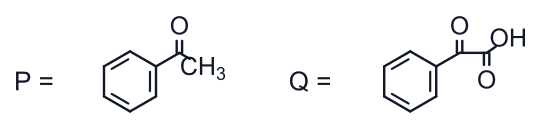
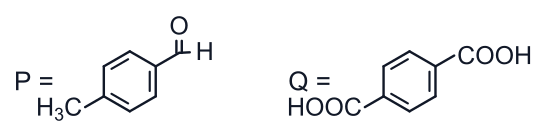
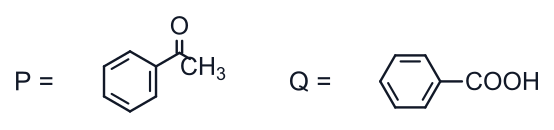
Compound P () gives a red-orange precipitate with 2,4-DNP reagent but does not reduce Fehling's reagent or give a positive Tollens' test. On drastic oxidation with chromic acid, P gives an aromatic product Q that produces effervescence with aqueous . Compounds P and Q, respectively, are:
- (1)
- (2)
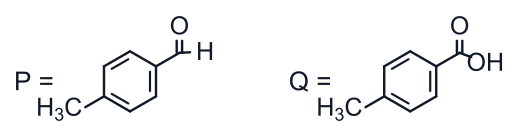
- (3)
- (4)
Answer and solution
Answer: (4)
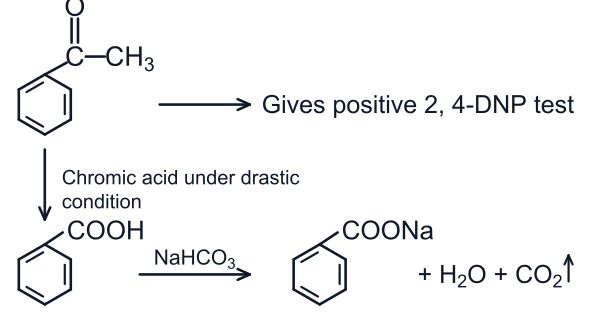
P is acetophenone, . Its aryl-ketone carbonyl gives the red-orange 2,4-DNP precipitate, while as a ketone it is negative to BOTH Fehling's and Tollens'; a positive Tollens' test would mean an aldehyde, so an aromatic aldehyde such as p-tolualdehyde is excluded. Drastic oxidation with chromic acid cleaves the methyl ketone to benzoic acid: . Q is benzoic acid, whose −COOH liberates with aqueous : . Option (1) gives the wrong oxidation product for acetophenone; options (2) and (3) take P to be p-tolualdehyde, which the Tollens' clue rules out.
- (1)
Match List-I with List-II and choose the correct answer from the options given below:
List I
List II
P)
I) 3 bonds, 2 bonds
Q)
II) 3 bonds, one lone pair
R)
III) 4 bonds
S)
IV) 5 bonds, 1 bond
- (1)
P-III, Q-IV, R-II, S-I
- (2)
P-IV, Q-I, R-III, S-II
- (3)
P-I, Q-II, R-IV, S-III
- (4)
P-II, Q-III, R-I, S-IV
Answer and solution
Answer: (2)
Ethene () has 4 C-H plus 1 C-C sigma bonds (5 sigma) and 1 pi bond (IV). Ethyne () has 2 C-H plus 1 C-C sigma (3 sigma) and 2 pi bonds (I). Methane () has 4 C-H sigma bonds (III). Ammonia () has 3 N-H sigma bonds and one lone pair on nitrogen (II). Hence P-IV, Q-I, R-III, S-II.
- (1)
The following two reactions give the same foul smelling product Z:
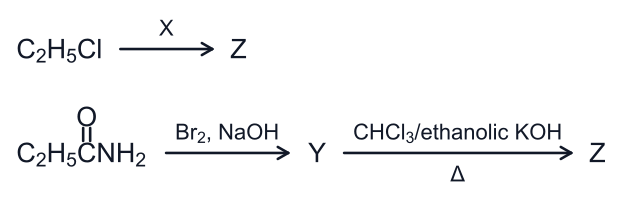
X and Z, respectively, are:
- (1)
- (2)
- (3)
- (4)
Answer and solution
Answer: (1)
With silver cyanide () the alkyl halide gives the isocyanide, so ethyl chloride yields foul-smelling ethyl isocyanide, (X = ). In the second route, propanamide undergoes Hoffmann bromamide degradation () to ethylamine, which then gives ethyl isocyanide via the carbylamine reaction ( + ethanolic ). Both paths converge on Z = . would give the nitrile (), which is not foul-smelling.
Why the other options are wrong:
- (2) Wrong: gives nitrile, and nitrile is not the foul-smelling carbylamine product.
- (3) Wrong: does not give the nitrile.
- (4) Wrong: gives nitrile, not isocyanide.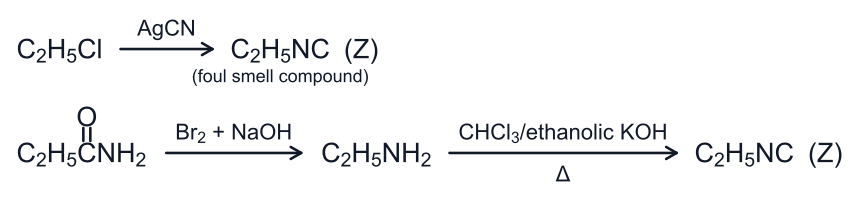
- (1)
The number of hydrogen atoms present in 5.4 g of urea is: (Given: Molar mass of urea = ; )
- (1)
- (2)
- (3)
- (4)
Answer and solution
Answer: (4)
Moles of urea = 5.4/60 = 0.09 mol. Urea, , contains 4 hydrogen atoms per molecule. So number of H atoms = . The distractors arise from using the wrong number of H atoms per molecule or a wrong power of ten.
- (1)
Identify the incorrect statement from the following:
- (1)
Nitrogen can form multiple bonds with itself.
- (2)
and form bond with transition metals.
- (3)
Phosphorus, arsenic and antimony show catenation property.
- (4)
Nitrogen can form bond with oxygen.
Answer and solution
Answer: (4)
Both nitrogen and oxygen are period-2 elements lacking accessible d-orbitals, so nitrogen cannot form a d-p bond with oxygen, making statement D incorrect. Nitrogen does form p-p multiple bonds (as in ), the heavier elements P and As have vacant d-orbitals allowing d-d overlap with transition metals, and P, As, Sb show catenation, so those statements are correct.
- (1)
Which one of the following is an ambidentate ligand?
- (1)
Ethane-1,2-diamine
- (2)
Ethylenediaminetetraacetate ion
- (3)
Thiocyanate
- (4)
Oxalate
Answer and solution
Answer: (3)
An ambidentate ligand has two different donor atoms and can bind through either one. Thiocyanate (SCN-) can coordinate through sulphur (-SCN) or nitrogen (-NCS), so it is ambidentate. Ethane-1,2-diamine and oxalate are bidentate chelating ligands and ethylenediaminetetraacetate ion (EDTA) is hexadentate, but each of their donor sets is fixed, so they are not ambidentate.
- (1)
The correct order of increasing metallic character of Na, Be, P, Mg and Si is:
- (1)
- (2)
- (3)
- (4)
Answer and solution
Answer: (1)
Metallic character decreases across a period (left to right) and increases down a group, and it is inversely related to electronegativity. Using Pauling electronegativities (Na 0.9 < Mg 1.2 < Be 1.5 < Si 1.8 < P 2.1), metallic character increases in the reverse order: P < Si < Be < Mg < Na.
- (1)
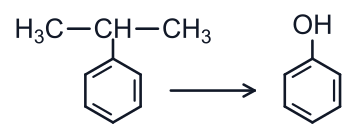
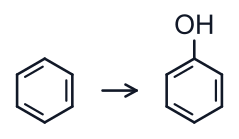
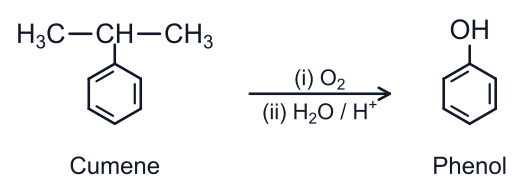
Match List-I (conversions) with List-II (reagents/conditions) and choose the correct answer from the options given below:
List I
List II
a)
i) (i) Oleum; (ii) NaOH, ; (iii) H
b)
ii) (i) O; (ii) HO/H
c) propan-2-ol
iii) (i) CHOH, H; (ii) H, catalyst
d)
iv) (i) conc. HSO, ; (ii) H/HO
- (1)
A-II, B-III, C-I, D-IV
- (2)
A-II, B-III, C-IV, D-I
- (3)
A-II, B-IV, C-III, D-I
- (4)
A-I, B-III, C-IV, D-II
Answer and solution
Answer: (2)
Cumene gives phenol by air oxidation () to cumene hydroperoxide then acid hydrolysis (/), so A-II. Acetic acid is converted to ethanol by esterification (/) followed by reduction (/catalyst), so B-III. Propan-1-ol is dehydrated (conc. , heat) to propene, which on Markovnikov hydration (/) gives propan-2-ol, so C-IV. Benzene is converted to phenol by sulphonation (oleum), NaOH fusion, then acidification, so D-I. Hence A-II, B-III, C-IV, D-I.
- (1)
Although +3 oxidation state is most common in lanthanoids, cerium still shows +4 oxidation state because:
- (1)
After losing one more electron, it acquires electronic configuration.
- (2)
Its nearest inert gas is Radon.
- (3)
Its atomic number is 61.
- (4)
After losing one more electron, it acquires electronic configuration.
Answer and solution
Answer: (4)
Cerium (Z = 58) has the configuration [Xe]4f1 5d1 6s2; on going to Ce4+ it loses its outer electrons to reach the especially stable, empty 4f0 (noble-gas-like) configuration, which is why it readily shows the +4 state. The options citing 4f14, radon, or atomic number 61 are factually wrong for cerium.
- (1)
In the following reaction sequence, X and Z respectively are:
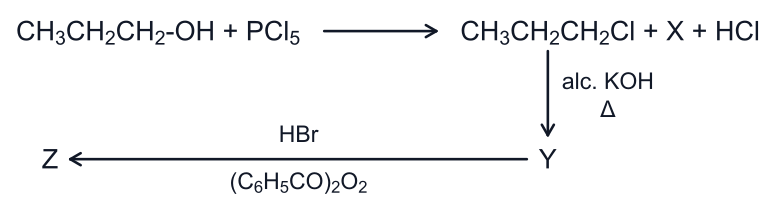
- (1)
- (2)
- (3)
- (4)
Answer and solution
Answer: (2)
Propan-1-ol reacting with gives 1-chloropropane together with phosphoryl chloride () and HCl, so X = . Alcoholic KOH dehydrohalogenates 1-chloropropane to propene (Y). Addition of HBr in the presence of a peroxide follows the anti-Markovnikov (peroxide/Kharasch) effect, placing Br on the terminal carbon to give 1-bromopropane, so Z = . Hence X = , Z = .
Why the other options are wrong:
- (1) Wrong: peroxide effect gives 1-bromopropane, not isopropyl bromide.
- (3) Wrong: gives (not ) and Z is the primary bromide.
- (4) Wrong: gives , not ( comes from ).- (1)
Match List I (Complex/ion) with List II (Shape/geometry) and choose the correct answer.
List I
List II
P)
I) Octahedral
Q)
II) Trigonal bipyramidal
R)
III) Square planar
S)
IV) Tetrahedral
- (1)
P-III, Q-IV, R-I, S-II
- (2)
P-III, Q-I, R-IV, S-II
- (3)
P-IV, Q-I, R-III, S-II
- (4)
P-I, Q-III, R-IV, S-II
Answer and solution
Answer: (2)
[PtCl(NH)] uses dsp hybridisation at Pt → square planar (III); [Co(NH)] is dsp → octahedral (I); [NiCl] has sp Ni with weak-field Cl → tetrahedral (IV); [Fe(CO)] is spd/dsp → trigonal bipyramidal (II). This gives P-III, Q-I, R-IV, S-II.
- (1)
The functional group that can be identified through phthalein dye test is:
- (1)
Aldehyde
- (2)
Phenolic
- (3)
Carboxylic acid
- (4)
Alcohol
Answer and solution
Answer: (2)
In the phthalein dye test a phenol is heated with phthalic anhydride and concentrated HSO to form phenolphthalein, which turns pink on addition of NaOH; this confirms a phenolic -OH group. Aldehydes are detected by Tollens'/Fehling's tests, carboxylic acids by effervescence with NaHCO, and alcohols by the ceric ammonium nitrate or Lucas tests.
- (1)
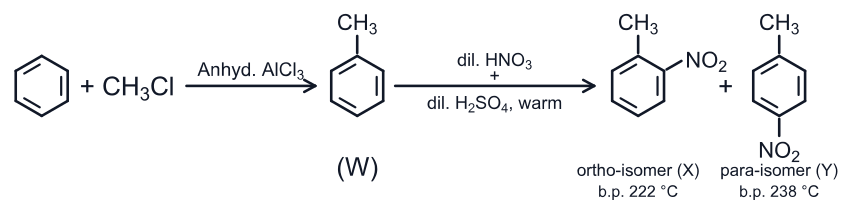
Two products X and Y are formed in the following reaction sequence.

The suitable method that can be used for the separation of products X and Y is:
- (1)
Fractional distillation
- (2)
Sublimation
- (3)
Differential extraction
- (4)
Continuous extraction
Answer and solution
Answer: (1)
Friedel-Crafts methylation of benzene gives toluene (W), and nitration then gives o-nitrotoluene (X) and p-nitrotoluene (Y). These isomeric liquids have close but different boiling points (o 222 °C, p 238 °C) and are separated by fractional distillation (under reduced pressure). Sublimation suits solids that vaporise directly, while extraction methods separate a solute between immiscible solvents, which does not apply here.
- (1)
Identify the correct statements. Choose the correct answer from the options given below.
Statement I: The molality of 2.5 g of ethanoic acid (Molar mass: 60 g mol) in 75 g of benzene solution is 0.556 m.
Statement II: The molarity of a solution containing 5 g of NaOH (molar mass: 40 g mol) in 450 mL of solution is 0.278 M at 298 K.
Statement III: Aquatic species are more comfortable in cold water.
Statement IV: The solubility of gas increases with decrease in pressure.
Statement V: For a binary mixture of A and B, the number of moles of A and B are and respectively. The mole fraction of B will be .- (1)
I, II and III only
- (2)
I and II only
- (3)
I and III only
- (4)
I, IV and V only
Answer and solution
Answer: (1)
(I) molality = m, correct. (II) molarity = M, correct. (III) correct: gas solubility rises as temperature falls, so cold water holds more dissolved O and aquatic life is more comfortable. (IV) wrong: by Henry's law gas solubility increases with increasing pressure. (V) wrong: mole fraction of B is , not . Hence only I, II and III are correct.
- (1)
During Lassaigne's test, the elements present in an organic compound are converted from:
- (1)
Ionic form to ionic form
- (2)
Covalent form to ionic form
- (3)
Covalent form to covalent form
- (4)
Ionic form to covalent form
Answer and solution
Answer: (2)
In Lassaigne's (sodium fusion) test the organic compound is fused with sodium metal, which converts the covalently bonded N, S and halogens into water-soluble ionic sodium salts (NaCN, NaS, NaX). These ions are then detected in aqueous extract, so covalent forms are transformed into ionic forms.
- (1)
A solution of copper sulphate is electrolysed for 10 minutes with a current of 1.5 amperes. The mass of copper deposited at cathode is: (Given: Molar mass of Cu = 63 g mol; 1 F = 96487 C mol)
- (1)
1.7018 g
- (2)
0.2938 g
- (3)
2.4036 g
- (4)
0.5876 g
Answer and solution
Answer: (2)
Charge passed C. Deposition follows , so mass g, i.e. 0.2938 g. The other values arise from using the wrong n-factor or the wrong time.
- (1)
At a certain temperature, T (K), during a process, 500 J is absorbed by the system and work of 200 J is done by the system. Then change in internal energy of the system is:
- (1)
400 J
- (2)
300 J
- (3)
700 J
- (4)
500 J
Answer and solution
Answer: (2)
By the first law of thermodynamics, . Heat absorbed by the system gives q = +500 J, and work done by the system gives w = -200 J. Therefore J.
- (1)
For a certain reaction R → Product, the plot of concentration [R] vs time has a negative slope as shown. The order of reaction is:
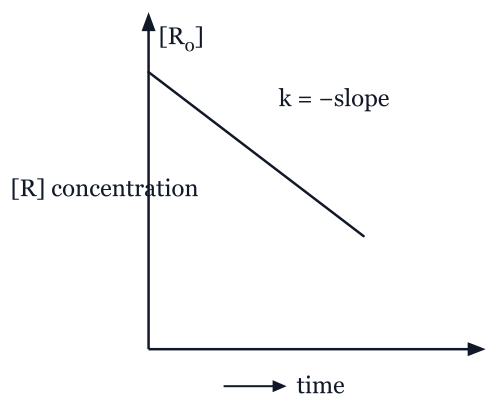
- (1)
0
- (2)
1
- (3)
2
- (4)
2.5
Answer and solution
Answer: (1)
A straight-line plot of concentration [R] against time corresponds to a zero-order reaction, for which ; the constant (linear) rate of decrease means the rate is independent of concentration and equal to the rate constant k (= -slope). First- and higher-order reactions give curved concentration-time plots, not straight lines.
- (1)
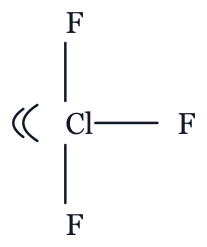
Identify the correct statement about from the following options:
- (1)
It has T-shaped geometry with two lone pairs on Cl atom.
- (2)
It has T-shaped geometry with three lone pairs on Cl atom.
- (3)
It has a trigonal pyramidal geometry with two lone pairs on Cl atom.
- (4)
It has a planar trigonal geometry with two lone pairs on Cl atom.
Answer and solution
Answer: (1)
In ClF the central Cl has five electron domains (3 bond pairs + 2 lone pairs) and spd hybridisation, giving a trigonal bipyramidal electron arrangement. The two lone pairs occupy equatorial positions, leaving a T-shaped molecular geometry. Hence ClF is T-shaped with two lone pairs on the Cl atom.
Why the other options are wrong:
- (2) ClF has two, not three, lone pairs on chlorine.
- (3) Trigonal pyramidal (like NH) has 3 bond pairs + 1 lone pair, not the case here.
- (4) Planar trigonal (like BF) has no lone pairs on the central atom.- (1)
In a test tube containing a salt, a few drops of dilute was added, which gave colourless vapours having the smell of vinegar. The vapours turned the blue litmus paper red. Identify the correct anion from the following:
- (1)
Sulphide,
- (2)
Sulphate,
- (3)
Acetate,
- (4)
Carbonate,
Answer and solution
Answer: (3)
A colourless acidic vapour with the smell of vinegar indicates acetic acid: acetate salts react with dilute HSO to liberate CHCOOH (vinegar odour), which turns blue litmus red. Sulphide would give rotten-egg-smelling HS, carbonate gives odourless CO (which turns lime water milky), and sulphate evolves no gas with dilute HSO.
- (1)
At 298 K, a certain buffer solution contains equal concentrations of and HX, for is . What is the pH of this buffer solution?
- (1)
2
- (2)
4
- (3)
6
- (4)
10
Answer and solution
Answer: (2)
For the conjugate pair, , so pKa = 4. Using Henderson-Hasselbalch, ; since [] = [HX], the log term is zero, giving pH = 4.
- (1)
Calculate emf of the half cell given below:
V
(Given: , )- (1)
-0.109 V
- (2)
0.035 V
- (3)
-0.035 V
- (4)
0.109 V
Answer and solution
Answer: (4)
For , the Nernst equation gives , with [H] = 0.02 M and p(H) = 2 atm. So V.
- (1)
The calculated 'spin-only' magnetic moment of () is:
- (1)
5.92 BM
- (2)
3.87 BM
- (3)
2.84 BM
- (4)
4.90 BM
Answer and solution
Answer: (3)
The spin-only magnetic moment is Bohr magneton (BM), where n is the number of unpaired electrons. Ti is [Ar]3d with 2 unpaired electrons, so BM.
- (1)
Identify the incorrect statement from the following:
- (1)
Carbon has the ability to form p-p multiple bond with itself.
- (2)
(E = B and Al) is a monomer when E = B and a dimer when E = Al.
- (3)
The order of catenation property of Group 14 elements is C >> Si > Ge Sn.
- (4)
Oxygen exhibits only -2 oxidation state.
Answer and solution
Answer: (4)
Oxygen shows several oxidation states besides -2: it is -1 in peroxides (HO), -½ in superoxides, and positive (+2, +1) in fluorides such as OF and OF, so statement (4) is incorrect and is the required answer. The other statements are correct: carbon readily forms p-p bonds (C=C, C≡C); BCl is monomeric (B uses back-bonding) while AlCl dimerises to AlCl; and catenation decreases down Group 14 as C >> Si > Ge Sn.
- (1)
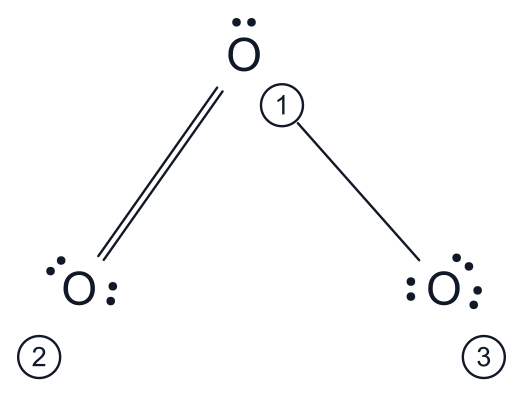
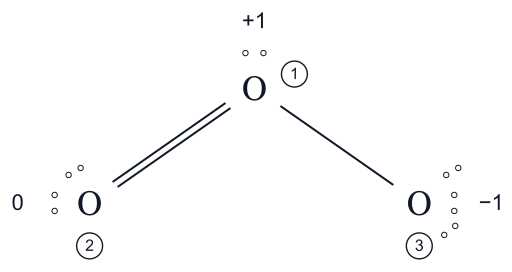
For the given Lewis (resonance) structure of ozone, the correct formal charges on the oxygen atoms numbered 2, 1 and 3 respectively are:
- (1)
- (2)
- (3)
- (4)
Answer and solution
Answer: (2)
Formal charge = (valence electrons) (non-bonding electrons) (bonding electrons). For the doubly bonded terminal O (atom 2): ; the central O (atom 1): ; the singly bonded terminal O (atom 3): . This gives 0, +1, , matching option (2).
- (1)
Phenolphthalein is used as an indicator for the titration of sodium hydroxide solution against a standard solution of oxalic acid. The colour change that is observed at an alkaline pH close to the equivalence point during this titration is:
- (1)
pinkish red to yellow
- (2)
yellow to pinkish red
- (3)
pink to colourless
- (4)
colourless to pink
Answer and solution
Answer: (4)
Phenolphthalein is colourless in acidic medium and turns pink in basic medium. As the solution shifts from acidic toward alkaline near the equivalence point, the observed change is colourless to pink (4). Options mentioning yellow refer to methyl orange, not phenolphthalein.
- (1)
When 1 dm of gas is passed over hot coke, the volume of gaseous mixture after complete reaction at STP becomes 1.4 dm. The composition of the gaseous mixture at STP is:
- (1)
0.8 dm of CO, 0.8 dm of
- (2)
0.8 dm of CO, 0.6 dm of
- (3)
0.6 dm of CO, 0.8 dm of
- (4)
0.6 dm of CO, 0.4 dm of
Answer and solution
Answer: (2)
The reaction converts x dm of into 2x dm of CO. Total final volume , so x = 0.4 dm. Therefore remaining dm and CO formed dm, which is option (2).
- (1)
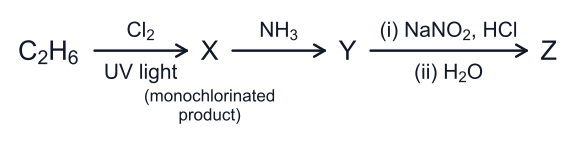
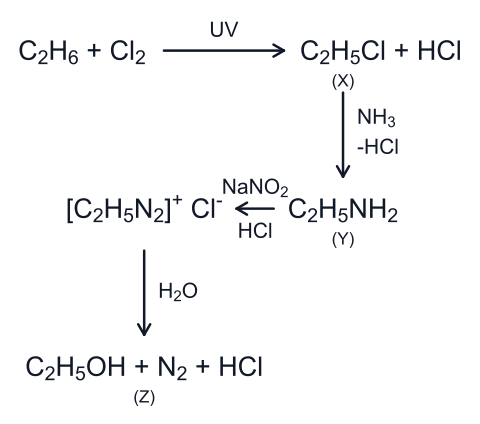
The major product Z formed in the following sequence of reactions is:
- (1)
- (2)
- (3)
- (4)
Answer and solution
Answer: (3)
Monochlorination of ethane gives chloroethane (X). Reaction with gives ethylamine (Y). Treating this primary aliphatic amine with forms a highly unstable diazonium salt that reacts with water to release and yield ethanol (Z). Hence (3) is correct.
- (1)
Given below is an expression for the rate constant of a first-order reaction occurring at a certain temperature, T (K): . The energy of activation in kcal mol for the reaction is: (Given: k in s, R = 1.987 cal mol K)
- (1)
24.84
- (2)
14.34
- (3)
18.63
- (4)
12.42
Answer and solution
Answer: (1)
Comparing with the Arrhenius form , the slope term gives . Thus cal mol kcal mol (1).
- (1)
Given below are certain reactions. Identify the reaction for which .
- (1)
- (2)
- (3)
- (4)
Answer and solution
Answer: (2)
Since , the two are equal only when . For , , so (2). The other three reactions have equal moles of gas on both sides (), giving .
- (1)
Identify the incorrect statement from the following:
- (1)
The largest and the smallest species among Mg, , Al and are Al and respectively.
- (2)
The IUPAC name of the element with atomic number 107 is Unnilseptium.
- (3)
The similarity in behaviour of Li with Mg is referred to as 'diagonal relationship'.
- (4)
The oxidation state and covalency of Al in are 3 and 6, respectively.
Answer and solution
Answer: (1)
Cationic size decreases with increasing positive charge and across a period, so among Mg, , Al and the largest species is neutral Mg and the smallest is , not Al and ; hence statement (1) is incorrect and is the answer. The others are correct: element 107 is Unnilseptium, Li and Mg show a diagonal relationship, and Al in the given complex has oxidation state +3 with covalency 6.
- (1)
Mixture of chloroform and acetone forms a solution with negative deviation from Raoult's law due to:
- (1)
Increase in escaping tendency of molecules of each component.
- (2)
Formation of hydrogen bonding between acetone and chloroform.
- (3)
Stronger intermolecular forces between chloroform molecules than those between chloroform and acetone molecules.
- (4)
Repulsive forces.
Answer and solution
Answer: (2)
An acetone-chloroform mixture shows negative deviation because a new hydrogen bond forms between the chloroform C-H and the carbonyl oxygen of acetone, making the A-B interactions stronger than the A-A and B-B interactions. This lowers the escaping tendency and hence the vapour pressure, so (2) is correct. Increased escaping tendency or repulsive forces would instead cause positive deviation.
Escaping tendency decreases, vapour pressure decreases and boiling point increases.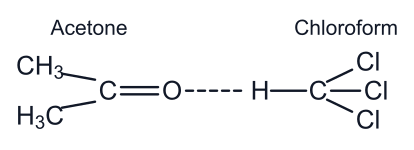
- (1)
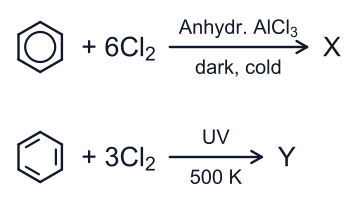
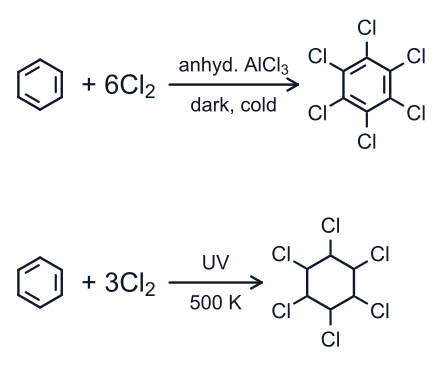
The number of chlorine atoms present in the organic products X and Y of the following reactions, respectively, are:
- (1)
3 and 3
- (2)
6 and 3
- (3)
6 and 6
- (4)
3 and 6
Answer and solution
Answer: (3)
With anhydrous in the dark and cold, benzene undergoes electrophilic substitution to hexachlorobenzene (X), which contains 6 chlorine atoms. Under ultraviolet (UV) light at 500 K, benzene adds three molecules to give benzene hexachloride (Y), also containing 6 chlorine atoms. So both products carry 6 chlorine atoms, matching option (3).
- (1)
Biology Questions 91 to 180
In angiosperms, root hairs arise from which one of the following regions of the root?
- (1)
The root cap zone
- (2)
The region of meristematic activity
- (3)
The region of elongation
- (4)
The region of maturation
Answer and solution
Answer: (4)
Root hairs are fine, thread-like unicellular outgrowths of epidermal cells that develop in the region of maturation (differentiation), where cells have fully elongated and differentiated. Hence option (4) is correct. The root cap, meristematic zone and elongation zone lie nearer the root tip than this region and do not bear root hairs.
- (1)
In which one of the following, the ovules are not enclosed by an ovary wall and remain exposed?
- (1)
Funaria
- (2)
Pinus
- (3)
Selaginella
- (4)
Wolffia
Answer and solution
Answer: (2)
Naked ovules that are not enclosed within an ovary and remain exposed both before and after fertilisation are the defining feature of gymnosperms. Among the choices, Pinus is a gymnosperm (2). Funaria is a moss (bryophyte), Selaginella is a pteridophyte, and Wolffia is a flowering angiosperm whose ovules are enclosed in an ovary.
- (1)
In the lac operon, the z gene codes for:
- (1)
permease
- (2)
transacetylase
- (3)
beta-galactosidase
- (4)
the repressor of lac operon
Answer and solution
Answer: (3)
In the lac operon the structural gene z codes for beta-galactosidase, the enzyme that hydrolyses lactose into glucose and galactose. Hence (3) is correct. The y gene codes for permease, the a gene for transacetylase, and the separate regulatory i gene codes for the repressor protein.
- (1)
Exploring molecular, genetic and species-level diversity for products of economic importance is called:
- (1)
Biofortification
- (2)
Bioremediation
- (3)
Bioprospecting
- (4)
Biomagnification
Answer and solution
Answer: (3)
Bioprospecting is the exploration of molecular, genetic and species-level biodiversity to find products and processes of economic value (such as new drugs and useful genes). Hence (3) is correct. Biofortification improves the nutrient content of crops, bioremediation uses organisms to remove pollutants, and biomagnification is the increasing concentration of a toxicant along a food chain.
- (1)
Match List-I with List-II and choose the correct answer from the options given below:
List I
List II
P) Genetically modified organism
I) Agrobacterium tumefaciens
Q) Thermostable DNA polymerase
II) Bt cotton
R) Ti plasmid
III) Thermus aquaticus
S) pBR322
IV) Escherichia coli
- (1)
P-II, Q-III, R-I, S-IV
- (2)
P-II, Q-I, R-IV, S-III
- (3)
P-I, Q-IV, R-III, S-II
- (4)
P-I, Q-II, R-IV, S-III
Answer and solution
Answer: (1)
Bacillus thuringiensis (Bt) cotton is a classic genetically modified organism (P-II); the thermostable DNA polymerase (Taq polymerase used in polymerase chain reaction (PCR)) is isolated from the bacterium Thermus aquaticus (Q-III); the Ti plasmid is derived from Agrobacterium tumefaciens (R-I); and plasmid constructed by Bolivar and Rodriguez, number 322 (pBR322) is a cloning vector of Escherichia coli (S-IV). This gives P-II, Q-III, R-I, S-IV.
- (1)
Match List-I with List-II and choose the correct answer from the options given below:
List I
List II
P) Productivity
I) Gross primary productivity minus respiration losses
Q) Net primary productivity
II) Rate of formation of new organic matter by consumers
R) Gross primary productivity
III) Rate of biomass production
S) Secondary productivity
IV) Rate of production of organic matter during photosynthesis
- (1)
P-III, Q-I, R-IV, S-II
- (2)
P-I, Q-II, R-III, S-IV
- (3)
P-I, Q-III, R-IV, S-II
- (4)
P-III, Q-I, R-II, S-IV
Answer and solution
Answer: (1)
Productivity is the rate of biomass production ; net primary productivity equals gross primary productivity minus respiration losses ; gross primary productivity is the rate of organic matter production during photosynthesis ; and secondary productivity is the rate of formation of new organic matter by consumers . This matches P-III, Q-I, R-IV, S-II.
- (1)
Since the origin and diversification of life on Earth, there have been five episodes of mass extinction of species. How is the sixth extinction, which is in progress, different from the previous episodes?
- (1)
The present net species extinction rate is zero.
- (2)
The current species extinction rate is nearly 10 times faster than in previous episodes.
- (3)
The present species extinction rates are 100 to 1000 times faster than in the pre-human times.
- (4)
The current species extinction rates are far lower than those in previous episodes.
Answer and solution
Answer: (3)
The current, sixth episode of mass extinction is estimated to be 100 to 1000 times faster than the natural (pre-human) background rate, largely because of human activities. Options stating the rate is zero or far lower are false, and the '10 times' figure greatly understates the accepted estimate.
- (1)
Alpha-helix is found in which level of protein structure?
- (1)
Secondary structure
- (2)
Tertiary structure
- (3)
Primary structure
- (4)
Quaternary structure
Answer and solution
Answer: (1)
The alpha-helix is a right-handed coiling of the polypeptide backbone stabilised by hydrogen bonds and is the hallmark of the secondary structure of proteins. Primary structure is the linear amino-acid sequence, tertiary structure is the folded three-dimensional shape, and quaternary structure results from the assembly of more than one polypeptide chain.
- (1)
The main function of bulliform cells in grasses is :
- (1)
to make the leaf impermeable to fungal spores.
- (2)
to transport water.
- (3)
to perform photosynthesis.
- (4)
to minimize water loss during water stress.
Answer and solution
Answer: (4)
Bulliform cells are large, empty, colourless epidermal cells in grass leaves. Under water stress they lose turgor and become flaccid, making the leaf roll or fold inward, which reduces the exposed surface area and thus minimizes transpirational water loss.
- (1)
Identify the correct sequence of steps in each cycle of Polymerase Chain Reaction :
- (1)
Extension Annealing Denaturation
- (2)
Annealing Denaturation Extension
- (3)
Denaturation Extension Annealing
- (4)
Denaturation Annealing Extension
Answer and solution
Answer: (4)
Each PCR cycle proceeds as denaturation (heat separates the two DNA strands), then annealing (primers bind to the single-stranded templates), then extension (DNA polymerase synthesises the new strands). Hence the correct order is Denaturation, then Annealing, then Extension.
- (1)
Match List-I with List-II
List I (Phase of cell cycle)
List II (Activity)
P) phase
I) Actual cell division occurs
Q) S phase
II) Cell is metabolically active and continuously grows but does not replicate its DNA
R) phase
III) Synthesis of DNA occurs and the amount of DNA per cell doubles
S) M phase
IV) Proteins are synthesized while cell growth continues
choose the correct answer from the options given below:
- (1)
P-IV, Q-I, R-II, S-III
- (2)
P-I, Q-II, R-III, S-IV
- (3)
P-III, Q-IV, R-I, S-II
- (4)
P-II, Q-III, R-IV, S-I
Answer and solution
Answer: (4)
In phase the cell is metabolically active and grows but does not replicate DNA; in S phase DNA is synthesised and the DNA per cell doubles; in phase proteins are synthesised in preparation for mitosis while growth continues; and in M phase the actual cell division takes place. This gives P-II, Q-III, R-IV, S-I.
- (1)
Which of the following statements are correct? Choose the correct answer from the options given below:
Statement I: The Amazon rainforest being cut and cleared for cultivation of soyabeans is an example of habitat loss.
Statement II: Steller's sea cow and passenger pigeon became extinct due to over-exploitation by humans.
Statement III: The Nile perch introduced into Lake Victoria in East Africa helped in population growth of cichlid fish in the lake.
Statement IV: Water hyacinth is an invasive species.
Statement V: When a species becomes extinct, the plant and animal species associated with it are not affected.- (1)
I, II and V only
- (2)
I, II and IV only
- (3)
III, IV and V only
- (4)
II, III and IV only
Answer and solution
Answer: (2)
Statements I (Amazon clearing = habitat loss), II (Steller's sea cow and passenger pigeon lost to over-exploitation) and IV (water hyacinth is invasive) are correct. III is wrong because the introduced Nile perch drove more than 200 cichlid species to extinction, and V is wrong because co-extinction affects the species associated with an extinct one. Correct set: I, II and IV.
- (1)
Which of the following statements are correct with reference to a transcription unit?
Statement I: A transcription unit in DNA is defined primarily by three regions : promoter, structural gene and terminator.
Statement II: The promoter is said to be located towards the 5'-end of the structural gene.
Statement III: The promoter is a DNA sequence that provides binding site for RNA polymerase.
Statement IV: The promoter defines the template and coding strands.
Statement V: The terminator is located towards the 3'-end of the coding strand and it defines the end of the process of transcription.
Choose the correct answer from the options given below:- (1)
I, II, III and IV only
- (2)
I, III, IV and V only
- (3)
II, III, IV and V only
- (4)
I, II, III, IV and V
Answer and solution
Answer: (4)
A transcription unit is defined by a promoter, a structural gene and a terminator (Statement I); the promoter lies towards the 5'-end of the structural gene (Statement II), provides the binding site for RNA polymerase (Statement III), and by its position determines which strand is template and which is coding (Statement IV). The terminator lies towards the 3'-end of the coding strand and usually ends transcription (Statement V). All five statements are correct.
- (1)
Which one of the following statements is not true about the universal rules of binomial nomenclature?
- (1)
Biological names are generally in Latin
- (2)
Both the words in a biological name, when handwritten, are separately underlined or printed in italics
- (3)
The specific epithet in the biological name starts with a small letter
- (4)
The first word in the biological name represents the specific epithet, while the second component denotes the genus
Answer and solution
Answer: (4)
In a binomial name, the genus comes first with an initial capital, and the specific epithet comes second with an initial lowercase letter. The words are Latinised and appear in italics in print or are separately underlined by hand. A claim that the second word denotes the genus reverses their roles and is false.
- (1)
Match List-I with List-II and choose the correct answer from the options given below:
List I
List II
P) Decomposition
I) Accumulation of dark coloured amorphous colloidal substance
Q) Detritus
II) Release of inorganic nutrients by the activity of microbes in soil
R) Mineralisation
III) Breaking down of complex organic matter into inorganic substances.
S) Humification
IV) Dead remains of plants and animals including fecal matter
- (1)
P-IV, Q-III, R-I, S-II
- (2)
P-III, Q-IV, R-II, S-I
- (3)
P-I, Q-II, R-III, S-IV
- (4)
P-III, Q-II, R-I, S-IV
Answer and solution
Answer: (2)
Decomposition is the breaking down of complex organic matter into inorganic substances; detritus is the dead remains of plants and animals including faecal matter; mineralisation is the release of inorganic nutrients by microbial activity in soil; and humification is the accumulation of the dark-coloured amorphous colloidal humus. This gives P-III, Q-IV, R-II, S-I.
- (1)
Which one of the following is the site for active ribosomal RNA synthesis?
- (1)
Centrosome
- (2)
Chromatin
- (3)
Nucleolus
- (4)
Kinetochore
Answer and solution
Answer: (3)
The nucleolus is a non-membrane-bound region within the nucleus and is the site of active ribosomal RNA (rRNA) synthesis and assembly of ribosomal subunits. The centrosome organises spindle fibres, chromatin is the DNA-protein complex carrying genes, and the kinetochore is the protein plate on the centromere for spindle-fibre attachment.
- (1)
The Respiratory Quotient (RQ) of a biomolecule used for respiration, as per the above equation would be :- (1)
Between 0.5 and 0.95
- (2)
Less than 0.5
- (3)
1.0
- (4)
Between 1.25 and 2
Answer and solution
Answer: (1)
The respiratory quotient is the ratio of the volume of evolved to the volume of consumed. From the equation, , which lies between 0.5 and 0.95, the range typical when fats are respired. It is not 1.0 (which is for carbohydrates) nor greater than 1.
- (1)
Match List-I with List-II
List I
List II
P) Incomplete dominance
I) Human skin colour
Q) Co-dominance
II) Inheritance of flower colour in Antirrhinum sp.
R) Pleiotropy
III) Phenylketonuria disease in humans
S) Polygenic inheritance
IV) ABO blood groups
Choose the correct answer from the options given below:
- (1)
P-II, Q-IV, R-III, S-I
- (2)
P-I, Q-III, R-II, S-IV
- (3)
P-I, Q-IV, R-III, S-II
- (4)
P-II, Q-I, R-III, S-IV
Answer and solution
Answer: (1)
Incomplete dominance is shown by flower colour in Antirrhinum, where the heterozygote is intermediate; co-dominance is illustrated by ABO blood groups, where alleles and are both expressed; pleiotropy is exemplified by phenylketonuria, where one gene affects several traits; and polygenic inheritance controls human skin colour. This gives P-II, Q-IV, R-III, S-I.
- (1)
Arrange the following steps of DNA fingerprinting in the correct sequence
Statement I: Isolation of DNA and its digestion by restriction endonucleases.
Statement II: Hybridisation using a labelled VNTR probe.
Statement III: Transferring of separated DNA fragments to synthetic membranes.
Statement IV: Detection of hybridised DNA fragments by autoradiography.
Statement V: Separation of DNA fragments by electrophoresis.
Choose the correct answer from the options given below:- (1)
I, II, IV, III, V
- (2)
I, IV, II, V, III
- (3)
I, V, III, II, IV
- (4)
I, V, II, III, IV
Answer and solution
Answer: (3)
(Statement I)DNA fingerprinting proceeds by isolating DNA and digesting it with restriction enzymes,
(Statement V)separating the fragments by gel electrophoresis according to size,
(Statement III) blotting them onto a synthetic nylon/nitrocellulose membrane,
(Statement II)hybridising with a labelled variable number of tandem repeats (VNTR) probe,
and
(Statement IV) finally detecting the bound probe by autoradiography.
This gives the order I, V, III, II, IV.- (1)
Which of the following statements are correct with reference to packaging of DNA helix?
Statement I: Histones are organized to form a unit of eight molecules called histone octamer.
Statement II: Histones are negatively charged basic proteins.
Statement III: Histones are rich in the basic amino acid residues - lysine and arginine.
Statement IV: The positively charged DNA is wrapped around the histone octamer to form nucleosome.
Statement V: The packaging of chromatin at higher levels requires an additional set of proteins called non-histone chromosomal proteins.
Choose the correct answer from the options given below:- (1)
I, III and V only
- (2)
II, IV and V only
- (3)
III, IV and V only
- (4)
I, II and IV only
Answer and solution
Answer: (1)
Eight histone molecules assemble into a histone octamer (I correct), and histones are positively charged basic proteins rich in lysine and arginine (III correct), so Statement II is wrong. It is the negatively charged DNA (not positively charged) that wraps around the octamer to form a nucleosome, so Statement IV is wrong. Higher-order packaging needs additional non-histone chromosomal (NHC) proteins (V correct). Hence I, III and V only.
- (1)
Find the incorrect statement(s) about photosynthesis from the following and choose the answer from the options given below:
Statement I: The water splitting complex is associated with PS I.
Statement II: plants use the pathway of fixation as the main biosynthetic pathway.
Statement III: In plants, photorespiration does not occur.
Statement IV: plants exhibit 'Kranz' anatomy.
Statement V: ATP synthesis in chloroplast occurs through chemiosmosis.- (1)
II and III only
- (2)
II only
- (3)
II and V only
- (4)
I and IV only
Answer and solution
Answer: (4)
The water-splitting (oxygen-evolving) complex lies on the inner side of the membrane and is associated with Photosystem II, not PS I, so statement I is incorrect. Kranz anatomy is a feature of plants, not plants, so statement IV is incorrect. Statements II, III and V are correct. Hence the incorrect statements are I and IV only.
- (1)
Arrange the following steps of somatic hybridisation in the correct sequence
Statement I: Digestion of cell walls.
Statement II: Isolation of naked protoplasts.
Statement III: Fusion of protoplasts to get hybrid protoplast.
Statement IV: Isolation of single cells from two different varieties of plants.
Statement V: Growing of hybrid protoplast to form a new plant.
choose the correct answer from the options given below:- (1)
IV, I, II, III, V
- (2)
V, II, I, IV, III
- (3)
IV, II, I, V, III
- (4)
V, I, II, III, IV
Answer and solution
Answer: (1)
Somatic hybridisation starts by isolating single cells from two different plant varieties (Statement IV), digesting their cell walls with enzymes (Statement I) to release naked protoplasts (Statement II), fusing the protoplasts to form a hybrid protoplast (Statement III), and finally growing it to regenerate a new plant (Statement V). Hence the correct sequence is IV, I, II, III, V.
- (1)
Match List-I with List-II and choose the correct answer from the options given below:
List I
List II
P) Conjunctive tissue
I) Specialised cells in the vicinity of guard cells
Q) Casparian strips
II) Endodermal cells rich in starch
R) Subsidiary cells
III) Tissue between xylem and phloem
S) Starch sheath
IV) Endodermal cells with suberin deposition
- (1)
P-IV, Q-III, R-I, S-II
- (2)
P-III, Q-IV, R-II, S-I
- (3)
P-III, Q-IV, R-I, S-II
- (4)
P-IV, Q-III, R-II, S-I
Answer and solution
Answer: (3)
Conjunctive tissue is the parenchyma lying between xylem and phloem (III). Casparian strips are suberin deposits on the walls of endodermal cells (IV). Subsidiary cells are specialised epidermal cells surrounding the guard cells (I). The starch sheath is the innermost cortical (endodermal) layer whose cells are rich in starch (II). Hence P-III, Q-IV, R-I, S-II.
- (1)
Which one of the following is not a characteristic of plant cells in the phase of elongation?
- (1)
New cell wall deposition
- (2)
Cell enlargement
- (3)
Increased vacuolation
- (4)
Large conspicuous nuclei
Answer and solution
Answer: (4)
The elongation phase is characterised by increased vacuolation, cell enlargement and deposition of new cell wall material. A large, conspicuous nucleus with dense cytoplasm is a feature of the meristematic (dividing) phase, not the elongation phase, so it is the exception.
- (1)
Match List-I with List-II
List I (Growth Regulator)
List II (Function/Effect)
P) 2,4-D
I) Brewing industry
Q) GA
II) Stimulation of stomatal closure
R) Kinetin
III) Herbicide
S) ABA
IV) Nutrient mobilisation
choose the correct answer from the options given below:
- (1)
P-III, Q-I, R-IV, S-II
- (2)
P-IV, Q-III, R-II, S-I
- (3)
P-I, Q-IV, R-III, S-II
- (4)
P-I, Q-II, R-IV, S-III
Answer and solution
Answer: (1)
2,4-dichlorophenoxyacetic acid (2,4-D) is a synthetic auxin used as a selective herbicide against dicot weeds (P - III).
GA is used in the malting/brewing industry to speed up the process (Q-I).
Kinetin, a cytokinin, promotes nutrient mobilisation and delays senescence (R-IV).
Abscisic acid (ABA),
the stress hormone, promotes stomatal closure during water stress (S-II).
Hence P-III, Q-I, R-IV, S-II.- (1)
The enzyme required for carboxylation in the Calvin cycle is
- (1)
Hexokinase
- (2)
PEP carboxylase
- (3)
RuBP carboxylase - oxygenase
- (4)
Carboxypeptidase
Answer and solution
Answer: (3)
In the Calvin cycle, is fixed onto ribulose bisphosphate (RuBP) by RuBP carboxylase-oxygenase (RuBisCO), the most abundant enzyme in the biosphere. PEP carboxylase catalyses the primary fixation in mesophyll cells of /CAM plants but not the Calvin-cycle carboxylation, while hexokinase and carboxypeptidase have unrelated functions.
- (1)
How many ATP and NADPH molecules are required to make one molecule of glucose through the Calvin pathway?
- (1)
18 ATP and 12 NADPH
- (2)
12 ATP and 18 NADPH
- (3)
24 ATP and 18 NADPH
- (4)
6 ATP and 12 NADPH
Answer and solution
Answer: (1)
Fixing one in the Calvin cycle consumes 3 adenosine triphosphate (ATP) and 2 reduced nicotinamide adenine dinucleotide phosphate (NADPH). Synthesising one glucose requires the fixation of 6 (six turns of the cycle), so the total need is ATP and NADPH.
- (1)
Which of the following floral formula is the correct floral formula of the Solanaceae family?
- (1)

- (2)
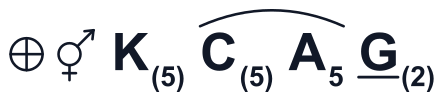
- (3)

- (4)
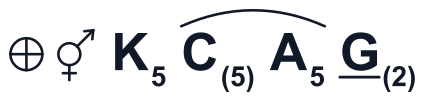
Answer and solution
Answer: (2)
Solanaceae flowers are actinomorphic (⊕) and bisexual (⚥) with a gamosepalous calyx K(5), a gamopetalous corolla C(5), five epipetalous stamens A5 (the arc linking corolla to androecium shows stamens attached to the corolla) and a bicarpellary, syncarpous, superior ovary G(2). Only option (2) shows both the fused calyx/corolla and the epipetalous condition, so it is the correct floral formula.
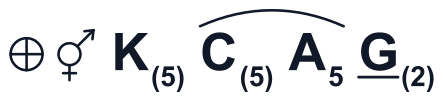
- (1)
Which of the following is an in-situ conservation method?
- (1)
Sacred Groves
- (2)
Wildlife Safari Parks
- (3)
Botanical Gardens
- (4)
Seed Banks
Answer and solution
Answer: (1)
in-situ conservation protects species within their natural habitat; sacred groves are forest patches traditionally protected by local communities and are a classic in-situ method. Wildlife safari parks, botanical gardens and seed banks conserve organisms away from their natural habitat and are therefore ex-situ methods.
- (1)
Which of the following statements are not true regarding restriction endonucleases?
Statement I: They are called molecular scissors.
Statement II: These are the enzymes responsible for restricting the growth of bacteriophages in E.coli .
Statement III: They cut the DNA only at the centre of the palindromic sites.
Statement IV: They remove nucleotides only from the ends of DNA fragments.
Statement V: They recognise specific palindromic base-pair sequences.
Choose the answer from the options given below:- (1)
I and II only
- (2)
I and V only
- (3)
IV and V only
- (4)
III and IV only
Answer and solution
Answer: (4)
Restriction endonucleases cut DNA a little away from the centre of the palindrome (between the same two bases on the two strands), not exactly at the centre, so statement III is untrue. They cut within the DNA; removing nucleotides from the ends is the job of exonucleases, so statement IV is also untrue. Statements I, II and V correctly describe them. Hence III and IV only are not true.
- (1)
In racemose inflorescence, _________.
- (1)
The main axis terminates in a flower
- (2)
Flowers are solitary
- (3)
The growth is limited
- (4)
Flowers are borne in an acropetal succession
Answer and solution
Answer: (4)
In a racemose inflorescence the main axis keeps growing (unlimited growth) and does not end in a flower; the flowers are borne laterally in acropetal succession, with older flowers at the base and younger ones toward the tip. Termination of the main axis in a flower and limited growth are features of the cymose inflorescence.
- (1)
Arrange the following in the correct developmental sequence related to microsporogenesis.
Statement I: Microspore tetrads
Statement II: Sporogenous tissue
Statement III: Pollen grains
Statement IV: Pollen mother cells
Choose the correct answer from the options given below:- (1)
IV, I, III, II
- (2)
II, IV, I, III
- (3)
II, IV, III, I
- (4)
I, IV, III, II
Answer and solution
Answer: (2)
Microsporogenesis begins with sporogenous tissue (Statement II), whose cells become pollen mother cells (Statement IV). Each pollen mother cell undergoes meiosis to form microspore tetrads (Statement I), which then separate into individual microspores that mature into pollen grains (Statement III). Hence the order is II, IV, I, III.
- (1)
Identify the correct statements about biomolecules.
Statement I: Lipids are generally water soluble.
Statement II: Proteins are polypeptides.
Statement III: Polysaccharides are long chains of sugars.
Statement IV: Adenine and guanine are substituted pyrimidines.
Statement V: Almost all enzymes are proteins.
Choose the correct answer from the options given below:- (1)
II, IV and V only
- (2)
II, III and V only
- (3)
I, II and III only
- (4)
III, IV and V only
Answer and solution
Answer: (2)
Proteins are polypeptides (Statement II), polysaccharides are long chains of monosaccharides (Statement III), and almost all enzymes are proteins (Statement V), so these are correct. Statement I is wrong because lipids are generally hydrophobic and water-insoluble; Statement IV is wrong because adenine and guanine are substituted purines, not pyrimidines.
- (1)
Which of the following statements are true with reference to the sex-determination in honeybees?
Statement I: An offspring formed from the union of a sperm and an egg, develops as a female (queen or worker).
Statement II: An unfertilized egg develops as a male by parthenogenesis.
Statement III: A male has half the number of chromosomes than that of a female.
Statement IV: Males produce sperms by meiosis.
Statement V: Honeybees have a haplodiploid sex-determination system.
Choose the correct answer from the options given below:- (1)
I, II, III and V only
- (2)
II, III, IV and V only
- (3)
I, II, III and IV only
- (4)
I, II, IV and V only
Answer and solution
Answer: (1)
Honeybees use a haplodiploid system (Statement V). A fertilised egg (diploid) becomes a female, queen or worker (Statement I); an unfertilised egg develops parthenogenetically into a haploid male (Statement II); the haploid male therefore has half the chromosome number of the diploid female (Statement III). Statement IV is false because haploid males cannot undergo normal reductional meiosis and instead form sperm by a modified mitosis, so the correct set is I, II, III and V.
- (1)
Heterophyllous development in response to environment is an example of which of the following phenomena?
- (1)
Redifferentiation
- (2)
Elasticity
- (3)
Dedifferentiation
- (4)
Plasticity
Answer and solution
Answer: (4)
Plasticity is the ability of plants to follow different developmental pathways and form different structures in response to environment or life phase; heterophylly in cotton, coriander and larkspur is a classic example. Dedifferentiation and redifferentiation describe changes in the meristematic state of cells, and elasticity is not the relevant developmental term.
- (1)
Which of the following statements are correct regarding amino acids?
Statement I: They are substituted methanes.
Statement II: Serine is an aromatic amino acid.
Statement III: Valine is a neutral amino acid.
Statement IV: Lysine is an acidic amino acid.
Choose the correct answer from the options given below:- (1)
III and IV only
- (2)
II and III only
- (3)
I and III only
- (4)
I and II only
Answer and solution
Answer: (3)
Amino acids are substituted methanes because the alpha carbon carries , , and an R group (I correct), and valine is a neutral (non-polar) amino acid (III correct). Statement II is wrong since serine has a hydroxyl side chain, making it an alcoholic (not aromatic) amino acid; Statement IV is wrong because lysine has an extra amino group, making it a basic (not acidic) amino acid. Hence I and III.
- (1)
"The Evil Quartet" of biodiversity loss includes which of the following?
- (1)
Over-exploitation; Alien species invasions; Air pollution; Co-extinctions
- (2)
Habitat loss and fragmentation; Air pollution; Water pollution; Co-extinctions
- (3)
Habitat loss and fragmentation; over-exploitation; Alien species invasions; Co-extinctions
- (4)
Over-exploitation; Alien species invasions; Soil pollution; Co-extinctions
Answer and solution
Answer: (3)
The Evil Quartet names the four major drivers of biodiversity loss: habitat loss and fragmentation, over-exploitation, alien (invasive) species invasions, and co-extinctions. Only option (3) lists exactly these; the others wrongly substitute air, water or soil pollution, which are not part of the quartet.
- (1)
Match List-I with List-II
List I (Process)
List II (Location)
P) Glycolysis
I) Inner mitochondrial membrane
Q) ETS
II) Mitochondrial matrix
R) Accumulation of protons
III) Cytoplasm
S) Krebs' cycle
IV) Intermembrane space
choose the correct answer from the options given below:
- (1)
P-IV, Q-II, R-I, S-III
- (2)
P-II, Q-III, R-IV, S-I
- (3)
P-III, Q-I, R-IV, S-II
- (4)
P-I, Q-IV, R-III, S-II
Answer and solution
Answer: (3)
Glycolysis takes place in the cytoplasm (P-III), the electron transport system operates on the inner mitochondrial membrane (Q-I), protons accumulate in the intermembrane space during chemiosmosis (R-IV), and the Krebs' cycle runs in the mitochondrial matrix (S-II). This gives P-III, Q-I, R-IV, S-II.
- (1)
Which one of the following is a triploid cell?
- (1)
Synergid
- (2)
Central cell
- (3)
Zygote
- (4)
Primary endosperm cell
Answer and solution
Answer: (4)
The primary endosperm cell forms during double fertilisation when a haploid male gamete fuses with the diploid secondary (fusion) nucleus, making it triploid (3n). Synergids are haploid, the zygote is diploid, and the central cell before fusion carries two haploid polar nuclei.
- (1)
Which one of the following types of pollination brings genetically different types of pollen grains to the stigma?
- (1)
Autogamy
- (2)
Xenogamy
- (3)
Geitonogamy
- (4)
Cleistogamy
Answer and solution
Answer: (2)
Xenogamy is cross-pollination in which pollen is transferred to the stigma of a flower on a genetically different plant, so it alone brings genetically different pollen. Autogamy (same flower) and geitonogamy (different flower of the same plant) deliver genetically identical pollen, and cleistogamous flowers are obligately autogamous.
- (1)
Match List I with List II :
List I (Placentation)
List II (Example)
P) Marginal
I) Mustard
Q) Axile
II) Pea
R) Parietal
III) Marigold
S) Basal
IV) Lemon
Choose the correct answer from the options given below:
- (1)
P-II, Q-IV, R-I, S-III
- (2)
P-I, Q-III, R-II, S-IV
- (3)
P-III, Q-I, R-IV, S-II
- (4)
P-IV, Q-II, R-I, S-III
Answer and solution
Answer: (1)
Marginal placentation is seen in pea (P-II), axile in lemon/citrus (Q-IV), parietal in mustard (R-I), and basal in marigold (S-III). This yields P-II, Q-IV, R-I, S-III.
- (1)
The main criteria used for Five Kingdom Classification proposed By R.H. Whittaker (1969) included.
Statement I: Cell structure
Statement II: Body organization
Statement III: Presence of flagellum
Statement IV: Reproduction
Statement V: Phylogenetic relationships
Choose the correct answer from the options given below:- (1)
I, II, III, IV and V
- (2)
II, III and IV only
- (3)
I, II, IV and V only
- (4)
I, II and V only
Answer and solution
Answer: (3)
Whittaker's five kingdom classification was based on cell structure (Statement I), body organisation (Statement II), mode of nutrition, reproduction (Statement IV) and phylogenetic relationships (Statement V). Presence of a flagellum (Statement III) was not one of the main criteria, so the correct set is I, II, IV and V.
- (1)
Match List I with List II :
List I
List II
P) Trypsin
I) Intercellular ground substance
Q) Morphine
II) Lectin
R) Concanavalin A
III) Enzyme
S) Collagen
IV) Alkaloid
Choose the correct answer from the options given below:
- (1)
P-III, Q-IV, R-II, S-I
- (2)
P-I, Q-II, R-III, S-IV
- (3)
P-IV, Q-III, R-II, S-I
- (4)
P-III, Q-II, R-IV, S-I
Answer and solution
Answer: (1)
Trypsin is a proteolytic enzyme (P-III), morphine is an alkaloid secondary metabolite (Q-IV), concanavalin A is a lectin (R-II), and collagen acts as an intercellular ground substance (S-I). This gives P-III, Q-IV, R-II, S-I.
- (1)
Which of the following statements are correct with respect to DNA separation, isolation and visualization?
Statement I: The cutting of DNA is done by molecular scissors.
Statement II: The DNA fragments separate according to their size in an agarose gel, upon electrophoresis.
Statement III: The separated DNA fragments can be seen without staining when exposed to UV light.
Statement IV: The separated DNA fragments, when stained with ethidium bromide, can be seen in visible light.
Choose the correct answer from the options given below:- (1)
II and IV only
- (2)
I and II only
- (3)
II and III only
- (4)
I and IV only
Answer and solution
Answer: (2)
Restriction enzymes act as molecular scissors that cut DNA (I correct), and the resulting fragments separate by size on an agarose gel during electrophoresis, with smaller fragments migrating farther (II correct). Statement III is wrong because DNA cannot be seen without staining, and Statement IV is wrong because ethidium-bromide-stained DNA is visualised under ultraviolet (UV) light, not in visible light. Hence I and II.
- (1)
Which one of the following disorders is caused by the substitution of Glutamic acid (Glu) by Valine (Val) at the sixth position of the beta globin chain of the haemoglobin molecule?
- (1)
Thalassemia
- (2)
Sickle-cell anaemia
- (3)
Phenylketonuria
- (4)
Haemophilia
Answer and solution
Answer: (2)
Sickle-cell anaemia is an autosomal recessive disorder caused by a point mutation (GAG to GUG) that substitutes glutamic acid with valine at the sixth position of the beta-globin chain. Thalassemia results from reduced or absent globin-chain synthesis, phenylketonuria from a defect in phenylalanine metabolism, and haemophilia is an X-linked clotting disorder.
- (1)
Match List I with List II:
List I
List II
P) Cortisol
I) Stimulates the formation of alveoli in mammary glands
Q) Aldosterone
II) Produces anti-inflammatory reactions
R) Cholecystokinin
III) Stimulates reabsorption of Na+ and water from renal tubule
S) Progesterone
IV) Stimulates secretion of pancreatic enzymes and bile juice
Choose the correct answer from the options given below:
- (1)
P-III, Q-II, R-IV, S-I
- (2)
P-IV, Q-II, R-I, S-III
- (3)
P-II, Q-III, R-IV, S-I
- (4)
P-II, Q-III, R-I, S-IV
Answer and solution
Answer: (3)
Cortisol (a glucocorticoid) produces anti-inflammatory reactions and suppresses immune responses (II). Aldosterone, a mineralocorticoid, stimulates reabsorption of and water from the renal tubules (III). Cholecystokinin from the intestinal mucosa stimulates secretion of pancreatic enzymes and bile juice (IV). Progesterone acts on the mammary glands to stimulate formation of alveoli (I). Thus P-II, Q-III, R-IV, S-I.
- (1)
Arrange the following events occurring in Renin-Angiotensin mechanism in the correct order:
Statement I: Increase in blood pressure and Glomerular filtration rate
Statement II: Reabsorption of Na+ and water from distal parts of tubule due to Aldosterone
Statement III: Fall in Glomerular filtration rate
Statement IV: Vasoconstriction by Angiotensin II and release of Aldosterone.
Statement V: Renin converts Angiotensinogen into Angiotensin I, followed by Angiotensin II.
Choose the correct answer from the options given below:- (1)
I, III, V, II, IV
- (2)
III, I, II, IV, V
- (3)
I, IV, II, V, III
- (4)
III, V, IV, II, I
Answer and solution
Answer: (4)
A fall in glomerular filtration rate/blood flow (Statement III) activates the juxta glomerular (JG) cells to release renin, which converts angiotensinogen to angiotensin I and then angiotensin II (Statement V). Angiotensin II acts as a vasoconstrictor and stimulates the adrenal cortex to release aldosterone (Statement IV). Aldosterone then promotes reabsorption of and water from the distal tubule (Statement II), which raises blood pressure and GFR (Statement I). Correct order: III, V, IV, II, I.
- (1)
In humans, respiration occurs in the following steps. Arrange these steps in the correct order.
Statement I: Diffusion of and between blood and tissues
Statement II: Diffusion of and across alveolar membrane
Statement III: Pulmonary ventilation by which atmospheric air is drawn in and rich alveolar air is released out
Statement IV: Cellular respiration
Statement V: Transport of gases by the blood- (1)
I, II, III, IV, V
- (2)
V, I, III, IV, II
- (3)
III, II, V, I, IV
- (4)
III, I, II, V, IV
Answer and solution
Answer: (3)
Respiration begins with pulmonary ventilation drawing in atmospheric air and expelling -rich alveolar air (Statement III), followed by diffusion of gases across the alveolar membrane (Statement II). Gases are then transported by the blood (Statement V), diffuse between blood and tissues (Statement I), and finally the cells utilise in cellular respiration releasing (Statement IV). The correct order is III, II, V, I, IV.
- (1)
The following are the stages of life cycle of Plasmodium. Arrange the stages in the proper order.
Statement I: The parasites reproduce asexually in RBCs, bursting the cells.
Statement II: The parasites reproduce asexually in liver cells, bursting the cells and releasing into blood.
Statement III: Gametocytes develop in RBCs.
Statement IV: Sporozoites reach the liver through the blood.
Statement V: Female mosquito injects sporozoites into humans during bite.
Choose the correct answer from the options given below:- (1)
V, IV, II, I, III
- (2)
I, II, III, IV, V
- (3)
III, I, II, IV, V
- (4)
V, III, IV, II, I
Answer and solution
Answer: (1)
Infection begins when a female Anopheles mosquito injects sporozoites into the human during a bite (Statement V).
Sporozoites travel through the blood to the liver (Statement IV).
multiply asexually in liver cells and burst out into the blood (Statement II).
then invade and multiply asexually in red blood cells (RBCs), rupturing them (Statement I).
Finally gametocytes develop in the RBCs (Statement III) to be taken up by the mosquito.
Correct order: V, IV, II, I, III.- (1)
Insertion of a foreign DNA at BamHI site in an E. coli cloning vector pBR322 results in the loss of antibiotic resistance towards:
- (1)
Ampicillin and tetracycline
- (2)
Ampicillin
- (3)
Tetracycline
- (4)
Gentamycin
Answer and solution
Answer: (3)
In plasmid constructed by Bolivar and Rodriguez, number 322 (pBR322) the BamHI recognition site lies within the tetracycline-resistance gene (tetR). Ligating foreign DNA at this site disrupts the tetR gene, so the recombinant plasmid loses tetracycline resistance (insertional inactivation) while retaining ampicillin resistance. Hence only tetracycline resistance is lost.
- (1)
The following reaction depicts the activity of a particular class of enzymes:
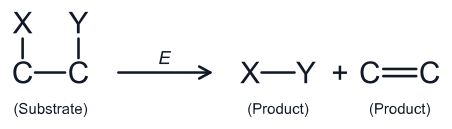
Identify the enzyme class 'E' from the following options:
- (1)
Transferases
- (2)
Isomerases
- (3)
Lyases
- (4)
Ligases
Answer and solution
Answer: (3)
Lyases catalyse the removal of groups from substrates by mechanisms other than hydrolysis, leaving behind double bonds. The reaction shown removes the X and Y groups (as X-Y) and generates a C=C double bond, which is characteristic of lyase activity. Transferases move a group between substrates, isomerases interconvert isomers, and ligases join two molecules together, none of which fit this reaction.
Why the other options are wrong:
- (1) Transferases transfer a functional group between a pair of substrates, not create a double bond.
- (2) Isomerases interconvert optical, geometric or positional isomers.
- (4) Ligases link two compounds together, the opposite of this elimination.- (1)
The specific receptors for neurotransmitters in a synapse are present on __________.
- (1)
Schwann cell
- (2)
Pre-synaptic membrane
- (3)
Myelin sheath
- (4)
Post-synaptic membrane
Answer and solution
Answer: (4)
At a chemical synapse, the neurotransmitter is released from the pre-synaptic neuron into the synaptic cleft and binds to specific receptors located on the post-synaptic membrane, opening ion channels and generating a new potential. Therefore the neurotransmitter receptors are present on the post-synaptic membrane, not on the pre-synaptic membrane, Schwann cell, or myelin sheath.
- (1)
What is the probability of having children with 'O' blood group, where both mother and father are heterozygous for 'A' and 'B' blood group, respectively?
- (1)
25%
- (2)
0%
- (3)
75%
- (4)
50%
Answer and solution
Answer: (1)
A heterozygous type-A parent is and a heterozygous type-B parent is . Their cross gives offspring (AB), (A), (B) and (O) in a 1:1:1:1 ratio. Only the genotype is blood group O, giving a probability of 1 in 4, i.e. 25%.
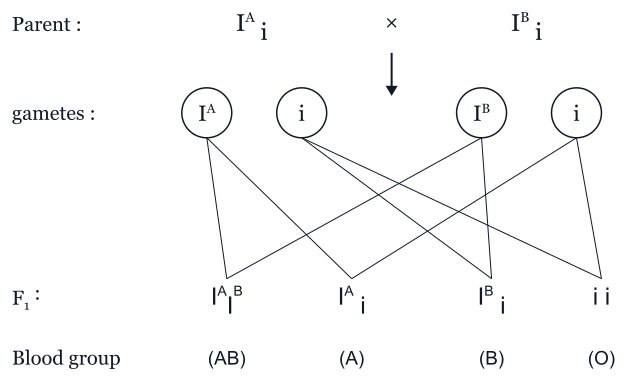
Why the other options are wrong:
- (2) Since both parents carry the recessive i allele, an O child is possible.
- (3) 75% would be the chance of a non-O child, not an O child.
- (4) 50% does not match the 1:1:1:1 offspring ratio for this cross.- (1)
Match List-I with List-II.
List I (Respiratory Volume)
List II (Capacity in mL)
P) ERV (Expiratory Reserve Volume)
I) 2500 - 3000 mL
Q) RV (Residual Volume)
II) 500 mL
R) IRV (Inspiratory Reserve Volume)
III) 1000 - 1100 mL
S) TV (Tidal Volume)
IV) 1100 - 1200 mL
Choose the correct answer from the options given below :
- (1)
P-III, Q-IV, R-I, S-II
- (2)
P-III, Q-I, R-IV, S-II
- (3)
P-I, Q-III, R-II, S-IV
- (4)
P-I, Q-II, R-III, S-IV
Answer and solution
Answer: (1)
Standard respiratory values: Expiratory Reserve Volume (ERV) is about 1000-1100 mL (III), Residual Volume (RV) is about 1100-1200 mL (IV), Inspiratory Reserve Volume (IRV) is about 2500-3000 mL (I), and Tidal Volume (TV) is about 500 mL (II). Hence P-III, Q-IV, R-I, S-II.
- (1)
Which of the following is not an example of convergent evolution?
- (1)
Flippers of penguins and dolphins
- (2)
Eyes of octopuses and mammals
- (3)
Fore limbs of whales and bats
- (4)
Wings of butterflies and birds
Answer and solution
Answer: (3)
Convergent evolution produces analogous structures in unrelated lineages performing similar functions, as with flippers of penguins and dolphins, eyes of octopuses and mammals, and wings of butterflies and birds. The forelimbs of whales and bats, however, share the same basic skeletal plan inherited from a common ancestor; they are homologous structures illustrating divergent evolution. Therefore the whale-and-bat forelimbs are the exception.
- (1)
Male frogs can be distinguished from female frogs due to the presence of
Statement I: Bulging eyes
Statement II: Vocal sacs
Statement III: Webbed digits in feet
Statement IV: Copulatory pad on first digit of fore limbs
Statement V: Olive green-coloured skin with dark irregular spots
Choose the correct answer from the options given below- (1)
II and III only
- (2)
III and V only
- (3)
I and II only
- (4)
II and IV only
Answer and solution
Answer: (4)
Male frogs are distinguished from females by two secondary sexual characters: vocal sacs (used to amplify croaking during the breeding season) and a copulatory pad on the first digit of the fore limbs (to grip the female during amplexus). Bulging eyes, webbed digits, and olive-green skin with dark spots are common to both sexes. Hence only II and IV.
- (1)
A group of researchers procured some fish like animals and upon investigation the following characters were observed: A. Endoskeleton was made of cartilage. B. Ectoparasitic; as they were found attached on fish skin with their circular sucking mouth. C. Paired fins and scales were absent, but 7 pairs of gill slits were present.
Which of the following species of animals did they consider to fit best with these characters?- (1)
Scoliodon sp.
- (2)
Petromyzon sp.
- (3)
Exocoetus sp.
- (4)
Branchiostoma sp.
Answer and solution
Answer: (2)
Petromyzon (lamprey) is a cyclostome with a cartilaginous endoskeleton, circular suctorial mouth, no scales or paired fins, and seven pairs of gill slits. It is ectoparasitic on fishes.
Scoliodon and Exocoetus are free-living fishes with paired fins, while Branchiostoma is a cephalochordate lacking the cyclostome-type suctorial mouth and parasitic habit.
These features identify Petromyzon.- (1)
Match List I with List II with respect to chronology of evolution of life forms
List I
List II
P) About 65 mya
I) Jawless fish probably evolved
Q) About 500 mya
II) The dinosaurs suddenly disappeared from the earth
R) About 350 mya
III) Seaweeds and few plants probably existed
S) About 320 mya
IV) Invertebrates were formed and became active
- (1)
P-III, Q-IV, R-I, S-II
- (2)
P-I, Q-II, R-III, S-IV
- (3)
P-II, Q-IV, R-III, S-I
- (4)
P-II, Q-IV, R-I, S-III
Answer and solution
Answer: (4)
Along the geological timeline: about 65 mya the dinosaurs suddenly disappeared from the earth (II); about 500 mya invertebrates were formed and became active (IV); about 350 mya jawless fishes probably evolved (I); and about 320 mya seaweeds and a few plants probably existed (III). This gives P-II, Q-IV, R-I, S-III.
- (1)
Match List I and List II
List I
List II
P) Progestasert
I) Barrier made of rubber used by females
Q) Multiload 375
II) Oral contraceptive
R) Diaphragm
III) Hormone releasing IUD
S) Saheli
IV) Copper releasing IUD
choose the correct answer from the options given below:
- (1)
P-III, Q-IV, R-I, S-II
- (2)
P-IV, Q-II, R-I, S-III
- (3)
P-IV, Q-III, R-I, S-II
- (4)
P-III, Q-IV, R-II, S-I
Answer and solution
Answer: (1)
Progestasert is a hormone-releasing intra uterine device (IUD) (P-III), Multiload 375 is a copper-releasing IUD (Q-IV), the diaphragm is a rubber barrier device used by females (R-I), and Saheli is a non-steroidal oral contraceptive pill (S-II). This matching corresponds to option (1).
- (1)
The WBC count of a person's blood sample is 8000/cu mm. How many eosinophils and lymphocytes would be in the same blood sample approximately?
- (1)
300 - 500/cu mm and 1200 - 1500/cu mm respectively
- (2)
160 - 240/cu mm and 1600 - 2000/cu mm respectively
- (3)
300 - 500/cu mm and 500 - 700/cu mm respectively
- (4)
100 - 120/cu mm and 160 - 200/cu mm respectively
Answer and solution
Answer: (2)
Eosinophils make up roughly 2-3% of total white blood cells (WBCs), so in 8000/cu mm that is about 160-240/cu mm. Lymphocytes make up about 20-25%, giving about 1600-2000/cu mm. Only option (2) provides both correct ranges.
- (1)
Match List I (Drug) with List II (Effect) and choose the correct answer from the options given below.
List I
List II
P) Nicotine
I) Causes sense of euphoria and increased energy
Q) Morphine
II) Stimulates adrenal gland to release catecholamines into blood circulation
R) Heroin
III) Effective sedative and painkiller
S) Cocaine
IV) A depressant; slows down body function
- (1)
P-III, Q-II, R-IV, S-I
- (2)
P-II, Q-III, R-I, S-IV
- (3)
P-II, Q-III, R-IV, S-I
- (4)
P-III, Q-II, R-I, S-IV
Answer and solution
Answer: (3)
Nicotine stimulates the adrenal gland to secrete catecholamines (P-II), morphine is an effective sedative and painkiller (Q-III), heroin is a depressant that slows body functions (R-IV), and cocaine produces a sense of euphoria and increased energy (S-I). This gives P-II, Q-III, R-IV, S-I, which is option (3).
- (1)
The human protein named -1-antitrypsin, obtained from transgenic animals, is used for the treatment of ______.
- (1)
Emphysema
- (2)
Alzheimer's disease
- (3)
Rheumatoid arthritis
- (4)
Cystic fibrosis
Answer and solution
Answer: (1)
According to NCERT, -1-antitrypsin produced from transgenic animals is used to treat emphysema, a lung disorder. Alzheimer's disease, rheumatoid arthritis and cystic fibrosis are conditions for which transgenic animal models are created for study, not treated by this protein.
- (1)
Select the set of fishes which belong to the class Osteichthyes:
- (1)
Devil fish, Cuttlefish and Hagfish
- (2)
Saw fish, Fighting fish and Dog fish
- (3)
Starfish, Hagfish and Cuttlefish
- (4)
Flying fish, Angel fish and Fighting fish
Answer and solution
Answer: (4)
Osteichthyes are the bony fishes. Flying fish (Exocoetus), angel fish (Pterophyllum) and fighting fish (Betta) are all bony fishes. The other sets include molluscs (cuttlefish), cyclostomes (hagfish), an echinoderm (starfish) or cartilaginous fishes (saw fish, dog fish), none of which are Osteichthyes.
- (1)
Select the incorrect statements from the following and choose the answer from the options given below.
Statement I: Digestive system in Platyhelminthes is incomplete.
Statement II: Bilateral symmetry is a characteristic feature of adult Echinoderms.
Statement III: Pseudocoelom is possessed by Aschelminthes.
Statement IV: Notochord is persistent throughout life in the class Chondrichthyes.
Statement V: Members of class Reptilia maintain a constant body temperature.- (1)
I and III only
- (2)
II and V only
- (3)
III and IV only
- (4)
II and IV only
Answer and solution
Answer: (2)
Statement II is wrong because adult echinoderms show radial symmetry (only their larvae are bilaterally symmetrical), and statement V is wrong because reptiles are poikilothermic (cold-blooded) and cannot maintain a constant body temperature. Statements I, III and IV are correct, so the incorrect pair is II and V, which is option (2).
- (1)
Non-membrane bound cell organelles found in both prokaryotic and eukaryotic cells are ______.
- (1)
Ribosomes
- (2)
Lysosomes
- (3)
Centrosomes
- (4)
Mitochondria
Answer and solution
Answer: (1)
Ribosomes lack a surrounding membrane and are present in both prokaryotic (70S) and eukaryotic (80S) cells. Lysosomes and mitochondria are membrane-bound and absent in prokaryotes, while the centrosome is found only in animal (eukaryotic) cells, so only ribosomes fit.
- (1)
Which of the following equations depicts Verhulst-Pearl logistic population growth?
- (1)
- (2)
- (3)
- (4)
Answer and solution
Answer: (2)
The Verhulst-Pearl logistic growth equation is , where K is the carrying capacity, r is the intrinsic rate of natural increase and N is the population density at time t. The term (K-N)/K represents environmental resistance, so option (2) is correct.
- (1)
Select the incorrect statement with reference to Rh grouping :
Statement I: Erythroblastosis foetalis is a condition observed having foetus with Rh-ve blood and mother with Rh+ve blood.
Statement II: Rh antigen is observed on RBCs in the majority of human beings.
Statement III: Before blood transfusion, Rh group should also be matched.
Statement IV: Rh incompatibility is observed when a pregnant mother is Rh-ve and the foetus is Rh+ve.
Statement V: Erythroblastosis foetalis can be avoided by administering anti-Rh antibodies to the mother immediately after the delivery of the second child.
Choose the answer from the options given below:- (1)
III and IV only
- (2)
I and II only
- (3)
I and V only
- (4)
II and III only
Answer and solution
Answer: (3)
Erythroblastosis foetalis can develop when an Rh-negative mother carries an Rh-positive foetus and becomes sensitised to the Rh antigen. In the NCERT account, anti-Rh antibodies are given immediately after delivery of the first child to prevent the disease in later pregnancies. Statement I reverses the mother–foetus Rh types, and Statement V gives the wrong timing; these are the two incorrect statements.
- (1)
Match List I with List II
List I (Bioactive molecules)
List II (Importance)
P) Streptokinase
I) Immunosuppressive agent
Q) Statins
II) Removal of clots from the blood vessels
R) Lipases
III) Blood cholesterol-lowering agent
S) Cyclosporin A
IV) Detergent formulations
Choose the correct answer from the options given below.
- (1)
P-II, Q-III, R-I, S-IV
- (2)
P-IV, Q-III, R-II, S-I
- (3)
P-III, Q-II, R-IV, S-I
- (4)
P-II, Q-III, R-IV, S-I
Answer and solution
Answer: (4)
Streptokinase is a clot buster that removes clots from blood vessels (P-II), statins are blood cholesterol-lowering agents (Q-III), lipases are used in detergent formulations (R-IV), and cyclosporin A is an immunosuppressive agent used in organ transplants (S-I). This gives P-II, Q-III, R-IV, S-I, which is option (4).
- (1)
Match List I with List II and choose the correct answer from the options given below.
List I
List II
P) Molluscs
I) Pulmonary respiration only
Q) Reptiles
II) Branchial respiration
R) Adult amphibians
III) Cellular respiration
S) Amoeba
IV) Pulmonary and cutaneous respiration
- (1)
P-II, Q-I, R-IV, S-III
- (2)
P-I, Q-II, R-IV, S-III
- (3)
P-II, Q-I, R-III, S-IV
- (4)
P-III, Q-II, R-I, S-IV
Answer and solution
Answer: (1)
Molluscs respire through gills, i.e. branchial respiration (P-II), reptiles breathe only through lungs, i.e. pulmonary respiration (Q-I), adult amphibians use both lungs and moist skin, i.e. pulmonary and cutaneous respiration (R-IV), and Amoeba depends on cellular respiration by simple diffusion (S-III). This matches option (1).
- (1)
The sixth mutant codon of beta globin gene causing polymerization of Haemoglobin and change in RBC shape is ______.
- (1)
GUG
- (2)
AUG
- (3)
GAG
- (4)
CAG
Answer and solution
Answer: (1)
In sickle cell anaemia the sixth codon of the -globin gene changes from GAG to GUG, so glutamic acid is replaced by valine. This substitution makes haemoglobin polymerize at low oxygen tension and distorts the red blood cell (RBC) into a sickle shape, so the mutant codon is GUG.
- (1)
Choose the correct statements regarding muscle contraction and choose the correct answer from the options given below.
Statement I: A motor neuron carries a signal sent by the Central Nervous System (CNS) to the sarcolemma of the muscle fibre.
Statement II: The neural signal generates an action potential which causes the release of Ca++ into sarcoplasm.
Statement III: Increase in Ca++ inactivates the actin for breaking cross bridges.
Statement IV: Actin binds to the myosin head to form a cross bridge.
Statement V: Shortening of sarcomere takes place, by pulling actin filaments towards the centre of 'A' band.- (1)
III and IV only
- (2)
I and II only
- (3)
III and V only
- (4)
I, II, IV and V only
Answer and solution
Answer: (4)
Statements I, II, IV and V correctly describe excitation-contraction coupling in muscle. Statement III is wrong because a rise in Ca++ actually activates the actin by unmasking its binding sites (allowing cross-bridge formation) rather than inactivating actin. Hence the correct set is I, II, IV and V, which is option (4).
- (1)
Which of the following statements are correct with reference to human endoskeleton? Choose the correct answer from the options given below.
Statement I: Human skull is monocondylic.
Statement II: The joint between any two adjoining vertebrae is a cartilaginous joint.
Statement III: In human beings, the number of cervical vertebrae is seven.
Statement IV: All ribs except the last 2 pairs are bicephalic.
Statement V: The occipital bone of skull is articulated with atlas vertebra.- (1)
II and V only
- (2)
II, III and V only
- (3)
III, IV and V only
- (4)
I, II and IV only
Answer and solution
Answer: (2)
The human skull is dicondylic (two occipital condyles), so I is wrong, and all human ribs are bicephalic (not just those except the last two pairs), so IV is wrong. Statements II (cartilaginous inter-vertebral joints), III (seven cervical vertebrae) and V (occipital bone articulating with the atlas) are correct, giving option (2).
- (1)
Spermatogonia undergo a series of cell divisions to produce sperms. Select the correct statements from the following and choose the correct answer from the options given below.
Statement I: Spermatogonia always undergo meiotic cell division.
Statement II: Primary spermatocytes divide mitotically to produce secondary spermatocytes.
Statement III: Secondary spermatocytes, through their second meiotic division, produce haploid spermatids.
Statement IV: Spermatids produce spermatozoa through mitosis.
Statement V: Spermatids transform into spermatozoa by spermiogenesis.- (1)
I and V only
- (2)
III and V only
- (3)
I, III and V only
- (4)
II, III and IV only
Answer and solution
Answer: (2)
Secondary spermatocytes complete the second meiotic division to give haploid spermatids (III correct), and spermatids differentiate into spermatozoa by spermiogenesis (V correct). Statement I is wrong because spermatogonia divide mitotically, Statement II is wrong because primary spermatocytes undergo meiosis I, and Statement IV is wrong because spermatids transform (not divide by mitosis) into sperm. So only Statements III and V are correct, option (2).
- (1)
The JGA (Juxta Glomerular Apparatus) is a special sensitive region formed by cellular modifications in _______ related to the same nephron.
- (1)
Distal convoluted tubule and efferent renal arteriole
- (2)
Proximal convoluted tubule and efferent renal arteriole
- (3)
Proximal convoluted tubule and afferent renal arteriole
- (4)
Distal convoluted tubule and afferent renal arteriole
Answer and solution
Answer: (4)
The juxtaglomerular apparatus forms at the point of contact where the distal convoluted tubule (macula densa) touches the afferent arteriole (juxtaglomerular cells) of the same nephron. Therefore the correct pairing is distal convoluted tubule and afferent renal arteriole, option (4).
- (1)
Which one of the following is an appropriate example of sexual deceit?
- (1)
Female wasp and fig
- (2)
Ophrys and bumblebee
- (3)
Sea anemone and clown fish
- (4)
Cuckoo and crow
Answer and solution
Answer: (2)
In sexual deceit the Mediterranean orchid Ophrys mimics a female bumblebee so that the male bee attempts pseudocopulation and inadvertently pollinates the flower. Female wasp and fig is mutualism, sea anemone and clown fish is commensalism, and cuckoo and crow is brood parasitism, so only Ophrys and bumblebee is sexual deceit.
- (1)
Choose the correct statements regarding frog's anatomy:
Statement I: Hepatic portal system is the special venous connection between liver and intestine.
Statement II: There are twelve pairs of cranial nerves arising from the brain.
Statement III: The ureters and oviducts open separately into the cloaca in female frogs.
Statement IV: Hind-brain consists of cerebellum, medulla oblongata and optic lobes.
Statement V: Sinus venosus joins the right atrium of heart.
choose the correct answer from the options given below:- (1)
I, II and III only
- (2)
II and IV only
- (3)
II and III only
- (4)
I, III and V only
Answer and solution
Answer: (4)
The hepatic portal system is a special venous connection that carries blood from the intestine to the liver.
Frogs have 10 pairs of cranial nerves, not 12 pairs.
In female frogs, the ureters and oviducts open separately into the cloaca.
The optic lobes are part of the midbrain, while the hindbrain consists mainly of the cerebellum and medulla oblongata.
The sinus venosus opens into the right atrium of the heart.
Therefore, the correct statements are I, III and V only.- (1)
Match List-I with List-II related to embryonic development at various months of pregnancy:
List I
List II
P) The foetus movement starts and hair appears on the head
I) 24 weeks of pregnancy
Q) The foetus develops limbs and digits
II) 20 weeks of pregnancy
R) The foetus develops external genital organs
III) 8 weeks of pregnancy
S) The foetus body is covered with fine hair; eyelids separate and eyelashes are formed
IV) 12 weeks of pregnancy
Choose the correct answer from the options given below:
- (1)
P-IV, Q-II, R-III, S-I
- (2)
P-II, Q-III, R-IV, S-I
- (3)
P-III, Q-II, R-IV, S-I
- (4)
P-II, Q-IV, R-III, S-I
Answer and solution
Answer: (2)
Limbs and digits form by the end of the second month (about 8 weeks), so Q-III. Most major organ systems and the external genital organs are formed by the end of the first trimester (about 12 weeks), so R-IV. The first foetal movements and hair on the head appear around the fifth month (about 20 weeks), so P-II. By about 24 weeks the body is covered with fine hair with separated eyelids and eyelashes, so S-I. Hence P-II, Q-III, R-IV, S-I.
- (1)
In a population of a grasshopper species, the chromosome number of some members is 23 and some other members possess 24 chromosomes. The 23 and 24 chromosome-bearing members in this species are ______.
- (1)
females and males, respectively
- (2)
all males
- (3)
males and females, respectively
- (4)
all females
Answer and solution
Answer: (3)
Grasshoppers follow the XO type of sex determination: males are XO (a single X and no partner sex chromosome) while females are XX. Therefore the individual with 23 chromosomes lacks the second sex chromosome and is male, while the one with 24 chromosomes is female. Hence males and females respectively.
- (1)
In which animal do haploid cells divide mitotically to produce gametes?
- (1)
Male honeybees
- (2)
Male earthworms
- (3)
Male frogs
- (4)
Male grasshoppers
Answer and solution
Answer: (1)
In honeybees the males (drones) are haploid, developing from unfertilised eggs by parthenogenesis, so their gametes must be formed by mitosis rather than meiosis. Male earthworms, frogs and grasshoppers are diploid and produce gametes through meiosis. Hence male honeybees.
- (1)
Arrange the following cell layers/structures around the female gamete, from outer to inner side.
I. A. Zona pellucida
II. B. Perivitelline space
III. C. Corona radiata
IV. D. Plasma membrane of ovum
Choose the correct answer from the options given below:- (1)
D, B, A, C
- (2)
C, A, D, B
- (3)
C, A, B, D
- (4)
A, C, B, D
Answer and solution
Answer: (3)
Moving inward from the outside of the secondary oocyte, the layers occur in the order corona radiata, then zona pellucida, then the perivitelline space, and finally the plasma membrane of the ovum. This corresponds to the sequence C, A, B, D. Hence option (3).
- (1)
What is the reason behind production of large holes in 'Swiss Cheese'?
- (1)
The production of large amount of by Propionibacterium sharmanii
- (2)
The production of large amount of by Clostridium butylicum
- (3)
The production of large amount of and by lactic acid bacteria called Lactobacillus
- (4)
The production of large amount of and by Trichoderma polysporum
Answer and solution
Answer: (1)
The large holes (eyes) characteristic of Swiss cheese are produced by large amounts of released by the bacterium Propionibacterium sharmanii during ripening. Clostridium is associated with butyric acid production, Lactobacillus with curd formation, and Trichoderma is a fungus (source of cyclosporin A). Hence the correct reason is from Propionibacterium sharmanii.
- (1)
The toxin proteins isolated from Bacillus thuringiensis, coded by which of the following genes would control cotton bollworms and corn borer, respectively?
- (1)
cryIAc and cryIAb
- (2)
cryIAc and cryIIAb
- (3)
cryIIAb and cryIAc
- (4)
cryIAc and cryIIIAb
Answer and solution
Answer: (1)
The cry genes of Bacillus thuringiensis are insect-group specific. The proteins encoded by cryIAc (and cryIIAb) control cotton bollworms, whereas the protein encoded by cryIAb controls the corn borer. Since the question asks for cotton bollworm followed by corn borer, the correct gene pair is cryIAc and cryIAb.
- (1)
Ecological pyramids represent the relationship between the organisms at different trophic levels and they are generally inverted for:
- (1)
Pyramid of number in grassland
- (2)
Pyramid of energy in pond ecosystem
- (3)
Pyramid of biomass in grassland
- (4)
Pyramid of biomass in sea
Answer and solution
Answer: (4)
Pyramids of number and biomass in grassland are upright, and the pyramid of energy is always upright. Inversion typically occurs for the pyramid of biomass in a sea/aquatic ecosystem, because the standing biomass of the phytoplankton (producers) at any moment is smaller than that of the zooplankton and consumers they support. Hence the pyramid of biomass in sea is inverted.
- (1)
Choose the correct statement regarding GIFT to overcome infertility.
- (1)
Ova collected from a female donor are transferred to the uterus of an infertile female.
- (2)
Early embryos with up to 8 blastomeres are transferred to the uterus of an infertile female.
- (3)
Early embryos with up to 8 blastomeres are transferred into the fallopian tube of an infertile female.
- (4)
It is the transfer of an ovum collected from a donor into the fallopian tube of another female who cannot produce ovum but can provide suitable environment for fertilization and development.
Answer and solution
Answer: (4)
GIFT (Gamete Intra Fallopian Transfer) is an in-vivo technique in which an ovum collected from a donor is transferred into the fallopian tube of a woman who cannot produce her own ovum but can provide a suitable environment for fertilisation and further development. Transfer of an early embryo with up to 8 blastomeres describes zygote intra fallopian transfer (ZIFT)/intra uterine transfer (IUT), not GIFT. Hence option (4) is correct.
- (1)
Choose the correct statements regarding cell organelles and their inclusions.
Statement I: The endomembrane system includes Golgi complex, endoplasmic reticulum and mitochondria.
Statement II: Rough endoplasmic reticulum bears ribosomes on its surface.
Statement III: Both mitochondria and plastids have circular DNA.
Statement IV: A network of microtubules, microfilaments and intermediate filaments present in the cytoplasm is called cytoskeleton.
Statement V: Mitochondrion is a single membrane-bound structure.
Choose the correct answer from the options given below:- (1)
I and II only
- (2)
I, II and III only
- (3)
III, IV and V only
- (4)
II, III and IV only
Answer and solution
Answer: (4)
Rough endoplasmic reticulum bears ribosomes on its surface (II correct).
Both mitochondria and plastids contain their own circular DNA (III correct).
The cytoplasmic network of microtubules, microfilaments and intermediate filaments forms the cytoskeleton (IV correct).
The endomembrane system does not include mitochondria (I wrong), and the mitochondrion is a double membrane-bound organelle, not single (V wrong).
Hence Statements II, III and IV are correct.- (1)
Select the correct statements regarding cell membrane in eukaryotic cell.
Statement I: Membrane of human RBCs has approximately 52% protein.
Statement II: Major phospholipids are arranged in a bilayer.
Statement III: Extensions of the plasma membrane into the cell form mesosomes.
Statement IV: Tails towards the inner part of lipids are hydrophobic and thus protected from aqueous medium.
Statement V: Glycocalyx is present on the outer surface of the plasma membrane.
Choose the correct answer from the options given below:- (1)
III, IV and V only
- (2)
II, III and V only
- (3)
I, II and IV only
- (4)
I, III and V only
Answer and solution
Answer: (3)
The human red blood cell (RBC) membrane contains about 52% protein and roughly 40% lipid (I correct)
The phospholipids form a bilayer with their hydrophobic tails oriented inward, away from the aqueous medium (II and IV correct).
Mesosomes and glycocalyx are prokaryotic features and are absent from the eukaryotic plasma membrane, so Statements III and V are wrong.
Hence Statements I, II and IV are correct.- (1)
Match List I with List II related to muscular/skeletal system:
List I
List II
P) Tetany
I) Inflammation of joints
Q) Arthritis
II) Autoimmune disorder affecting neuromuscular junction
R) Myasthenia gravis
III) Wild contraction in muscle due to low in body fluid
S) Muscular dystrophy
IV) Progressive degeneration of skeletal muscle
Choose the correct answer from the options given below:
- (1)
P-III, Q-I, R-II, S-IV
- (2)
P-I, Q-II, R-III, S-IV
- (3)
P-IV, Q-III, R-II, S-I
- (4)
P-III, Q-II, R-I, S-IV
Answer and solution
Answer: (1)
Tetany is the rapid, wild muscle spasm caused by low in body fluid (P-III).
Arthritis is inflammation of the joints (Q-I).
Myasthenia gravis is an autoimmune disorder affecting the neuromuscular junction (R-II).
Muscular dystrophy is progressive degeneration of skeletal muscle (S-IV).
Hence P-III, Q-I, R-II, S-IV.- (1)
Evolution of human appears parallel to the progressive development of brain and language skills. As such, the evolution of individual species in the sequence of their appearance is:
- (1)
Ramapithecus Homo habilis Homo erectus Neanderthal Homo sapiens
- (2)
Homo sapiens Ramapithecus Homo habilis Neanderthal Homo erectus
- (3)
Homo habilis Homo erectus Ramapithecus Neanderthal Homo sapiens
- (4)
Neanderthal Ramapithecus Homo habilis Homo erectus Homo sapiens
Answer and solution
Answer: (1)
The accepted chronological order of human evolution proceeds from Ramapithecus through Homo habilis and Homo erectus to Neanderthal man and finally modern Homo sapiens. Only option (1) reflects this sequence; the others wrongly place Homo sapiens, Ramapithecus or Neanderthal out of order.
- (1)
The flightless bird with forelimbs modified as paddle-like structures suited for swimming is known as:
- (1)
Struthio
- (2)
Neophron
- (3)
Aptenodytes
- (4)
Psittacula
Answer and solution
Answer: (3)
Aptenodytes is the genus of penguins, flightless birds whose forelimbs are modified into paddle-like flippers used for swimming.
Struthio (ostrich) is flightless but its reduced wings are used for balance while running, not swimming, while Neophron (vulture) and Psittacula (parakeet) are flying birds.
Hence Aptenodytes.- (1)
Choose the correct statements regarding population interactions between two species.
Statement I: In both parasitism and commensalism, only one species benefits and the other species is harmed.
Statement II: Both species benefit in mutualism.
Statement III: Both species benefit in commensalism.
Statement IV: In parasitism, only one species benefits and the other species is harmed.
Statement V: In amensalism, one species is harmed and the other is unaffected.
Choose the correct answer from the options given below:- (1)
II and V only
- (2)
I and II only
- (3)
II, IV and V only
- (4)
I and IV only
Answer and solution
Answer: (3)
In mutualism both interacting species benefit (II correct).
In parasitism one species benefits while the other is harmed (IV correct).
In amensalism one species is harmed while the other remains unaffected (V correct).
Commensalism benefits one species and leaves the other unaffected (not harmed), so Statement III is wrong, and Statement I is wrong because commensalism does not harm either partner.
Hence Statements II, IV and V are correct.- (1)
Questions
Is this the official NEET 2026 question paper?
Yes. These are the 180 questions NTA set for NEET UG 2026. The solutions are written by BrainIt, not by NTA.
Where is the official NEET 2026 answer key?
NTA publishes it on its official site, neet.nta.nic.in. On this page each question shows its accepted answer under it.
How is the paper marked?
Four marks for a correct answer, minus one for a wrong one, and nothing for a question left blank.
Something here wrong or out of date? Email hello@brainit.pro and a person will read it.