

Amines: NEET previous year questions
Every Amines question from the official NEET papers on this site, with the answer and a worked solution.
The questions come from NEET 2026, Re-NEET 2026 and NEET 2020. Each shows its answer and solution when you open it, so you can attempt it first. For what the chapter covers and how NEET tests it, see the Amines guide.
NEET 2026
NEET 2026 · Q46
Select the reagents that reduce nitriles to primary amines. Choose the correct answer from the options given below.
Statement I: (i) ; (ii)
Statement II:
Statement III:
Statement IV:
Statement V: /aq.- (1)
II, IV and V only
- (2)
I, III and IV only
- (3)
I, IV and V only
- (4)
I, II and III only
Answer and solution
Answer: (2)
Nitriles are reduced to primary amines by followed by hydrolysis, by catalytic hydrogenation , and by (sodium amalgam in ethanol). So Statements I, III and IV are correct. (Stephen reduction) stops at the aldehyde, and /aq. NaOH is the Hoffmann bromamide reaction on amides, not a nitrile reduction.
- (1)
NEET 2026 · Q60
The following two reactions give the same foul smelling product Z:
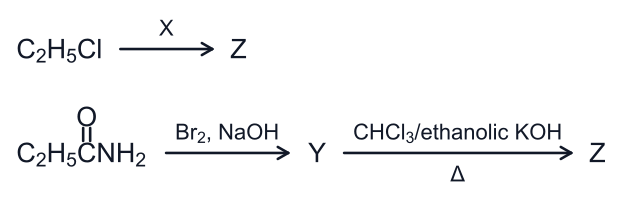
X and Z, respectively, are:
- (1)
- (2)
- (3)
- (4)
Answer and solution
Answer: (1)
With silver cyanide () the alkyl halide gives the isocyanide, so ethyl chloride yields foul-smelling ethyl isocyanide, (X = ). In the second route, propanamide undergoes Hoffmann bromamide degradation () to ethylamine, which then gives ethyl isocyanide via the carbylamine reaction ( + ethanolic ). Both paths converge on Z = . would give the nitrile (), which is not foul-smelling.
Why the other options are wrong:
- (2) Wrong: gives nitrile, and nitrile is not the foul-smelling carbylamine product.
- (3) Wrong: does not give the nitrile.
- (4) Wrong: gives nitrile, not isocyanide.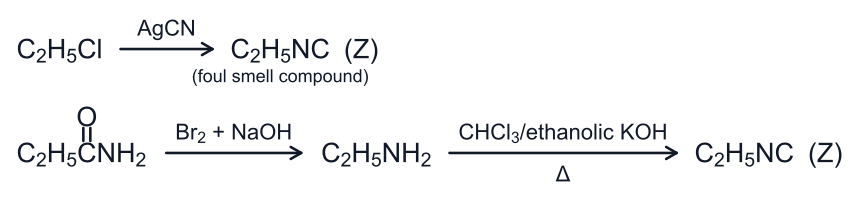
- (1)
NEET 2026 · Q85
The major product Z formed in the following sequence of reactions is:
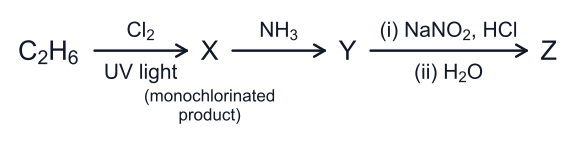
- (1)
- (2)
- (3)
- (4)
Answer and solution
Answer: (3)
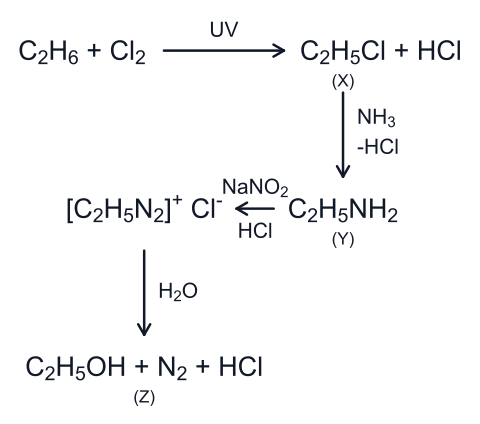
Monochlorination of ethane gives chloroethane (X). Reaction with gives ethylamine (Y). Treating this primary aliphatic amine with forms a highly unstable diazonium salt that reacts with water to release and yield ethanol (Z). Hence (3) is correct.
- (1)
Re-NEET 2026
Re-NEET 2026 · Q79
Identify the reactions which give aniline as the major product.
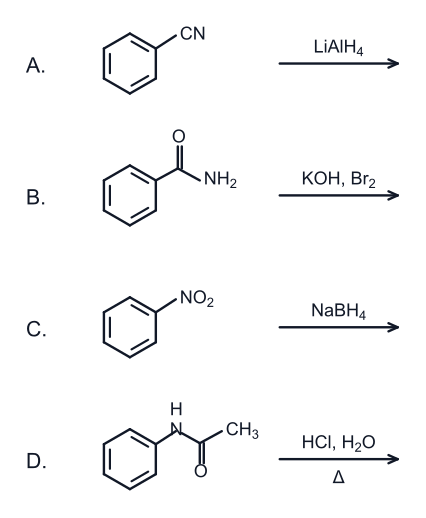
Choose the correct answer from the options given below.
- (1)
A and B only
- (2)
B and D only
- (3)
A and C only
- (4)
C and D only
Answer and solution
Answer: (2)
Reaction B is the Hofmann bromamide degradation, which removes one carbon from an amide and delivers the amine with the nitrogen now bonded directly to the ring - aniline. Reaction D is simple acid hydrolysis of an anilide, cleaving the amide bond to regenerate aniline and acetic acid. Reaction A gives benzylamine, since reduces the nitrile carbon to and leaves an extra carbon in the chain, and reaction C fails because is too mild to reduce an aromatic nitro group. NCERT Class 12, Amines (methods of preparation).
Why the other options are wrong:
- (1) includes the nitrile reduction, forgetting that the nitrile carbon is retained and gives benzylamine
- (3) includes both the nitrile reduction and the attempt, neither of which yields aniline
- (4) includes the reduction, confusing it with or catalytic hydrogenation- (1)
Re-NEET 2026 · Q84
Given below are two statements.
Statement I: Oxidation of p-nitrotoluene with acidic gives an acid that is stronger than benzoic acid.
Statement II: Reduction of p-nitrotoluene with followed by neutralization gives an amine that is more basic than aniline.
In light of the above statements, choose the most appropriate answer from the options given below.- (1)
Both Statement-I and Statement-II are correct
- (2)
Both Statement-I and Statement-II are incorrect
- (3)
Statement-I is correct but Statement-II is incorrect
- (4)
Statement-I is incorrect but Statement-II is correct
Answer and solution
Answer: (1)
Each reagent attacks a different group on the same starting material. Acidic permanganate oxidises the methyl group to , leaving the nitro group intact; the resulting p-nitrobenzoic acid is stronger than benzoic acid because the electron-withdrawing nitro group stabilises the carboxylate anion. instead reduces the nitro group to , leaving the methyl in place; the resulting p-toluidine is more basic than aniline because the electron-releasing methyl group raises the electron density on nitrogen. Both statements are therefore correct. NCERT Class 12, Amines; Aldehydes, Ketones and Carboxylic Acids.
- (1)
NEET 2020
NEET 2020 · Q129
Which of the following amine will give the carbylamine test?
- (1)
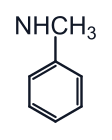
- (2)
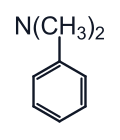
- (3)
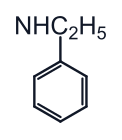
- (4)
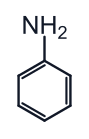
Answer and solution
Answer: (4)
Only primary amines give the carbylamine test. Aniline is primary, whereas N-methyl-, N-ethyl- and N,N-dimethylaniline are secondary or tertiary. Chapter: Amines.
Why the other options are wrong:
- (1) N-methylaniline is a secondary amine with only one N-H, and an isocyanide needs two N-H hydrogens to form with and alcoholic .
- (2) N,N-dimethylaniline is a tertiary amine with no N-H at all, so no isocyanide can form.
- (3) N-ethylaniline is a secondary amine; its single N-H is not enough to give the foul-smelling isocyanide.- (1)
Practise Amines in the app: it brings back the questions you get wrong, so the chapter improves, not just your memory of these. Or try the free CBT mock. All chapters: NEET chapter-wise PYQs.
Questions
Are these the official NEET questions on Amines?
Yes. They are the questions NTA set in each paper, in its wording. The solutions are written by BrainIt.
Something here wrong or out of date? Email hello@brainit.pro and a person will read it.