

Solutions: NEET previous year questions
Every Solutions question from the official NEET papers on this site, with the answer and a worked solution.
The questions come from NEET 2026, Re-NEET 2026 and NEET 2020. Each shows its answer and solution when you open it, so you can attempt it first. For what the chapter covers and how NEET tests it, see the Solutions guide.
NEET 2026
NEET 2026 · Q71
Identify the correct statements. Choose the correct answer from the options given below.
Statement I: The molality of 2.5 g of ethanoic acid (Molar mass: 60 g mol) in 75 g of benzene solution is 0.556 m.
Statement II: The molarity of a solution containing 5 g of NaOH (molar mass: 40 g mol) in 450 mL of solution is 0.278 M at 298 K.
Statement III: Aquatic species are more comfortable in cold water.
Statement IV: The solubility of gas increases with decrease in pressure.
Statement V: For a binary mixture of A and B, the number of moles of A and B are and respectively. The mole fraction of B will be .- (1)
I, II and III only
- (2)
I and II only
- (3)
I and III only
- (4)
I, IV and V only
Answer and solution
Answer: (1)
(I) molality = m, correct. (II) molarity = M, correct. (III) correct: gas solubility rises as temperature falls, so cold water holds more dissolved O and aquatic life is more comfortable. (IV) wrong: by Henry's law gas solubility increases with increasing pressure. (V) wrong: mole fraction of B is , not . Hence only I, II and III are correct.
- (1)
NEET 2026 · Q89
Mixture of chloroform and acetone forms a solution with negative deviation from Raoult's law due to:
- (1)
Increase in escaping tendency of molecules of each component.
- (2)
Formation of hydrogen bonding between acetone and chloroform.
- (3)
Stronger intermolecular forces between chloroform molecules than those between chloroform and acetone molecules.
- (4)
Repulsive forces.
Answer and solution
Answer: (2)
An acetone-chloroform mixture shows negative deviation because a new hydrogen bond forms between the chloroform C-H and the carbonyl oxygen of acetone, making the A-B interactions stronger than the A-A and B-B interactions. This lowers the escaping tendency and hence the vapour pressure, so (2) is correct. Increased escaping tendency or repulsive forces would instead cause positive deviation.
Escaping tendency decreases, vapour pressure decreases and boiling point increases.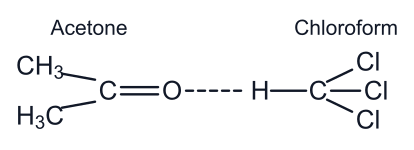
- (1)
Re-NEET 2026
Re-NEET 2026 · Q54
Assertion (A): For an ideal solution formed by mixing liquids and , and
Reason (R): No interactions occur between and
In the light of the above statements, choose the most appropriate answer from the options given below.- (1)
Both A and R are correct and R is the correct explanation of A
- (2)
Both A and R are correct but R is NOT the correct explanation of A
- (3)
A is correct but R is not correct
- (4)
A is not correct but R is correct
Answer and solution
Answer: (3)
The assertion is a defining property of an ideal solution: because the molecules pack and interact just as they did before mixing, neither heat nor volume changes on mixing. The reason misstates why. Interactions certainly DO occur between P and Q - the requirement is that the P-Q interaction be equal in strength to the P-P and Q-Q interactions it replaces, so the energy terms cancel. A solution with no intermolecular forces at all would be a gas, not a liquid mixture. NCERT Class 12, Solutions (ideal and non-ideal solutions).
- (1)
Re-NEET 2026 · Q71
Consider the following statements about the solutions formed by mixing two liquids.
Statement I: An ideal solution thus formed obeys Raoult's law throughout the composition range.
Statement II: Mixture of chloroform and acetone shows negative deviation from Raoult's law.
Statement III: Mixture of aniline and phenol shows positive deviation from Raoult's law.- (1)
I and II only
- (2)
II and III only
- (3)
I only
- (4)
I and III only
Answer and solution
Answer: (1)
Statement I is the definition of ideality - Raoult's law must hold over the whole composition range, not merely at the dilute ends. Statement II is correct because chloroform's C-H is acidic enough to hydrogen-bond to acetone's carbonyl oxygen, an interaction stronger than either pure liquid had, so escaping tendency drops and the deviation is negative. Statement III is wrong for the same underlying reason: aniline and phenol also form strong hydrogen bonds with each other, which gives a NEGATIVE deviation, not a positive one. NCERT Class 12, Solutions.
- (1)
NEET 2020
NEET 2020 · Q113
The freezing point depression constant (Kf) of benzene is 5.12 K kg mol-1. The freezing point depression for the solution of molality 0.078 m containing a non-electrolyte solute in benzene is (rounded off upto two decimal places) :
- (1)
0.80 K
- (2)
0.40 K
- (3)
0.60 K
- (4)
0.20 K
Answer and solution
Answer: (2)
The freezing point depression is given by . Substituting the values, K. Chapter: Solutions.
- (1)
NEET 2020 · Q115
The mixture which shows positive deviation from Raoult's law is
- (1)
Benzene + Toluene
- (2)
Acetone + Chloroform
- (3)
Chloroethane + Bromoethane
- (4)
Ethanol + Acetone
Answer and solution
Answer: (4)
Ethanol and acetone show positive deviation from Raoult's law due to weaker intermolecular interactions in the solution compared to pure components. Chapter: Solutions.
- (1)
Practise Solutions in the app: it brings back the questions you get wrong, so the chapter improves, not just your memory of these. Or try the free CBT mock. All chapters: NEET chapter-wise PYQs.
Questions
Are these the official NEET questions on Solutions?
Yes. They are the questions NTA set in each paper, in its wording. The solutions are written by BrainIt.
Something here wrong or out of date? Email hello@brainit.pro and a person will read it.