

Oscillations: NEET previous year questions
Every Oscillations question from the official NEET papers on this site, with the answer and a worked solution.
The questions come from NEET 2026, Re-NEET 2026 and NEET 2020. Each shows its answer and solution when you open it, so you can attempt it first. For what the chapter covers and how NEET tests it, see the Oscillations guide.
NEET 2026
NEET 2026 · Q5
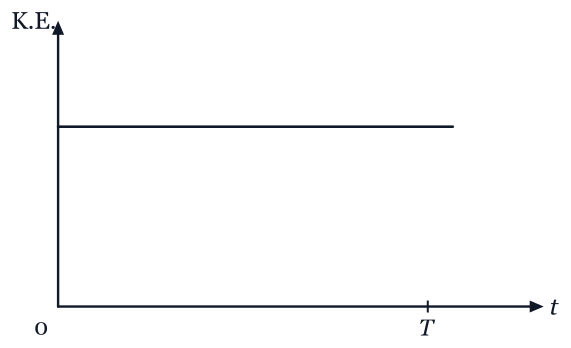
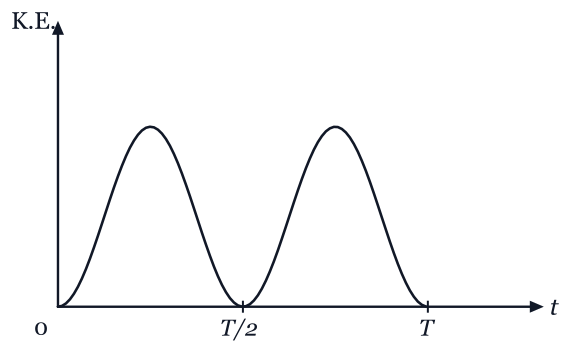
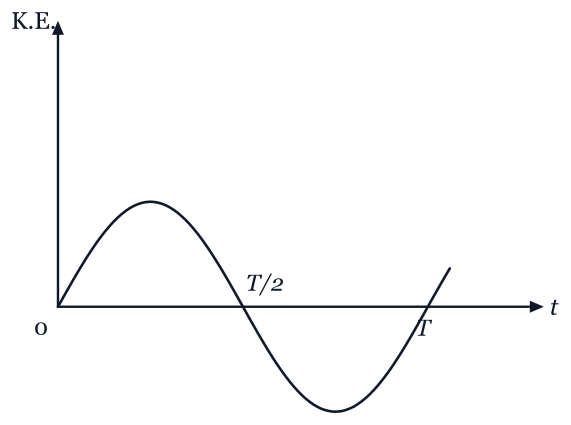
For a simple pendulum, having time period , the variation of kinetic energy (K.E.) with time () is represented by:
- (1)
- (2)
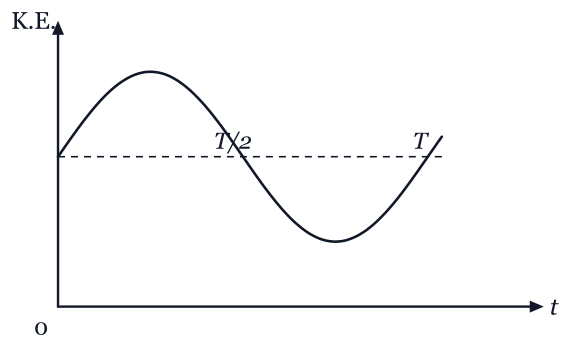
- (3)
- (4)
Answer and solution
Answer: (3)
The velocity in simple harmonic motion (SHM) is , so the kinetic energy is proportional to . This is always non-negative and repeats with period , producing two identical humps between 0 and that fall to zero at the extreme positions. Graph (3) shows exactly this, so the answer is (3).
- (1)
NEET 2026 · Q16
The sum of kinetic energy and potential energy of a simple pendulum bob is 0.02 joule. The speed of the simple pendulum bob at equilibrium position is approximately: (Consider mass of the bob = 20 g)
- (1)
0.2 m/s
- (2)
1.41 m/s
- (3)
14.1 m/s
- (4)
2.0 m/s
Answer and solution
Answer: (2)
At the equilibrium (lowest) point the bob's energy is entirely kinetic, so equals the total energy 0.02 J. With m = 20 g = 0.02 kg, , giving (option (2)). Forgetting to divide by the mass gives (option (1)).
- (1)
NEET 2026 · Q33
Savitha, a XI standard student, while conducting an experiment to determine the effective length of a simple pendulum , notes down the data of time taken to complete 30 oscillations as 60 s and hence calculates the length of the simple pendulum as: (Take , and m/s)
- (1)
0.75 m
- (2)
1.5 m
- (3)
2 m
- (4)
1 m
Answer and solution
Answer: (4)
The time period is s. From , the length is m. The other options result from arithmetic or period errors.
- (1)
Re-NEET 2026
Re-NEET 2026 · Q25
A cylindrical cork of uniform density floats in a liquid of density . If the cork is depressed slightly and released, it oscillates harmonically with time period . If the same cork floats in another liquid of density , then the similar oscillation has time period . The value of is:
- (1)
4
- (2)
2
- (3)
1/2
- (4)
1/4
Answer and solution
Answer: (4)
Depressing the cork by creates an extra buoyant force directed back towards equilibrium, so the effective spring constant is and . With and unchanged, . Doubling the period therefore requires the density to fall by a factor of four: . NCERT Class 11, Oscillations (simple harmonic motion (SHM) examples).
- (1)
Re-NEET 2026 · Q28
Consider a spring-mass simple harmonic oscillator in one dimension. The mass of the particle is kg and the spring constant is . At a given instant, the extension of the spring is -meter and the speed of the particle is . On the - plane, if the graph of as a function of is a circle, then the correct option is:
- (1)
- (2)
- (3)
- (4)
Answer and solution
Answer: (2)
Conservation of energy gives , which rearranges to - an ellipse in the plane. An ellipse becomes a CIRCLE only when the two semi-axes are equal, i.e. , which requires numerically. NCERT Class 11, Oscillations (energy in simple harmonic motion).
- (1)
NEET 2020
NEET 2020 · Q153
The phase difference between displacement and acceleration of a particle in a simple harmonic motion is
- (1)
3/2 rad
- (2)
/2 rad
- (3)
zero
- (4)
rad
Answer and solution
Answer: (4)
In SHM, a = -x. Acceleration is therefore exactly opposite to displacement, giving a phase difference of radians. Chapter: Oscillations.
- (1)
Practise Oscillations in the app: it brings back the questions you get wrong, so the chapter improves, not just your memory of these. Or try the free CBT mock. All chapters: NEET chapter-wise PYQs.
Questions
Are these the official NEET questions on Oscillations?
Yes. They are the questions NTA set in each paper, in its wording. The solutions are written by BrainIt.
Something here wrong or out of date? Email hello@brainit.pro and a person will read it.