

Chemical Thermodynamics: NEET previous year questions
Every Chemical Thermodynamics question from the official NEET papers on this site, with the answer and a worked solution.
The questions come from NEET 2026, Re-NEET 2026 and NEET 2020. Each shows its answer and solution when you open it, so you can attempt it first. For what the chapter covers and how NEET tests it, see the Chemical Thermodynamics guide.
NEET 2026
NEET 2026 · Q48
Consider the following reaction: . and at 298 K. Identify the correct option with for the reaction and the spontaneity of the reaction at 298 K. (Given: )
- (1)
, spontaneous
- (2)
, spontaneous
- (3)
, non-spontaneous
- (4)
, non-spontaneous
Answer and solution
Answer: (3)
With , . Then . A positive means the reaction is non-spontaneous.
- (1)
NEET 2026 · Q74
At a certain temperature, T (K), during a process, 500 J is absorbed by the system and work of 200 J is done by the system. Then change in internal energy of the system is:
- (1)
400 J
- (2)
300 J
- (3)
700 J
- (4)
500 J
Answer and solution
Answer: (2)
By the first law of thermodynamics, . Heat absorbed by the system gives q = +500 J, and work done by the system gives w = -200 J. Therefore J.
- (1)
Re-NEET 2026
Re-NEET 2026 · Q59
Two moles of an ideal gas undergo free expansion from 10 L to 100 L at 300 K. The values of and are (R is universal gas constant)
- (1)
- (2)
- (3)
- (4)
Answer and solution
Answer: (4)
Free expansion is into vacuum, so no work is done and no heat is exchanged: , . The surroundings are therefore completely untouched and . Entropy is a STATE function, so the system's change is computed along any reversible path with the same endpoints: . The net positive total confirms the irreversibility. NCERT Class 11, Thermodynamics (entropy and spontaneity).
- (1)
Re-NEET 2026 · Q69
Consider the reversible processes for 1.0 mol of an ideal gas as shown in the figure.
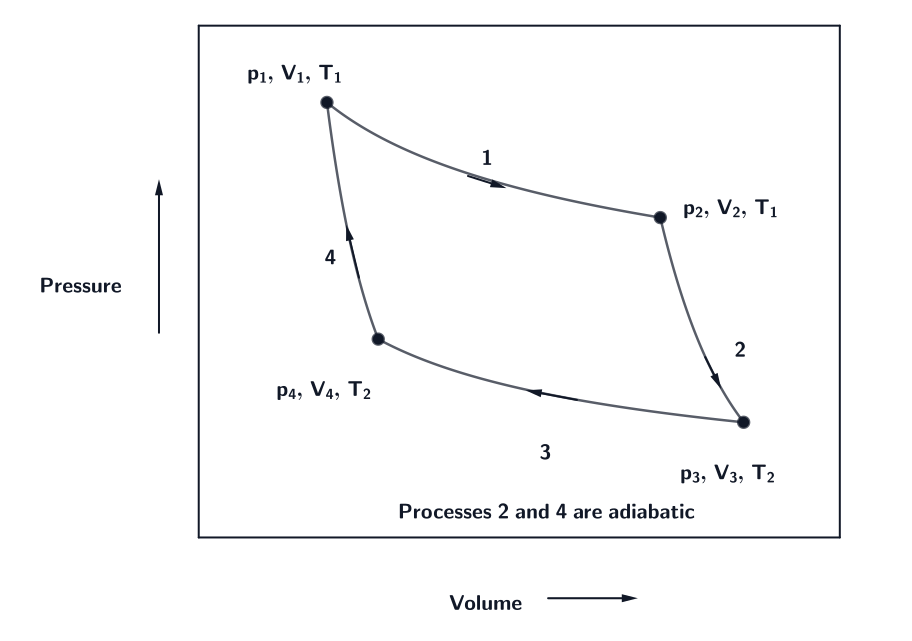
, , and represent work done (in calories) in the processes 1, 2, 3 and 4, respectively; and are changes in the internal energy for the processes 2 and 4, respectively. [use ] The correct option is
- (1)
- (2)
- (3)
- (4)
Answer and solution
Answer: (1)
The cycle is a Carnot-type sequence: steps 1 and 3 are isothermal (at and ) and steps 2 and 4 are adiabatic. For a reversible isothermal change , so with and the two isothermal contributions add to exactly the expression in option (1). NCERT Class 11, Thermodynamics (work in reversible isothermal and adiabatic processes).
Why the other options are wrong:
- (2) for an adiabatic step so for EACH, giving ; the minus sign is the error
- (3) gets the sign of the isothermal work backwards and wrongly treats the adiabatic as zero
- (4) confuses over a cycle with ; the net work equals the enclosed area and is non-zero- (1)
Re-NEET 2026 · Q74
A protein undergoes reversible thermal denaturation from its initial state to denatured state according to . At 60 °C, the concentrations of both and are equal at equilibrium, and the standard enthalpy change of denaturation is 666 kJ . The standard entropy change ( in kJ ) of the protein upon denaturation at 60 °C is closest to
- (1)
2.0
- (2)
2000.0
- (3)
333.0
- (4)
11.1
Answer and solution
Answer: (1)
Equal equilibrium concentrations mean , and since , the standard free energy change is zero. Setting gives , using . NCERT Class 11, Thermodynamics (Gibbs energy and equilibrium).
- (1)
NEET 2020
NEET 2020 · Q97
For the reaction 2Cl(g) → Cl(g), the correct option is
- (1)
rH > 0 and rS < 0
- (2)
rH < 0 and rS > 0
- (3)
rH < 0 and rS < 0
- (4)
rH > 0 and rS > 0
Answer and solution
Answer: (3)
The reaction involves the formation of a bond, which releases energy, making . Additionally, the reaction decreases the number of gas molecules, reducing entropy, so . Chapter: Chemical Thermodynamics.
- (1)
NEET 2020 · Q107
The correct option for free expansion of an ideal gas under adiabatic condition is
- (1)
q = 0, T < 0 and w > 0
- (2)
q < 0, T = 0 and w = 0
- (3)
q > 0, T > 0 and w > 0
- (4)
q = 0, T = 0 and w = 0
Answer and solution
Answer: (4)
In a free expansion of an ideal gas under adiabatic conditions, no work is done (w = 0) and no heat is exchanged (q = 0). Since the internal energy of an ideal gas depends only on temperature, . Chapter: Chemical Thermodynamics.
- (1)
Practise Chemical Thermodynamics in the app: it brings back the questions you get wrong, so the chapter improves, not just your memory of these. Or try the free CBT mock. All chapters: NEET chapter-wise PYQs.
Questions
Are these the official NEET questions on Chemical Thermodynamics?
Yes. They are the questions NTA set in each paper, in its wording. The solutions are written by BrainIt.
Something here wrong or out of date? Email hello@brainit.pro and a person will read it.