

Atoms: NEET previous year questions
Every Atoms question from the official NEET papers on this site, with the answer and a worked solution.
The questions come from NEET 2026, Re-NEET 2026 and NEET 2020. Each shows its answer and solution when you open it, so you can attempt it first. For what the chapter covers and how NEET tests it, see the Atoms guide.
NEET 2026
NEET 2026 · Q10
In the first excited state of hydrogen atom, the energy of its electron is eV. The radial distance of the electron from the hydrogen nucleus in this case is approximately:
(Take 1 eV = J, e = C and N m/C)- (1)
m
- (2)
m
- (3)
m
- (4)
m
Answer and solution
Answer: (3)
For the hydrogen atom the magnitude of the total energy equals half the magnitude of the potential energy, so eV. Solving, m, option (3). This is the Bohr orbit radius, i.e. angstrom.
- (1)
Re-NEET 2026
Re-NEET 2026 · Q35
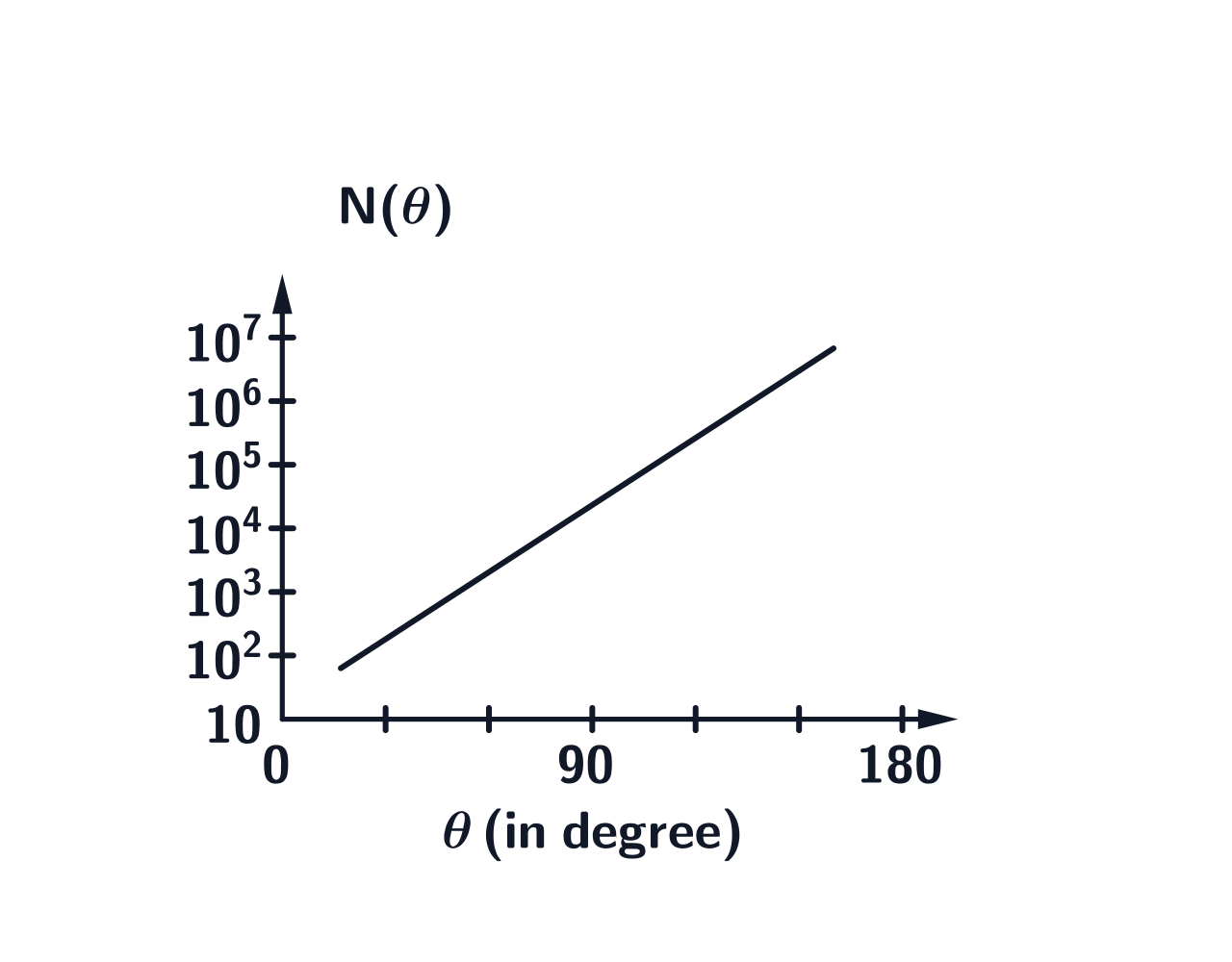
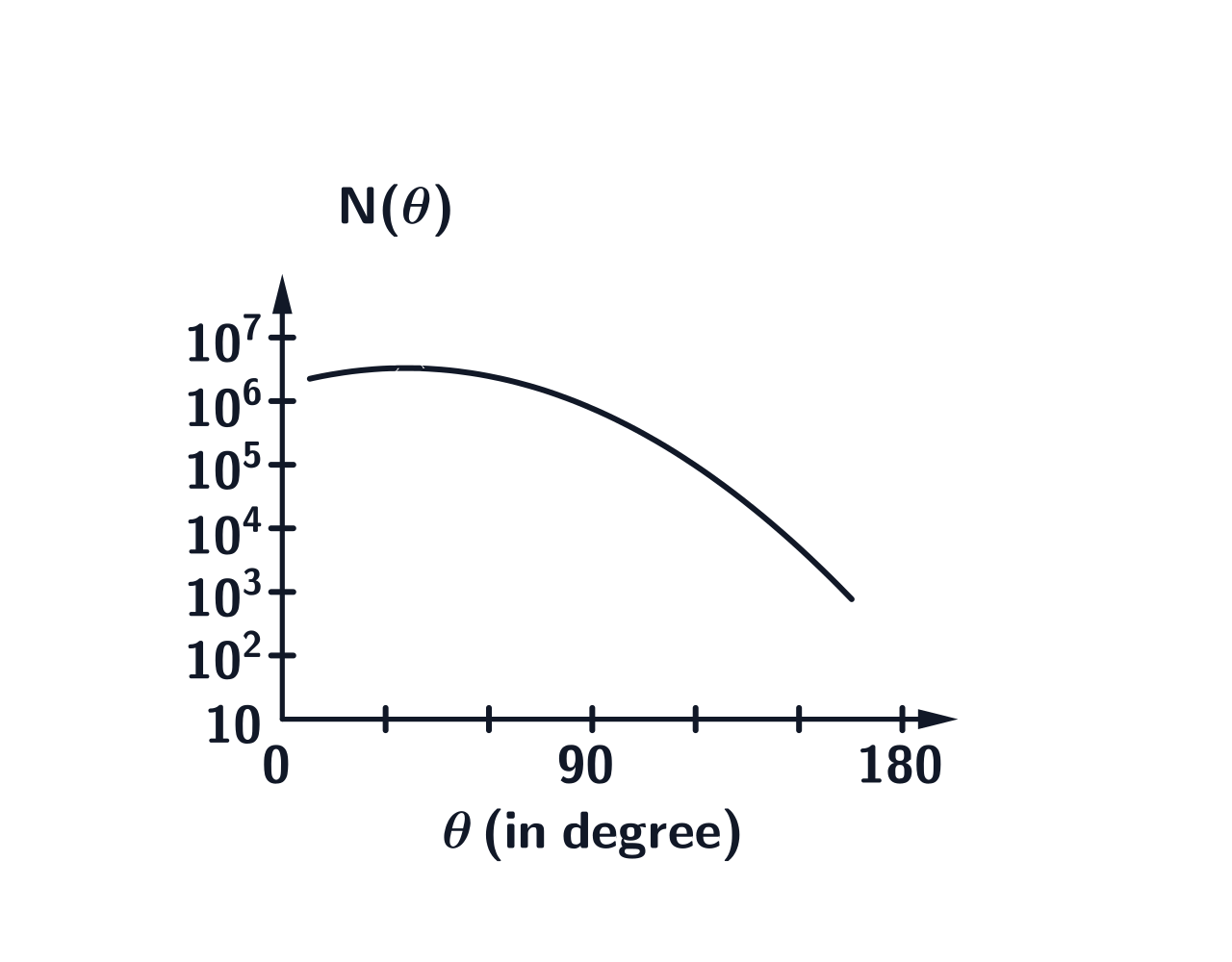
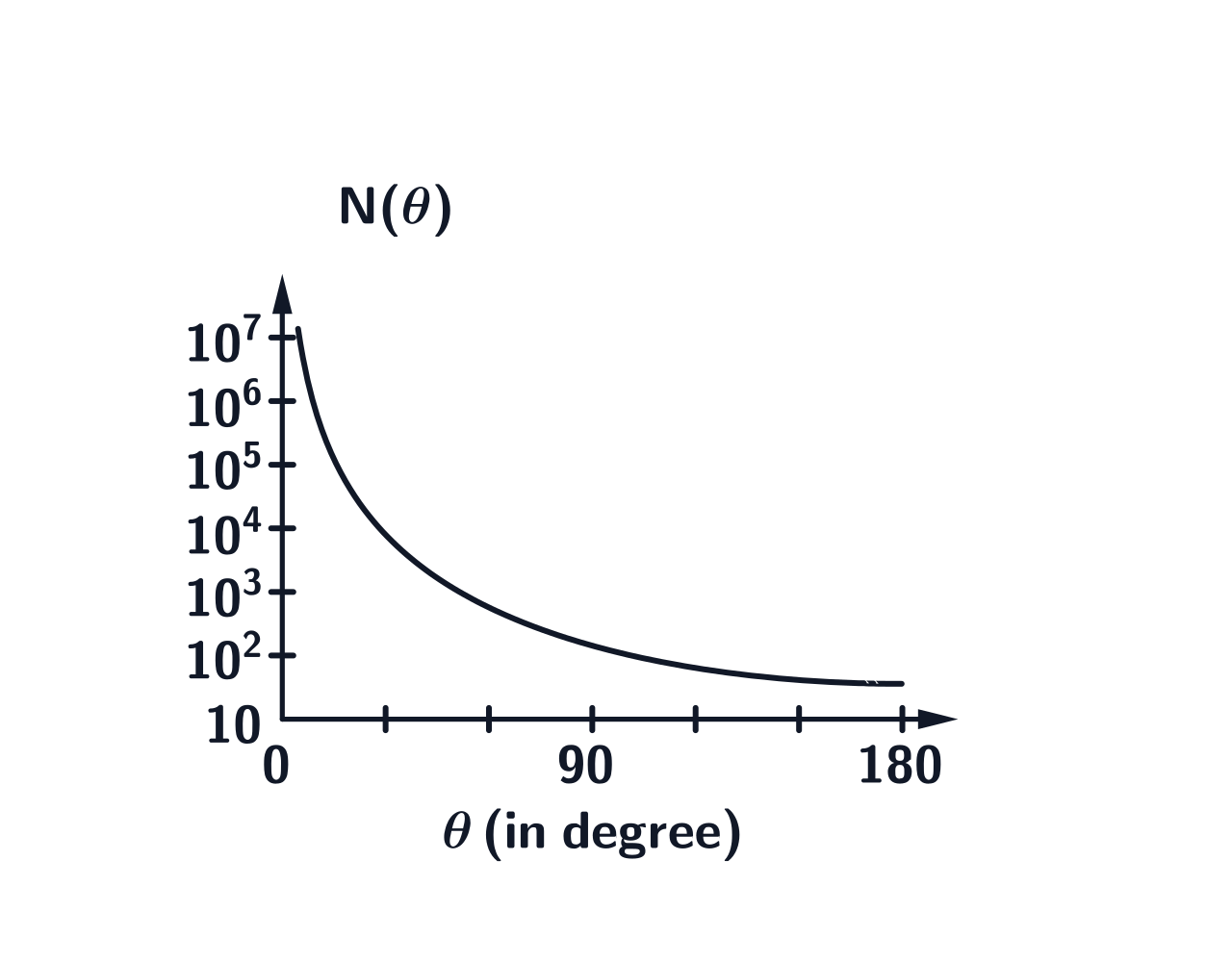
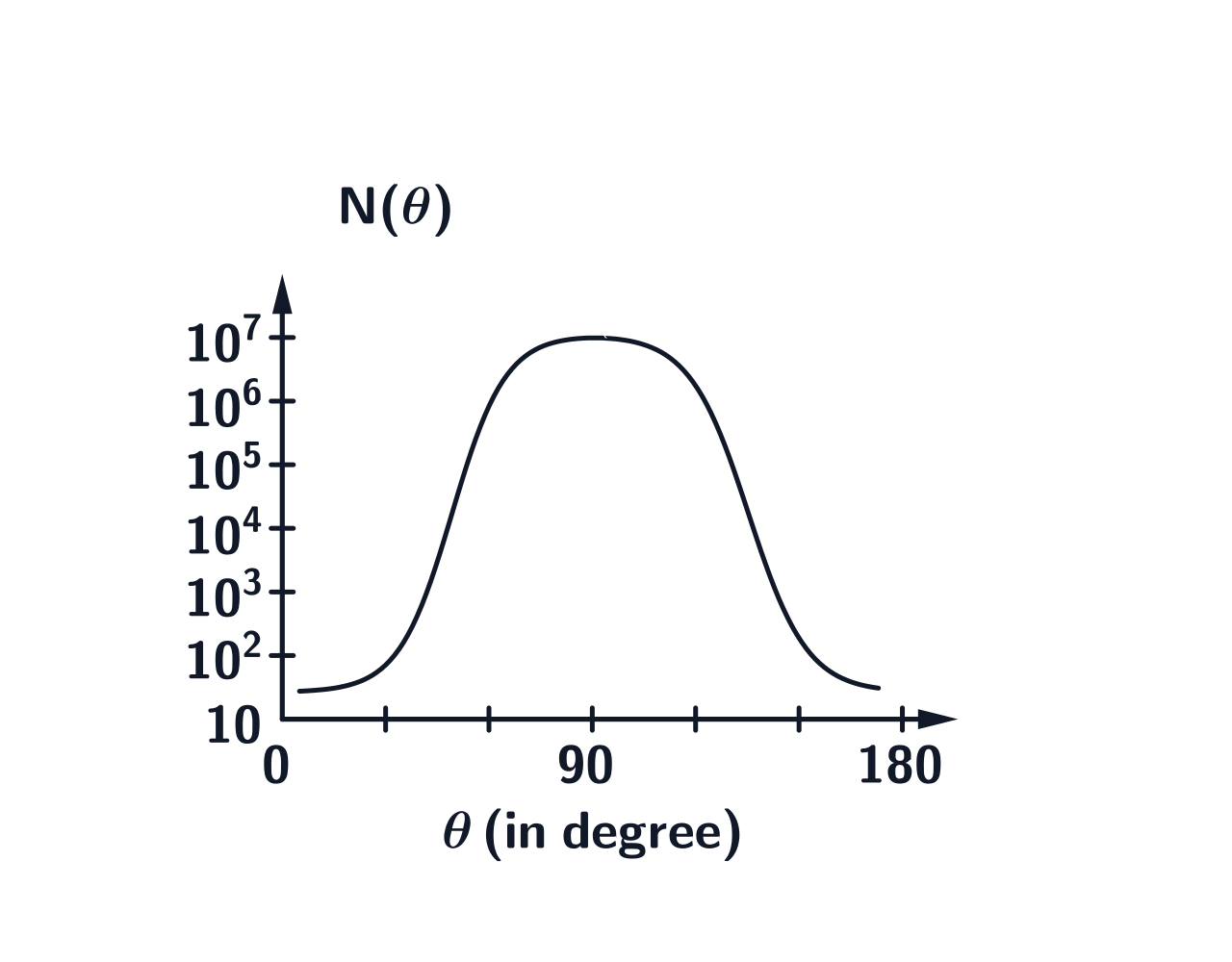
In Geiger-Marsden experiment, the number of scattered -particles is plotted as a function of scattering angle . Which of the following options represents the correct plot?
- (1)
- (2)
- (3)
- (4)
Answer and solution
Answer: (3)
Rutherford's scattering formula gives , so the count is enormous for small deflections and drops by several orders of magnitude as increases - which is exactly why the plots are drawn on a logarithmic vertical axis. The experimental finding was that the overwhelming majority of -particles pass almost undeviated, with only a tiny fraction turned through large angles by the nucleus. NCERT Class 12, Atoms (alpha-particle scattering).
Why the other options are wrong:
- (1) reverses the physics, implying most particles suffer large deflections and the atom is uniformly dense
- (2) captures the falling trend but far too weakly - it misses that the drop spans many orders of magnitude
- (4) invents a preferred scattering angle, as if the nucleus deflected particles by a characteristic amount- (1)
Re-NEET 2026 · Q40
Consider that an electron is revolving in an excited state of Hydrogen atom with velocity . The radius of the orbit is m. The value of is: [Take the mass of electron to the kg, charge of electron = C and ]
- (1)
4
- (2)
3
- (3)
2
- (4)
1
Answer and solution
Answer: (4)
In a Bohr orbit the Coulomb attraction supplies the centripetal force: , which rearranges to . Substituting , the numerator is and the denominator is . Their ratio is , so . NCERT Class 12, Atoms (Bohr model).
- (1)
NEET 2020
NEET 2020 · Q141
For which one of the following, Bohr model is not valid ?
- (1)
Singly ionised helium atom (He+)
- (2)
Deuteron atom
- (3)
Singly ionised neon atom (Ne+)
- (4)
Hydrogen atom
Answer and solution
Answer: (3)
The Bohr model is valid for hydrogen-like atoms, which have one electron. Hydrogen, singly ionised helium, and deuteron all fit this criterion. Singly ionised neon, however, has more than one electron, making the Bohr model inapplicable. Chapter: Atoms.
- (1)
Practise Atoms in the app: it brings back the questions you get wrong, so the chapter improves, not just your memory of these. Or try the free CBT mock. All chapters: NEET chapter-wise PYQs.
Questions
Are these the official NEET questions on Atoms?
Yes. They are the questions NTA set in each paper, in its wording. The solutions are written by BrainIt.
Something here wrong or out of date? Email hello@brainit.pro and a person will read it.