

Dual Nature of Radiation and Matter: NEET previous year questions
Every Dual Nature of Radiation and Matter question from the official NEET papers on this site, with the answer and a worked solution.
The questions come from NEET 2026, Re-NEET 2026 and NEET 2020. Each shows its answer and solution when you open it, so you can attempt it first. For what the chapter covers and how NEET tests it, see the Dual Nature of Radiation and Matter guide.
NEET 2026
NEET 2026 · Q9
Match List I with List II:
List I
List II
P)
I) de Broglie wavelength
Q) Diffraction and Interference
II) Particle nature of light
R)
III) Wave nature of light
S) Compton effect
IV) Energy of photon
Choose the correct answer from the options given below:
- (1)
P-IV, Q-I, R-II, S-III
- (2)
P-IV, Q-III, R-II, S-I
- (3)
P-I, Q-IV, R-III, S-II
- (4)
P-IV, Q-III, R-I, S-II
Answer and solution
Answer: (4)
gives the energy of a photon (IV); diffraction and interference demonstrate the wave nature of light (III); is the de Broglie wavelength of a particle (I); and the Compton effect confirms the particle nature of light (II). Hence P-IV, Q-III, R-I, S-II, which is option (4).
- (1)
NEET 2026 · Q42
For a metal of work function , which of the following wavelengths of incident radiation does not give rise to the photoelectric effect? (Take Planck's constant as )
- (1)
100 nm
- (2)
150 nm
- (3)
200 nm
- (4)
50 nm
Answer and solution
Answer: (3)
Photoemission requires photon energy , i.e. wavelength . Here . Any wavelength longer than this cannot eject electrons; , so it produces no photoelectric effect.
- (1)
Re-NEET 2026
Re-NEET 2026 · Q8
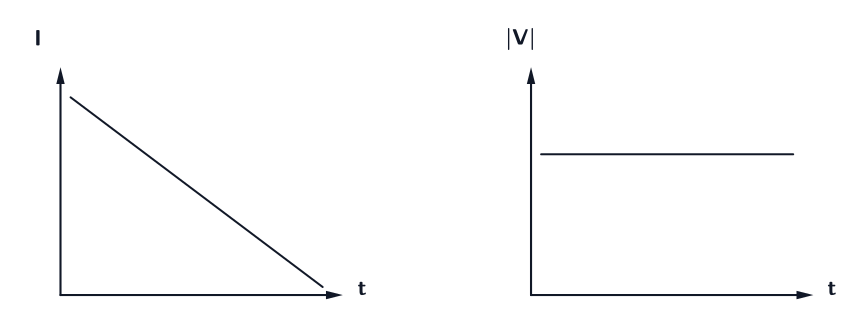
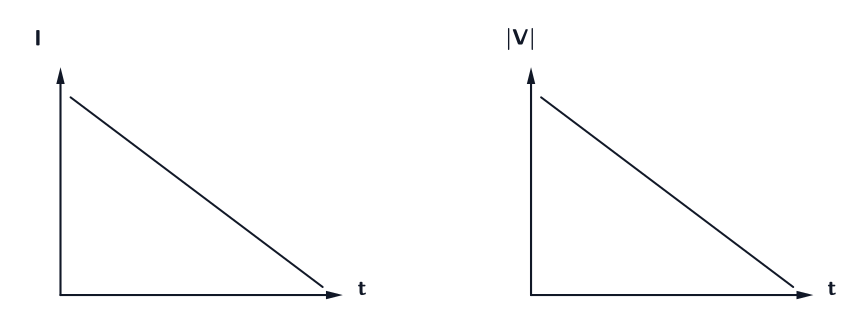
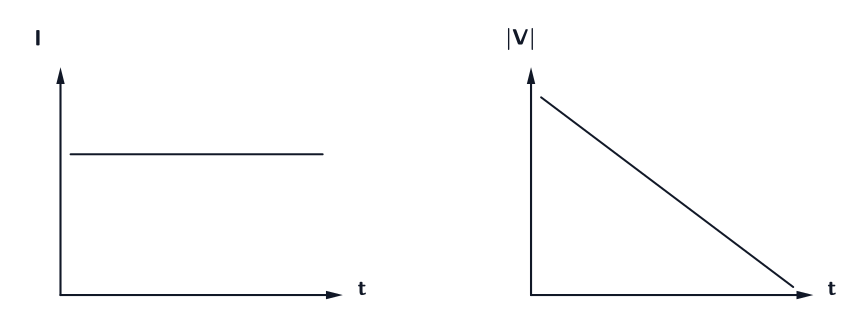
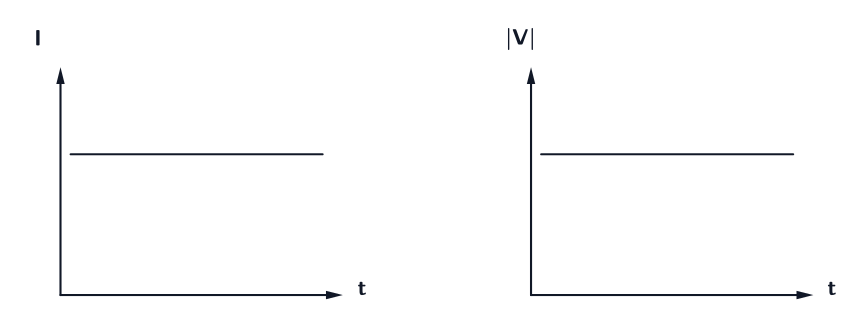
A beam of light falls on a metal surface such that photo-electrons are generated. If power of the light source starts to decrease linearly with time , then variation of the photocurrent and magnitude of the stopping potential with time is best represented by:
- (1)
- (2)
- (3)
- (4)
Answer and solution
Answer: (1)
Photocurrent is set by the NUMBER of photons striking the surface per second, so it is proportional to the source power and falls linearly with . Stopping potential, by contrast, depends only on the maximum kinetic energy of the emitted electrons, , which is fixed by the FREQUENCY and the work function - neither of which changes here. So stays flat while decays. NCERT Class 12, Dual Nature of Radiation and Matter.
Why the other options are wrong:
- (2) treats stopping potential as intensity-dependent, the single most common photoelectric misconception
- (3) swaps the roles entirely, tying current to frequency and stopping potential to intensity
- (4) assumes neither quantity responds to the source, ignoring that current tracks photon flux- (1)
Re-NEET 2026 · Q18
A ray of light with wavelength is incident on three different photoelectric cells namely 1, 2 and 3. The threshold wavelength of these photoelectric cells are , , and , respectively and the magnitude of stopping potentials of these cells are , and , respectively. The relation between and threshold wavelengths are , and . The correct option is:
- (1)
- (2)
- (3)
- (4)
Answer and solution
Answer: (1)
Emission occurs only when the incident wavelength is SHORTER than the threshold wavelength. Cell 1 has , so the photons are too weak and . For the other two, ; a LARGER threshold wavelength means a smaller work function and hence a larger stopping potential. Since , the term is nearly zero and . NCERT Class 12, Dual Nature of Radiation and Matter (Einstein's photoelectric equation).
- (1)
Re-NEET 2026 · Q19
A photon and an electron, each of 20 eV energy, move in free space. The ratio of linear momentum of electron to that of photon , is: [Take speed of light = , charge of electron = C and mass of electron = kg]
- (1)
- (2)
- (3)
225
- (4)
275
Answer and solution
Answer: (3)
A photon's momentum is . A non-relativistic electron of the same kinetic energy has . The ratio is therefore about 225 - a massive particle carries far more momentum than a photon of the same energy, because for matter but for light. NCERT Class 12, Dual Nature of Radiation and Matter.
- (1)
NEET 2020
NEET 2020 · Q143
An electron is accelerated from rest through a potential difference of V volt. If the de Broglie wavelength of the electron is 1.227 × 10⁻² nm, the potential difference is
- (1)
10 V
- (2)
10 V
- (3)
10 V
- (4)
10 V
Answer and solution
Answer: (3)
For an electron, (nm) = 1.227/. Setting nm gives = 100 and V = 10 V. Chapter: Dual Nature of Radiation and Matter.
- (1)
NEET 2020 · Q146
Light of frequency 1.5 times the threshold frequency is incident on a photosensitive material. What will be the photoelectric current if the frequency is halved and intensity is doubled?
- (1)
four times
- (2)
one-fourth
- (3)
zero
- (4)
doubled
Answer and solution
Answer: (3)
The new frequency is 0.75ν, below the threshold ν. No electrons are emitted irrespective of the doubled intensity, so the photoelectric current is zero. Chapter: Dual Nature of Radiation and Matter.
- (1)
Practise Dual Nature of Radiation and Matter in the app: it brings back the questions you get wrong, so the chapter improves, not just your memory of these. Or try the free CBT mock. All chapters: NEET chapter-wise PYQs.
Questions
Are these the official NEET questions on Dual Nature of Radiation and Matter?
Yes. They are the questions NTA set in each paper, in its wording. The solutions are written by BrainIt.
Something here wrong or out of date? Email hello@brainit.pro and a person will read it.