

Ray Optics and Optical Instruments: NEET previous year questions
Every Ray Optics and Optical Instruments question from the official NEET papers on this site, with the answer and a worked solution.
The questions come from NEET 2026, Re-NEET 2026 and NEET 2020. Each shows its answer and solution when you open it, so you can attempt it first. For what the chapter covers and how NEET tests it, see the Ray Optics and Optical Instruments guide.
NEET 2026
NEET 2026 · Q8
A ray of monochromatic light is passing through an equilateral prism () as shown in the figure. The refracted ray () is parallel to its base () and the angle of incidence () is 50. Then the angle of deviation () is:

- (1)
45
- (2)
35
- (3)
40
- (4)
55
Answer and solution
Answer: (3)
When the ray inside an equilateral prism () travels parallel to the base, the prism is in the minimum-deviation condition where the angle of incidence equals the angle of emergence (). Using gives , option (3).

- (1)
NEET 2026 · Q43
In a concave lens, a ray of light emanating from the object parallel to the principal axis of the lens after refraction:
- (1)
passes through , which is the radius of curvature of the lens.
- (2)
appears to diverge from the first principal focus.
- (3)
emerges parallel to the principal axis.
- (4)
passes through the second principal focus.
Answer and solution
Answer: (2)
A concave lens is diverging, so a ray incident parallel to the principal axis bends away from the axis and travels as though it originated from the focal point on the same (incident) side of the lens. Traced backwards, the emergent ray appears to diverge from that near-side focus. Strictly, this near-side point is the second principal focus ( in the figure), but option (2) is still the best answer, because it is the only option where the ray appears to diverge from a focus.
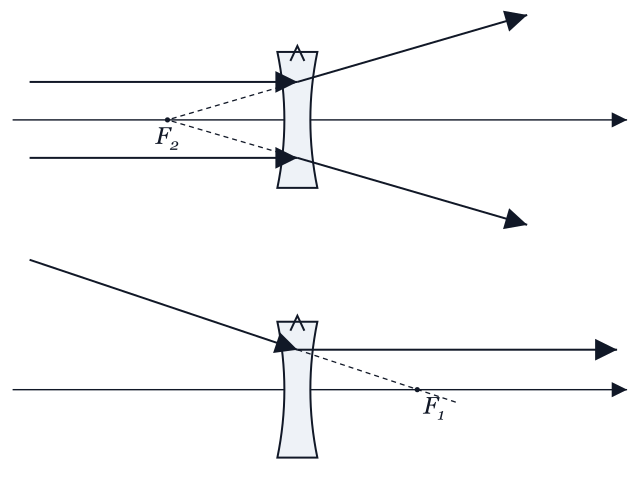
Why the other options are wrong:
- (1) A parallel ray relates to the focus, not to ; this describes a different ray.
- (3) It does not stay parallel; a diverging lens spreads a parallel beam.
- (4) The emergent ray only appears to come from the second principal focus on the incident side; it moves away from that point and never passes through it.- (1)
Re-NEET 2026
Re-NEET 2026 · Q20
Which of the following measurements require 'index correction'?
- (1)
Measurement of resistance of a wire using meter bridge
- (2)
Measurement of gravitational acceleration using simple pendulum
- (3)
Measurement of focal length of lenses using optical bench
- (4)
Measurement of speed of sound using resonance tube
Answer and solution
Answer: (3)
On an optical bench the positions read on the scale are those of the UPRIGHTS, not of the optical centres of the lens, mirror or object pin. The fixed offset between an upright's index mark and the actual optical element is removed by the index (or bench) correction, applied to every measured object and image distance before computing the focal length. NCERT Class 12 practical work, Ray Optics and Optical Instruments.
- (1)
Re-NEET 2026 · Q22
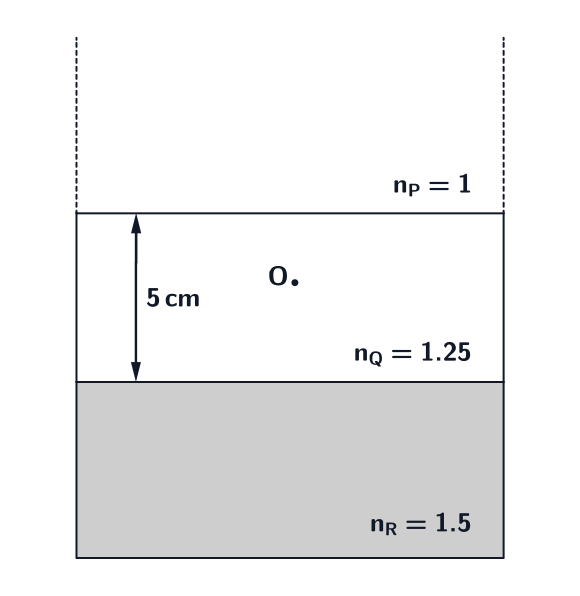
Consider three media , and with refractive indices 1, 1.25, and 1.5 respectively. The medium having a thickness of 5 cm is placed between extended media and as shown in the figure. An object is placed at the centre of medium . If viewed from medium near the normal direction, the apparent depth of is . For similar observation from medium , the apparent depth is . The value of , in cm, is:
- (1)
0
- (2)
1
- (3)
2
- (4)
3
Answer and solution
Answer: (2)
For near-normal viewing across a plane boundary, apparent depth real depth , and the object sits 2.5 cm from each face. Viewed from : . Viewed from : . Hence . Looking in from the DENSER side makes the object appear farther away, which is the sense check here. NCERT Class 12, Ray Optics and Optical Instruments (refraction at plane surfaces).
Why the other options are wrong:
- (1) assumes the symmetric placement of the object makes the two apparent depths equal, ignoring the different observer media
- (3) uses the full 5 cm thickness instead of the 2.5 cm from the object to each face
- (4) computes alone and reports it as the difference- (1)
Re-NEET 2026 · Q29
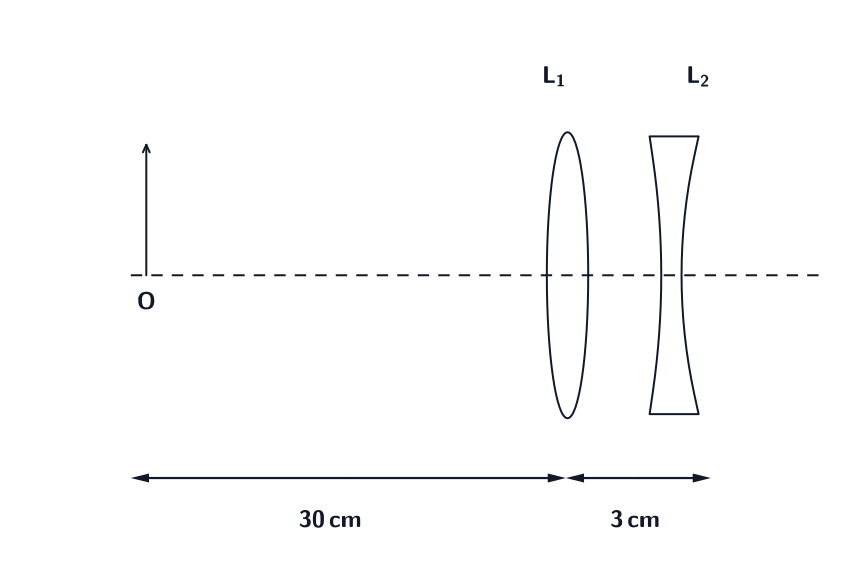
The lens combination as shown in the figure, consists of two lenses, and , of the focal lengths +10 cm and -10 cm, respectively. The position of the image formed is:
- (1)
20 cm to the left of the concave lens
- (2)
60 cm to the left of the concave lens
- (3)
30 cm to the right of the concave lens
- (4)
60 cm to the right of the concave lens
Answer and solution
Answer: (2)
For the convex lens, and give , so its image lies 15 cm to its right. The lenses are 3 cm apart, so that image sits 12 cm BEYOND the concave lens and acts as a VIRTUAL OBJECT with . Then , giving : 60 cm to the left of the concave lens. NCERT Class 12, Ray Optics and Optical Instruments (combination of thin lenses).
Why the other options are wrong:
- (1) uses the thin-lens-in-contact formula , which fails for a 3 cm separation
- (3) keeps the sign of positive, missing that a negative places a virtual image on the incoming side
- (4) gets the magnitude right but assigns the image to the wrong side of the concave lens- (1)
NEET 2020
NEET 2020 · Q139
A ray is incident at an angle of incidence i on one surface of a small angle prism (with angle of prism A) and emerges normally from the opposite surface. If the refractive index of the material of the prism is , then the angle of incidence is nearly equal to
- (1)
2A/
- (2)
A
- (3)
A/2
- (4)
A/(2)
Answer and solution
Answer: (2)
Because the ray emerges normally, the second internal angle is zero and the first is approximately the prism angle A. For a small angle, Snell's law gives i A. Chapter: Ray Optics and Optical Instruments.
- (1)
NEET 2020 · Q148
Assume that light of wavelength 600 nm is coming from a star. The limit of resolution of a telescope whose objective diameter is 2 m is
- (1)
rad
- (2)
rad
- (3)
rad
- (4)
rad
Answer and solution
Answer: (4)
The limit of resolution for a telescope is given by . Substituting the values, . Chapter: Ray Optics and Optical Instruments.
- (1)
NEET 2020 · Q163
The Brewsters angle iᵦ for an interface should be
- (1)
30° < iᵦ < 45°
- (2)
45° < iᵦ < 90°
- (3)
iᵦ = 90°
- (4)
0° < iᵦ < 30°
Answer and solution
Answer: (2)
Brewster's angle is given by , where is the refractive index of the second medium with respect to the first. Since , must be greater than 45° but less than 90°. Chapter: Ray Optics and Optical Instruments.
- (1)
Practise Ray Optics and Optical Instruments in the app: it brings back the questions you get wrong, so the chapter improves, not just your memory of these. Or try the free CBT mock. All chapters: NEET chapter-wise PYQs.
Questions
Are these the official NEET questions on Ray Optics and Optical Instruments?
Yes. They are the questions NTA set in each paper, in its wording. The solutions are written by BrainIt.
Something here wrong or out of date? Email hello@brainit.pro and a person will read it.