

Work, Energy and Power: NEET previous year questions
Every Work, Energy and Power question from the official NEET papers on this site, with the answer and a worked solution.
The questions come from NEET 2026 and Re-NEET 2026. Each shows its answer and solution when you open it, so you can attempt it first. For what the chapter covers and how NEET tests it, see the Work, Energy and Power guide.
NEET 2026
NEET 2026 · Q24
The power of a crane, which lifts a mass of 1000 kg to a height of 20 m in 10 s is: ()
- (1)
19.6 W
- (2)
39.2 W
- (3)
19.6 kW
- (4)
39.2 kW
Answer and solution
Answer: (3)
The useful power is work done against gravity divided by time, . Substituting, (option (3)). The 19.6 W answer drops a factor of 1000, and the 39.2 values double-count g or the height.
- (1)
Re-NEET 2026
Re-NEET 2026 · Q1
A particle of mass moves along a horizontal axis from to . The coefficient of kinetic friction varies as a function of as , where , are constants of appropriate dimensions, so that . The total work done by the frictional force during the motion is , where is the acceleration due to gravity. The value of is:
- (1)
3
- (2)
1
- (3)
- (4)
Answer and solution
Answer: (4)
The condition fixes , so falls linearly from to zero. Because the force varies with position, the work must be integrated: . Comparing with gives , which is simply the average of the initial and final friction coefficients since the variation is linear. NCERT Class 11, Work, Energy and Power (work done by a variable force).
- (1)
Re-NEET 2026 · Q44
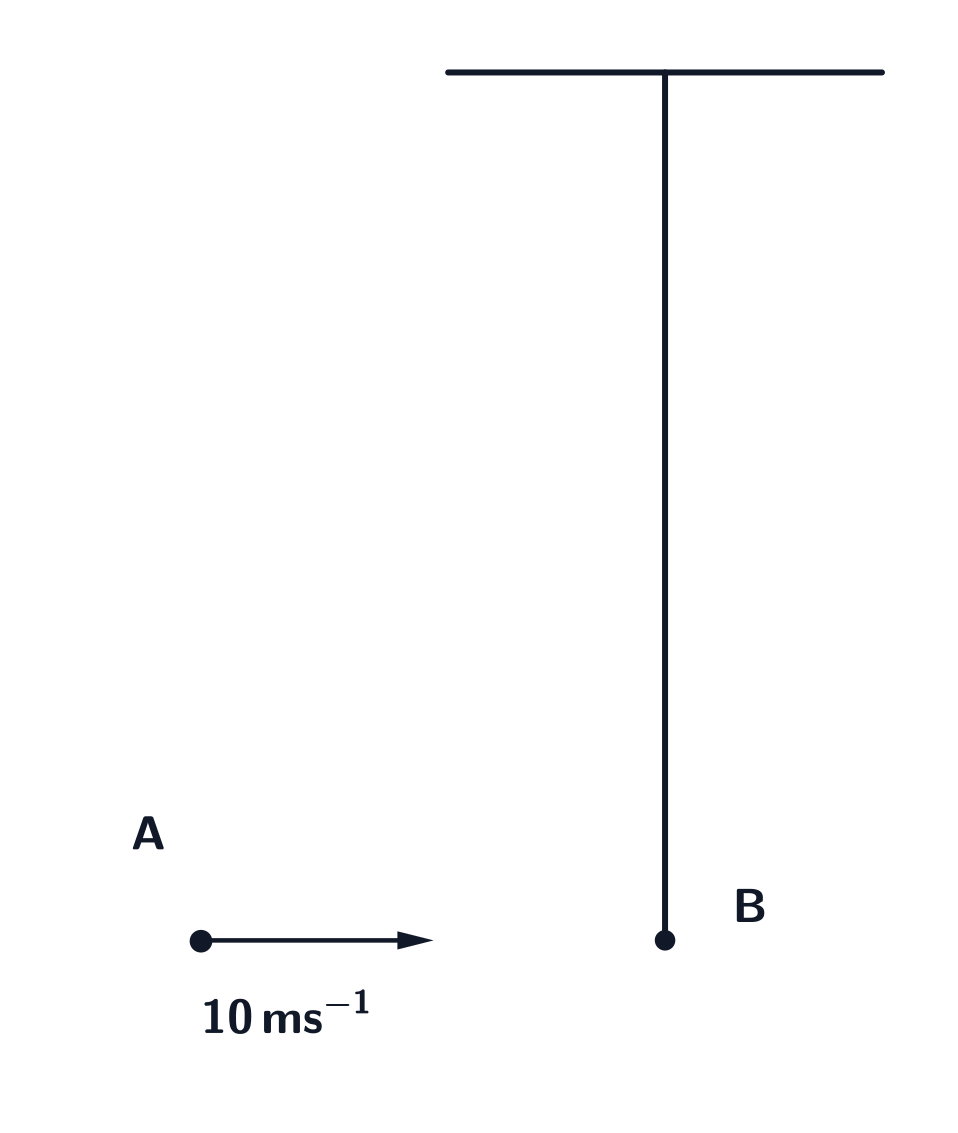
Bob of mass at rest is hanging vertically from the ceiling via a massless string of length 10 m, as shown in the figure. Point mass of mass travelling horizontally with speed 10 hits bob elastically. The bob rises meter after the collision. Taking the acceleration due to gravity and neglecting the size of the bob, the value of is:
- (1)
8
- (2)
7
- (3)
5
- (4)
2.5
Answer and solution
Answer: (3)
In a head-on ELASTIC collision between equal masses the velocities are simply exchanged, so stops dead and leaves the collision at the full 10 . Energy conservation on the swing then gives . The bob rises only 5 m, less than the 10 m string length, so it stays below the horizontal through the point of suspension and the string never goes slack. NCERT Class 11, Work, Energy and Power (collisions).
Why the other options are wrong:
- Option (1) (8 m) and option (2) (7 m) are higher than 5 m. Even if took all the kinetic energy of , it could rise only . A greater height needs energy the collision never supplied.
- Option (4) (2.5 m) gives only half the kinetic energy of , as if the energy were shared equally between the two masses. That halves the height. In an elastic collision of equal masses, all of it passes to .- (1)
Practise Work, Energy and Power in the app: it brings back the questions you get wrong, so the chapter improves, not just your memory of these. Or try the free CBT mock. All chapters: NEET chapter-wise PYQs.
Questions
Are these the official NEET questions on Work, Energy and Power?
Yes. They are the questions NTA set in each paper, in its wording. The solutions are written by BrainIt.
Something here wrong or out of date? Email hello@brainit.pro and a person will read it.