

Coordination Compounds: NEET previous year questions
Every Coordination Compounds question from the official NEET papers on this site, with the answer and a worked solution.
The questions come from NEET 2026, Re-NEET 2026 and NEET 2020. Each shows its answer and solution when you open it, so you can attempt it first. For what the chapter covers and how NEET tests it, see the Coordination Compounds guide.
NEET 2026
NEET 2026 · Q53
Match List I (Complex) with List II (Type of isomerism):
List I
List II
a)
i) Optical
b)
ii) Solvate
c)
iii) Geometrical
d)
iv) Linkage
- (1)
A-III, B-I, C-II, D-IV
- (2)
A-I, B-III, C-II, D-IV
- (3)
A-II, B-IV, C-III, D-I
- (4)
A-III, B-I, C-IV, D-II
Answer and solution
Answer: (4)
shows cis/trans (geometrical) isomerism (III); is a tris-chelate that is chiral, showing optical isomerism (I); shows linkage isomerism through the ambidentate / ligand (IV); and shows solvate (hydrate) isomerism (II). Hence A-III, B-I, C-IV, D-II.
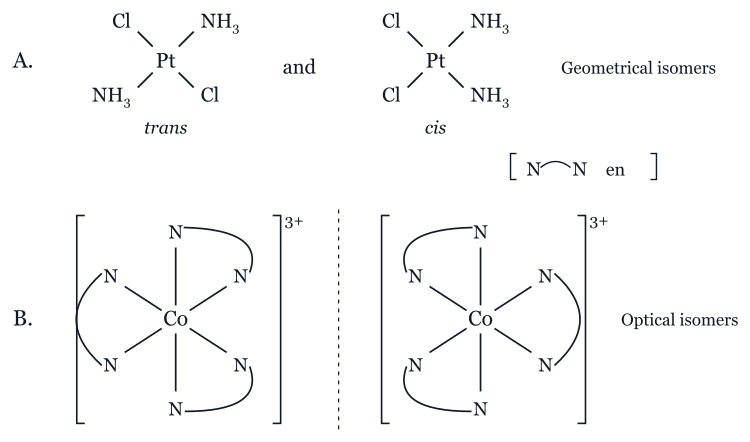
- (1)
NEET 2026 · Q63
Which one of the following is an ambidentate ligand?
- (1)
Ethane-1,2-diamine
- (2)
Ethylenediaminetetraacetate ion
- (3)
Thiocyanate
- (4)
Oxalate
Answer and solution
Answer: (3)
An ambidentate ligand has two different donor atoms and can bind through either one. Thiocyanate (SCN-) can coordinate through sulphur (-SCN) or nitrogen (-NCS), so it is ambidentate. Ethane-1,2-diamine and oxalate are bidentate chelating ligands and ethylenediaminetetraacetate ion (EDTA) is hexadentate, but each of their donor sets is fixed, so they are not ambidentate.
- (1)
NEET 2026 · Q68
Match List I (Complex/ion) with List II (Shape/geometry) and choose the correct answer.
List I
List II
P)
I) Octahedral
Q)
II) Trigonal bipyramidal
R)
III) Square planar
S)
IV) Tetrahedral
- (1)
P-III, Q-IV, R-I, S-II
- (2)
P-III, Q-I, R-IV, S-II
- (3)
P-IV, Q-I, R-III, S-II
- (4)
P-I, Q-III, R-IV, S-II
Answer and solution
Answer: (2)
[PtCl(NH)] uses dsp hybridisation at Pt → square planar (III); [Co(NH)] is dsp → octahedral (I); [NiCl] has sp Ni with weak-field Cl → tetrahedral (IV); [Fe(CO)] is spd/dsp → trigonal bipyramidal (II). This gives P-III, Q-I, R-IV, S-II.
- (1)
Re-NEET 2026
Re-NEET 2026 · Q47
Given below are two statements. (Given : )
Statement I: is chiral.
Statement II: trans- is chiral.
In light of the above statements, choose the most appropriate answer from the options given below:- (1)
Both Statement-I and Statement-II are correct
- (2)
Both Statement-I and Statement-II are incorrect
- (3)
Statement-I is correct but Statement-II is incorrect
- (4)
Statement-I is incorrect but Statement-II is correct
Answer and solution
Answer: (3)
A tris-chelate of type has no plane or centre of symmetry and exists as the non-superimposable delta and lambda propeller forms, so is indeed chiral. For the bis-chelate , only the CIS isomer is chiral; the TRANS isomer, with the two aqua ligands on opposite sides, possesses a plane of symmetry and is therefore achiral. Statement-II names the wrong isomer. NCERT Class 12, Coordination Compounds (isomerism).
- (1)
Re-NEET 2026 · Q58
According to crystal field theory, the correct order of ligands with respect to their decreasing order of field strength is
- (1)
- (2)
- (3)
- (4)
Answer and solution
Answer: (1)
The spectrochemical series orders ligands by the size of the crystal field splitting they produce. Carbon monoxide is the strongest field ligand in this set because it accepts electron density into its orbitals; ammonia follows as a stronger sigma donor than water; and chloride, being a weak-field pi donor, is the weakest. The accepted sequence is . NCERT Class 12, Coordination Compounds (crystal field theory).
- (1)
Re-NEET 2026 · Q66
Among the species given below, the spin-only magnetic moment is highest for (Given: Atomic number of Ti = 22, Mn = 25, Fe = 26 and Co = 27)
- (1)
- (2)
- (3)
- (4)
Answer and solution
Answer: (1)
All four are octahedral with strong-field or moderate-field ligands, so the electrons pair up in before entering . Counting d electrons: is , giving low-spin with TWO unpaired electrons; is , giving with one; is , giving with none; is with one. Since rises with n, the manganese complex has the highest moment at about 2.83 Bohr magneton (BM). NCERT Class 12, Coordination Compounds.
- (1)
Re-NEET 2026 · Q68
The formula of tetraammineaquachloridocobalt(III) chloride is
- (1)
- (2)
- (3)
- (4)
Answer and solution
Answer: (4)
The name lists the coordination sphere first: four ammine, one aqua and one chlorido ligand around cobalt(III). Charge balance inside the brackets gives , so two chloride counter-ions are needed outside to neutralise the complex cation. The word 'chloride' at the end names those counter-ions, not a ligand. NCERT Class 12, Coordination Compounds (IUPAC nomenclature).
- (1)
Re-NEET 2026 · Q78
The complex which has facial and meridional isomers is (Given : py = pyridine and en = )
- (1)
- (2)
- (3)
- (4)
Answer and solution
Answer: (1)
Facial and meridional isomerism is specific to octahedral complexes of the type . In the fac isomer the three identical ligands occupy one triangular face; in the mer isomer they lie in a plane through the metal. has exactly this 3:3 arrangement. NCERT Class 12, Coordination Compounds (geometrical isomerism).
- (1)
Re-NEET 2026 · Q87
A 1 : 3 electrolyte in an aqueous solution is
- (1)
- (2)
- (3)
- (4)
Answer and solution
Answer: (3)
Only the ions OUTSIDE the coordination sphere are released in solution; ligands bound to the metal stay put. has all six ammonia molecules coordinated and three chlorides as counter-ions, so it dissociates into one complex cation and three chloride ions - a 1 : 3 electrolyte. NCERT Class 12, Coordination Compounds (Werner's theory, primary and secondary valence).
- (1)
NEET 2020
NEET 2020 · Q98
Which of the following is the correct order of increasing field strength of ligands to form coordination compounds?
- (1)
< < <
- (2)
< < <
- (3)
< < <
- (4)
< < <
Answer and solution
Answer: (4)
In the spectrochemical series relevant here, ligand field strength rises as < < < . Chapter: Coordination Compounds.
- (1)
NEET 2020 · Q99
The calculated spin-only magnetic moment of Cr ion is
- (1)
4.90 BM
- (2)
5.92 BM
- (3)
2.84 BM
- (4)
3.87 BM
Answer and solution
Answer: (1)
The spin-only magnetic moment is given by , where n is the number of unpaired electrons. For , the electronic configuration is , with 4 unpaired electrons. Substituting n = 4, . Chapter: Coordination Compounds.
- (1)
NEET 2020 · Q122
Urea reacts with water to form A, which decomposes to form B. When B is passed through Cu(aq), a deep-blue solution C is formed. What is the formula of C?
- (1)
[Cu(NH)]
- (2)
Cu(OH)
- (3)
CuCO·Cu(OH)
- (4)
CuSO
Answer and solution
Answer: (1)
Urea hydrolysis ultimately releases NH. Excess ammonia coordinates Cu to form the deep-blue tetraamminecopper(II) ion [Cu(NH)]. Chapter: Coordination Compounds.
- (1)
Practise Coordination Compounds in the app: it brings back the questions you get wrong, so the chapter improves, not just your memory of these. Or try the free CBT mock. All chapters: NEET chapter-wise PYQs.
Questions
Are these the official NEET questions on Coordination Compounds?
Yes. They are the questions NTA set in each paper, in its wording. The solutions are written by BrainIt.
Something here wrong or out of date? Email hello@brainit.pro and a person will read it.